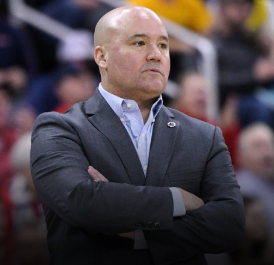
Kansas State’s men’s basketball program is heading into a new era under head coach Casey Alexander, and with that transition comes a completely reshaped roster. As the Wildcats prepare for the 2026–27 season, Alexander has assembled a massive incoming transfer class that will define the early identity of his tenure in Manhattan.
In total, Kansas State is bringing in 10 transfer players, along with two freshmen recruits, while only one scholarship player Serbian shooter Andrej Kostic returns from last season’s squad. On paper, it is a near-complete roster overhaul, one that will require quick chemistry building and immediate buy-in if the Wildcats hope to compete in the Big 12.

Early projections are not especially kind. Analytical models such as Bart Torvik place Kansas State outside the top tier nationally and near the bottom half of the Big 12 standings. While expectations are modest, there is optimism that Alexander’s system built on length, athleticism, and shooting may unlock more than the raw numbers currently suggest.
Unlike the previous regime, which often leaned heavily on expensive individual talent and shifting tactical approaches, Alexander has opted for a more balanced and system-oriented roster build. The goal is less about star power and more about cohesion, versatility, and fit. Whether that strategy translates into wins remains to be seen.
With that in mind, the incoming transfers have been evaluated and ranked based on projected impact, upside, and readiness for Big 12 competition.
10. Brock Vice (Murray State)
At the bottom of the list sits Brock Vice, a forward who brings limited statistical production from his time in the Missouri Valley. While his numbers low scoring and rebounding totals do not stand out, he still carries some developmental intrigue due to his athletic profile and recruiting pedigree. Once considered a promising high school prospect with multiple Division I suitors, Vice could still carve out a niche as a depth big man if he adjusts to the Big 12 level.
9. Pape N’Diaye (Xavier)
Pape N’Diaye enters as a traditional rim-protecting center with limited offensive output but useful size. At 7 feet tall, his value lies in interior defense, shot blocking, and physical presence in the paint. While his minutes have been inconsistent across stops, Kansas State will likely use him in situational matchups where size becomes critical.
8. Timotej Malovec (Miami)
Timotej Malovec brings international flair and developmental upside, but his early college production has been modest. The Slovakian forward has shown flashes of shooting ability and versatility, though consistency remains a question. His trajectory will depend heavily on how quickly he adapts to the physicality and pace of Big 12 basketball.
7. Isaiah Abraham (Georgetown)
Isaiah Abraham is a classic boom-or-bust wing prospect. With strong physical tools at 6-foot-7 and solid shooting potential, he offers intriguing upside. However, limited production at previous stops and uneven playing time make him a developmental project rather than a proven contributor.
6. Matt Gilhool (LSU)
Matt Gilhool is arguably the biggest wildcard in the class. A former highly rated recruit, injuries prevented him from making an immediate impact in college. Now fully reset after a redshirt year, he enters Kansas State with both uncertainty and significant upside. Coaches believe his practice performances hint at untapped potential.
5. JT Rock (New Mexico)
JT Rock offers intriguing size and skill as a 7-foot-plus center with shooting ability. Though his playing time has been limited, he showed efficiency in a reserve role and brings modern big-man versatility. If he adapts to a faster system, he could become a valuable stretch option in the frontcourt.
4. Dezdrick Lindsay (Oregon)
Dezdrick Lindsay is one of the most polished and physically ready players in the group. Known for energy, athleticism, and defensive effort, he provides immediate rotational value. While not a high-volume scorer, his hustle and versatility make him a dependable contributor.
3. Montana Wheeler (Bradley)
Montana Wheeler brings intriguing long-term upside after a promising freshman campaign. A steady guard with scoring and playmaking ability, Wheeler could develop into a foundational piece if he grows within Alexander’s system. His trajectory suggests significant future value beyond just the upcoming season.
2. Brandon Rechsteiner (Colorado State)
Brandon Rechsteiner stands out as one of the most productive and reliable additions. As a double-digit scorer with strong shooting consistency and experience, he enters as one of the safest bets to contribute immediately. His experience and scoring ability give Kansas State a stabilizing presence in the backcourt.
1. Jaden Schutt (Virginia Tech)
At the top of the rankings is Jaden Schutt, a high-upside guard who appears primed for a breakout season. A former elite recruit with a strong shooting track record, Schutt has steadily improved his efficiency and could thrive in Alexander’s offensive system. With size, shooting range, and athletic tools, he is widely viewed as the most impactful incoming transfer.
Final Outlook
Kansas State’s rebuilt roster is a mix of proven contributors, developmental projects, and high-upside gambles. While national projections remain modest, the success of this group will depend heavily on how quickly Alexander can establish chemistry and maximize each player’s strengths.
If the transfers click, the Wildcats could outperform expectations. If not, it may be a long rebuilding year in Manhattan.
Leave a Reply