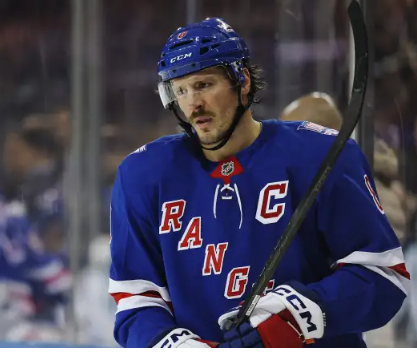
Handed the captaincy and the symbolic weight of a franchise in transition, J.T. Miller entered the 2025–26 season under immense pressure and ultimately fell well short of the lofty expectations placed upon him.
This installment closes out the Rangers Report Cards series, evaluating every member of the 2025–26 New York Rangers roster. Previous entries in the series can be found [here], along with the preseason outlook for Miller.
The focus now turns to the team’s captain, J.T. Miller. As outlined in the season preview, this year marked a turning point for the Rangers: their first campaign under head coach Mike Sullivan, the beginning of a new system, and most importantly the first full season with Miller wearing the “C.” While some growing pains were anticipated, few could have predicted the extent of the collapse that followed, including from the player expected to anchor the entire project.
Expectations: A Franchise Shift Centered on One Player
Midway through the previous season, Rangers GM Chris Drury made his intentions unmistakably clear. Determined to reshape the team’s identity and culture, he pursued a physical, veteran presence capable of redefining the locker room. That pursuit culminated in J.T. Miller.
Following the departure of several established leaders—most notably Chris Kreider—the organization effectively restructured its hierarchy around Miller. The message was clear: this was now his team. That belief was reinforced in the offseason when he was officially named captain.
With that decision came enormous expectations. Miller was not only expected to lead emotionally and structurally, but also to deliver elite production. A near point-per-game season—projected around 90 points—was widely anticipated, with significant power-play contributions expected to follow.
However, leadership demands went far beyond scoring. The Rangers wanted an identity shift: physicality, intensity, accountability, and a nightly standard of effort. Miller was brought in to embody and enforce that mentality across the roster. Instead, the season became a test of whether that vision could survive reality.
Performance: Production Decline and Visible Frustration
Simply put, the season did not come close to expectations.
Even before analyzing the numbers, the most concerning trend was consistency of effort. At times, Miller flashed his usual offensive awareness and puck control, but too often his impact faded shift to shift. Defensive lapses became recurring talking points, with multiple goals against attributed to missed assignments or disengaged backchecking.
The result was a player frequently caught out of position, appearing a step behind the play both mentally and physically. His defensive struggles became widely discussed, even turning into viral lowlights on social media. Whatever the explanation—injury, fatigue, or system adjustment—the overall impression was of a player unable to sustain the level expected of a franchise captain.
Offensively, the regression was equally notable. His production dropped to its lowest level in years, and his influence on games fluctuated dramatically. The consistency that was expected of him simply never materialized.
Leadership: From Stability to Strain
Perhaps the most troubling development was Miller’s evolving leadership presence.
Early in the season, he spoke with intent and professionalism, delivering the expected messaging about accountability and improvement. However, as losses accumulated, his tone shifted. Interviews became more candid, occasionally bordering on frustration and resignation, reflecting a team and captain struggling to find answers.
While it is fair to acknowledge the emotional toll of prolonged losing, captains are often judged by their ability to stabilize situations rather than mirror them. In that regard, Miller’s influence appeared to diminish as the season progressed.
Underlying Context: Injury, Usage, and Late Resurgence
There were mitigating factors. Miller played through undisclosed injuries for stretches of the season, and his availability alone does not reflect the physical toll he endured. Even so, the statistical decline remains significant.
A late-season stretch provided a glimpse of improvement, particularly when placed on energetic lines that briefly revived his even-strength impact. He finished with a respectable 50.8 CF% at even strength, suggesting he was not entirely ineffective when deployed in favorable conditions.
His faceoff dominance remained a strength, finishing at 61.5%, one of the best marks on the team. He also contributed physically with 123 hits, ranking near the top of the roster despite missing time.
Internationally, Miller’s performance told a different story. At the 2026 Milan Olympics, he played a key role for Team USA’s gold medal run, demonstrating strong defensive responsibility and competitiveness on a larger stage. That contrast—international effectiveness versus inconsistent NHL form—became one of the season’s most discussed contradictions.
Off-Ice Impact: A Different Kind of Leadership
Despite on-ice struggles, Miller’s off-ice presence remained highly positive.
He was awarded the Rod Gilbert “Mr. Ranger” Award, recognizing leadership, community impact, and service. Alongside his wife, he made a record-setting donation of $154,000 to the Garden of Dreams Foundation and maintained a strong presence at community events and fan engagements throughout the year.
In this area, Miller fully embodied the leadership qualities the organization envisioned when acquiring him.
Grade Summary
Author’s Grade: D
Banter Consensus: D
Final Thoughts: A Mismatch Between Role and Reality
Much of the criticism directed at Miller stems from expectations that may have been unrealistic from the outset. The Rangers placed him in a role that demanded immediate transformation of both culture and performance an enormous burden for any player, even one with his experience.
While he did not meet those expectations, it is also fair to note that few players could have fully delivered under such pressure, particularly in New York’s demanding market.
Still, the reality remains: the Rangers needed a cornerstone season from their captain, and they did not get it.
Looking ahead, Miller’s contract and trade protection make roster flexibility complicated, but not impossible to navigate. There remains a belief that a more balanced version of his role—and perhaps a healthier, more stable environment—could yield better results.
At breakup day, Miller struck a noticeably calmer tone, acknowledging the challenges of the season and the weight of the captaincy. Whether that reflection translates into on-ice improvement remains the central question.
For the Rangers to re-emerge as true contenders, they will need J.T. Miller’s performance to finally align with the responsibilities he has been given.
Leave a Reply