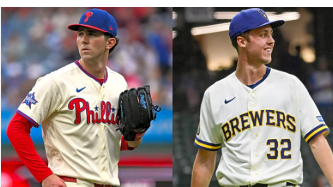
When the Philadelphia Phillies traveled to Milwaukee on Friday night, the spotlight naturally centered on a matchup between two of baseball’s most intriguing young pitchers: Andrew Painter and Jacob Misiorowski. Both entered professional baseball carrying enormous expectations, both possess elite velocity, and both were once viewed as future franchise cornerstones.
But by the end of Milwaukee’s dominant 6-0 victory, the contrast between the two right-handers highlighted a troubling reality for Philadelphia. What was expected to be a showcase of two rising stars instead became a painful reminder of the Phillies’ long-standing struggles when it comes to developing elite prospects into major league contributors.
For years, Andrew Painter represented the future of Phillies pitching. Selected in the first round of the 2021 MLB Draft, he quickly emerged as one of the most highly regarded pitching prospects in baseball. Scouts raved about his command, maturity, and overpowering fastball, while many evaluators projected him to become the next homegrown ace in a franchise history filled with legendary pitchers.
The expectations were enormous. Painter appeared destined to reach the major leagues at an unusually young age after dominating minor league hitters almost immediately following his selection. His rapid rise through the system had many believing he would become the centerpiece of Philadelphia’s rotation for years to come.
However, baseball rarely follows a straight path.
Just as Painter appeared ready to make his major league debut, a torn UCL during spring training derailed his development. The injury required Tommy John surgery and cost him significant time during some of the most important developmental years of his career.
Although the organization remained optimistic, the lost seasons created obvious challenges. Returning from such a serious injury is difficult for any pitcher, particularly one whose game depends heavily on velocity and command.
When Painter returned to action in the minor leagues, the results were inconsistent. His once-dominant arsenal no longer looked as overwhelming, and opposing hitters began finding success against pitches that previously generated swings and misses. Nevertheless, the Phillies continued believing in his long-term potential and entered the 2026 season hoping he could establish himself in the major league rotation.
That process has proven far more difficult than expected.
Through his first 13 appearances, Painter has struggled to find consistency. His command has been shaky, his fastball has lacked its former dominance, and opposing hitters have taken advantage of mistakes in the strike zone. Entering Friday’s game, pressure was already mounting as fans and analysts searched for signs that the former top prospect was beginning to turn a corner.
Instead, another difficult outing followed.
Attempting to help him settle into the game, Philadelphia employed an opener before turning things over to Painter. The strategy failed to change the outcome. Over five innings, Painter allowed five earned runs, surrendered multiple hits and walks, and once again struggled to put hitters away. While he flashed occasional signs of promise, the overall performance continued a troubling trend that has followed him throughout the season.
At the same time, Jacob Misiorowski was delivering a masterclass on the opposite side of the field.
Like Painter, Misiorowski entered professional baseball carrying significant hype. The towering right-hander became known for his triple-digit fastball and intimidating presence on the mound. However, unlike Painter, his transition to the highest level has been remarkably smooth.
The Brewers star entered Friday’s contest already possessing one of the best statistical profiles among young pitchers in baseball. He had established himself as a legitimate All-Star candidate and one of the most dominant starters in the National League.
Against Philadelphia, he elevated his performance even further.
Misiorowski overwhelmed the Phillies lineup from start to finish, allowing just one hit while striking out 15 batters in a complete-game masterpiece. Philadelphia’s hitters looked overmatched throughout the night as the young right-hander consistently attacked the strike zone with elite velocity and confidence.
Every inning served as a reminder of what a successful prospect development path can produce. While Painter searched for answers, Misiorowski looked every bit like the frontline ace many expected him to become.
The statistical comparison only amplified the difference.
Following Friday’s performance, Misiorowski lowered his ERA to an exceptional 1.34 while strengthening his growing reputation as one of baseball’s emerging stars. Painter, meanwhile, saw his ERA climb to 6.43 as questions surrounding his immediate future continued to grow.
Yet the story extends beyond a single game or even a single player.
For many Phillies fans, Painter’s struggles have reopened concerns about the organization’s broader track record with highly touted prospects. Over the years, Philadelphia has produced numerous players who generated excitement throughout the minor leagues only to fall short of expectations once they reached the major league level.
Several former top prospects arrived carrying the weight of franchise-altering expectations but never fully developed into the stars many envisioned. Whether due to injuries, inconsistency, developmental setbacks, or unrealized potential, the list has become longer than the organization would like.
That history creates additional pressure on Painter, who now finds himself at a crossroads. While he remains only 23 years old and possesses considerable talent, patience is beginning to wear thin among a fan base eager to see results from one of the organization’s most celebrated prospects in recent memory.
The Phillies still believe Painter can become an important piece of their future. His age, pedigree, and raw talent provide reasons for optimism. Many successful major league pitchers experienced early struggles before eventually establishing themselves as frontline starters.
However, the challenge facing Philadelphia is immediate as well as long-term. The club is trying to compete for a championship, and every start carries significance. Continued growing pains become increasingly difficult to absorb for a team with postseason aspirations.
What made Friday’s loss particularly frustrating was not simply Painter’s performance. It was the visual comparison standing just 60 feet away. Phillies fans watched another young pitcher with similar hype, similar tools, and similar expectations evolve into exactly the type of dominant ace they hoped Painter would become.
The matchup ultimately became more than a game between two promising arms. It served as a snapshot of where each organization currently stands in developing elite pitching talent.
For Milwaukee, it was confirmation that one of baseball’s brightest young stars has arrived.
For Philadelphia, it was another reminder that Andrew Painter’s journey remains unfinished—and that the franchise’s search for its next homegrown ace is still very much a work in progress.
Leave a Reply