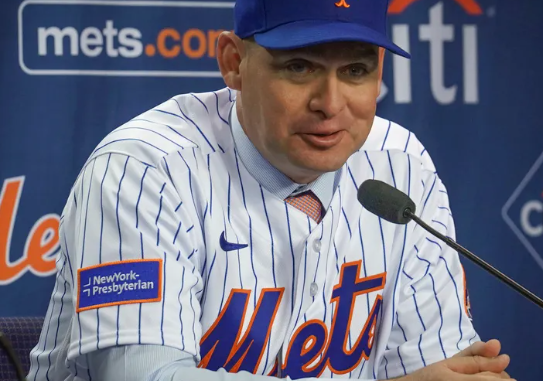
As the New York Mets prepare for the second half of the 2026 MLB season, few players have more at stake than Brett Baty. Once regarded as one of the organization’s brightest young prospects, the versatile infielder enters the stretch run with his long-term future still uncertain despite showing flashes of the talent that made him the 12th overall pick in the 2019 MLB Draft.

Baty heads into the second half after seeing his career-best 10-game hitting streak come to an end during the final weekend before the All-Star break. While the streak offered encouraging signs of offensive consistency, his overall numbers remain modest. Through the first half of the season, the 26-year-old is batting .221 with a .297 on-base percentage and a .314 slugging percentage, while adding four home runs and posting 0.0 Baseball Reference WAR (bWAR).
Those statistics tell only part of the story.
Although Baty has yet to deliver the offensive breakout many expected, he has quietly increased his value by embracing a utility role. Rather than serving exclusively as a third baseman, he has spent time at second base, first base, right field and third, giving manager Carlos Mendoza valuable flexibility throughout an injury-filled season.
Originally projected to provide depth at multiple positions entering the year, Baty has ultimately logged far more innings at third base than anticipated, largely because of Francisco Lindor’s absence from the lineup. His willingness to move around the field has helped stabilize the Mets’ defense, even if his offensive production has remained inconsistent.
That defensive versatility could prove to be one of the biggest reasons the Mets remain committed to him despite his uneven performance at the plate.
Mets Still Believe in Baty’s Long-Term Potential
Despite inconsistent offensive numbers, there appears to be little indication that New York is ready to move on from the former first-round selection.
The organization has continued giving Baty opportunities throughout the season, suggesting the front office still believes there is untapped potential waiting to emerge. While some outside observers have speculated that the Mets are simply preserving his trade value, the club’s handling of Baty indicates they still view him as an important piece of their future roster.
His youth, relatively inexpensive contract and remaining minor league option provide additional reasons for the Mets to remain patient.
Rather than shopping Baty aggressively, New York may instead explore moving Mark Vientos during the offseason. Vientos has struggled to establish himself defensively, and his offensive production has also fallen below expectations, making him a more likely trade candidate than Baty despite both players facing questions about their long-term roles.
Versatility Gives Baty an Edge
One area where Baty has separated himself is his defensive flexibility.
Unlike many young corner infielders, Baty has demonstrated a willingness to learn multiple positions. While his play has occasionally been inconsistent, he has shown enough competence across the diamond to become a valuable roster option.
Interestingly, his overall production has mirrored that of former Mets infielder Jeff McNeil, now with the Athletics. McNeil has posted a .226/.290/.302 slash line while producing -0.5 bWAR, numbers that compare closely with Baty’s offensive output.
The difference has largely been Baty’s defensive value, particularly at third base, where advanced metrics have viewed his performance more favorably than expected.
That defensive contribution could become increasingly valuable as the Mets begin planning for 2027.
A Strong Finish Could Secure His Place
The final two months of the season may ultimately determine how the Mets approach Baty’s future.
If he continues the offensive rhythm he showed before the All-Star break and builds on his recent success, he could solidify himself as an important part of New York’s roster heading into next season.
Several factors could work in his favor.
Veteran infielder Marcus Semien has battled injuries while experiencing one of the least productive seasons of his career, making quality depth at second base increasingly important.
Meanwhile, uncertainty also surrounds third base.
Should Bo Bichette exercise his contract opt-out after the season, the Mets could suddenly face another significant vacancy in their infield. Although Baty has not consistently produced enough offense to be viewed as an everyday solution, a strong second-half performance could convince the organization to give him another opportunity to compete for a larger role.
The Mets may prefer to view him as a valuable multi-position player capable of filling several roles rather than locking him into one starting position.
Inconsistency Remains the Biggest Concern
The greatest obstacle standing between Baty and a permanent role continues to be consistency.
His season has unfolded in dramatic swings.
Early in the year, drawing walks proved difficult, but he has since improved his plate discipline significantly, collecting 30 walks before the All-Star break.
His month-by-month production has also fluctuated sharply, producing OPS figures of .566, .750, .435 and .740, illustrating the unpredictable nature of his offensive game.
A difficult opening month followed by an especially disappointing June left many questioning whether his time with the organization was nearing its end before his late surge revived optimism.
Those stretches of hot and cold hitting have defined much of Baty’s major league career and remain the primary reason the Mets continue searching for answers.
Pressure Mounts for Former First-Round Pick
Seven years after being selected with the 12th overall pick in the 2019 MLB Draft, Baty has yet to develop into the middle-of-the-order hitter many scouts envisioned.
The talent has never been questioned.
The challenge has been translating that potential into sustained major league production.
For the Mets, the remainder of the 2026 season could provide the clearest indication yet of whether Baty still projects as part of their long-term plans or simply becomes valuable roster depth.
A productive second half would likely strengthen his case to remain in Queens while giving New York another versatile infield option entering 2027.
However, if his offensive struggles return and he finishes the season on another prolonged slump, the front office could be forced to reconsider his future. At that point, trading the former top prospect despite diminished value may become a realistic possibility as the Mets continue reshaping their roster for another postseason push.
Leave a Reply