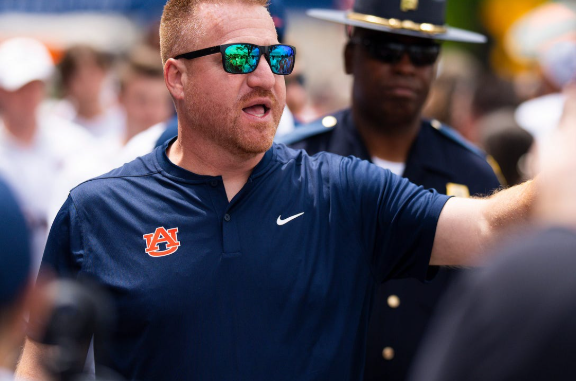
New Auburn head coach Alex Golesh is making it clear that building a new football culture will be one of his top priorities, and he is willing to take an unconventional approach to accomplish it.
As the Tigers prepare for the 2026 college football season, Golesh has decided to move Auburn’s fall camp away from the university’s campus and into a resort environment. The goal is to remove everyday distractions, create a more controlled atmosphere and give players an extended opportunity to focus on football, relationships and the standards of the new coaching staff.
The move comes at a critical moment for Auburn. The Tigers are entering another coaching transition after cycling through four head coaches in six years, creating an obvious need for stability and a clear identity. Golesh was brought in with the expectation that he can establish both, and his approach to fall camp provides an early indication of how seriously he is taking the challenge.
According to reporting from On3’s Justin Hokanson, Auburn plans to spend 13 days at the Marriott hotel and resort at Robert Trent Jones to begin fall camp. Rather than having players move between football activities and the distractions that naturally come with being on campus, Golesh wants the team together and fully immersed in the program.
Golesh has also established strict boundaries for the players during the stay. The coach emphasized that the extended camp is intended to be about the team, with outside distractions—including relationships and personal commitments—temporarily removed from the equation.
The objective is not simply to conduct more practices. Golesh wants the players to spend meaningful time together, strengthen relationships and develop the level of trust necessary for a team attempting to establish a completely new identity.
The decision quickly drew praise from ESPN college football analyst David Pollack, who viewed the move as evidence that Golesh understands the importance of culture in rebuilding a program.
Pollack publicly applauded the strategy, describing Auburn as fully committing to the process and suggesting that Golesh is handling the cultural side of the job effectively.
That endorsement carries some weight because Pollack is a former Georgia player and has spent years analyzing college football programs and coaching strategies. His reaction reflects the broader idea that successful programs often require coaches to create environments where players can develop strong connections away from the normal distractions of college life.
Golesh’s decision also represents a departure from simply trying to fix Auburn through game plans and recruiting. The Tigers need to develop consistency across the entire program, and that begins with establishing expectations inside the locker room.
Auburn has endured considerable instability in recent seasons. The Tigers have struggled to maintain sustained success and have not defeated their biggest in-state rival, Alabama, in nearly seven years. Although Auburn has had opportunities in the rivalry and suffered several painful defeats, the larger challenge for Golesh is preventing the program from defining its success solely around beating Alabama.
For Auburn to return to national relevance, the Tigers need to become competitive on a consistent basis rather than measuring every season exclusively against what happens in the Iron Bowl.
That is where Golesh’s emphasis on culture could become particularly important.
Taking the team away from campus gives the coaching staff an opportunity to establish routines, reinforce expectations and create an environment where players are constantly surrounded by teammates and coaches. It can also accelerate relationships between newcomers and returning players, something that becomes increasingly important in an era of roster turnover and player movement.
The 13-day camp is therefore about much more than finding the starting lineup or installing plays. It is an opportunity for Golesh to establish what he expects from Auburn players on a daily basis.
The Tigers have experienced considerable turnover at the top of the program, and another short-term approach would only continue the cycle. Golesh’s challenge is to build something sustainable, and that requires patience from the administration and fan base.
Auburn fans understandably want immediate results, particularly after years of inconsistency. However, rebuilding the foundation of a program cannot necessarily be accomplished in a single season.
The 2026 campaign should instead be viewed as an opportunity for Auburn to demonstrate meaningful progress. If Golesh can create a disciplined team with a strong internal culture, the results on the field could follow as the program develops.
The off-campus camp is an early step toward that objective. By temporarily removing players from their normal surroundings and placing the entire roster in an environment centered on football and team-building, Golesh is attempting to establish a clear identity from the beginning.
For a program searching for stability, the move sends a straightforward message: Auburn’s new era will be built around discipline, accountability and collective commitment.
Whether that approach produces immediate wins remains to be seen, but Golesh’s willingness to prioritize culture before the season begins has already attracted attention. Pollack’s praise suggests that, at least from a leadership standpoint, Auburn’s new head coach is taking the kind of deliberate steps that could help separate his tenure from the unstable periods that came before him.
Leave a Reply