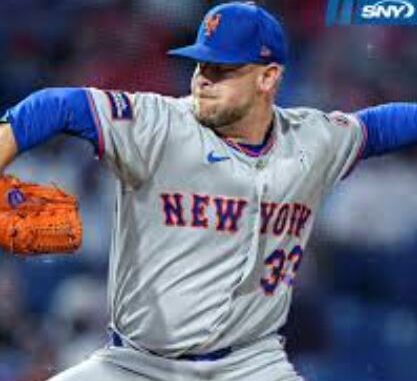
The New York Mets may have landed more than just short-term value when they acquired prospect Billy Amick from the Minnesota Twins as part of the trade that sent veteran left-handed reliever A.J. Minter to Minnesota.
While Minter has quickly established himself as a reliable piece of the Twins’ bullpen, Amick has immediately begun making his own case as one of the most intriguing young hitters in the Mets’ minor-league system.
The 23-year-old infielder has been on an extraordinary power surge since joining Double-A Binghamton, producing home runs at a remarkable pace and giving the Mets another potential offensive prospect to monitor closely.

Amick was acquired by New York alongside fellow prospect Bruin Agbayani in the July 31 trade. Minnesota made the move with the intention of strengthening its bullpen for a potential postseason push, acquiring Minter from the Mets in exchange for the two young players.
So far, Minter has performed well for his new club. Since joining Minnesota, the veteran reliever has allowed only one run on four hits and one walk while striking out four across five innings in six appearances.
However, Amick’s immediate production has given the Mets plenty of reason to be excited about their side of the transaction.
Since arriving in the Mets organization, Amick has gone 11-for-36 over 10 games, producing six home runs and 17 RBI. His power display has been particularly impressive considering how quickly he has adjusted to a new organization and level of competition.
At one point, Amick had hit six home runs in just nine games with the Mets, while posting a staggering .906 slugging percentage during that stretch. The performance has quickly turned him into one of the more talked-about hitters in New York’s minor-league system.
Amick’s power is not necessarily a new development. He had already shown considerable home-run potential during his time in the Twins organization, but his immediate surge after the trade has raised questions about whether the Mets could have acquired an overlooked offensive weapon.
Minnesota selected Amick in the second round of the 2024 MLB Draft out of the University of Tennessee. His college career established him as a powerful right-handed hitter, and the Twins viewed him as a player capable of developing into an impact offensive contributor.
Before the trade, Amick was ranked as the No. 21 prospect in Minnesota’s system by MLB Pipeline. He was not considered one of the Mets’ top 30 prospects immediately after the deal, but his rapid start could change that evaluation if he continues producing at this level.
Before being traded, Amick had spent the 2026 season with Double-A Wichita. In 86 games, he hit .217/.338/.482 with 23 home runs and 72 RBI. While his batting average left something to be desired, his power numbers demonstrated why organizations remain interested in his offensive upside.
The Mets will likely be encouraged by the fact that his power has carried over immediately following the trade.
Amick has also demonstrated defensive versatility throughout his professional career. He has experience at both third base and first base, giving the Mets flexibility as they determine where he fits best long term.
The other prospect involved in the Minter trade, Bruin Agbayani, provides New York with another developmental piece, although his progress has been delayed by injury.
Agbayani, 19, is currently ranked as the Mets’ No. 30 overall prospect. Before the trade, he was ranked No. 29 in the Twins’ system.
Unlike Amick, Agbayani has not yet appeared for the Mets organization because he was on the 60-day injured list when New York acquired him. Minnesota selected him in the sixth round of the 2025 MLB Draft.
Agbayani appeared in five games during his first professional season and played in 10 games this year for Single-A Fort Myers. Across those appearances, he went 15-for-57 with three doubles, six RBI and 16 walks.
His defensive versatility is another part of his appeal. Agbayani has experience at shortstop, second base and third base, giving the Mets another young infielder with multiple-position potential once he is healthy.
The early returns from the trade therefore present an interesting contrast for both organizations.
Minnesota acquired Minter because the club believed his experience and ability to handle high-pressure innings could help strengthen its chances of making the postseason. The veteran left-hander has done his part so far, providing the Twins with dependable relief work since arriving.
The bigger question for Minnesota will be whether the short-term benefit of adding Minter outweighs the potential long-term value of the prospects it surrendered.
Minter is scheduled to become a free agent after the season, meaning the Twins’ ultimate evaluation of the deal could depend heavily on whether they reach the postseason.
Minnesota entered the stretch run hovering around the American League Wild Card picture, but the club remained below .500. If the Twins ultimately miss the playoffs, the decision to trade two young players for a rental reliever could receive considerably more scrutiny.
On the other hand, a postseason appearance could make the deal look very different.
If Minter plays a significant role in helping Minnesota reach October, the organization could view the prospects as a worthwhile price for improving its immediate chances. There is also the possibility that Minter could remain with the Twins beyond the season if both sides are interested in a new contract.
For now, however, Amick’s performance has made the trade more intriguing from the Mets’ perspective.
The Mets did not acquire Amick as a highly ranked prospect. Instead, they obtained a young player whose primary calling card was his power potential. His explosive start with Binghamton suggests that there may be considerably more upside in his bat than his previous prospect ranking indicated.
It is far too early to declare a winner in the trade, particularly because Amick still needs to prove that he can sustain his production over a much larger sample.
Minor-league hot streaks can happen, and opposing pitchers will eventually make adjustments. The real test will be whether Amick can continue hitting for power while improving his overall consistency and handling the adjustments that come with moving closer to the major leagues.
Still, the early results are difficult for the Mets to ignore.
Six home runs in his first 10 games with the organization, combined with 17 RBI and a slugging percentage approaching .900 during his early run, have transformed Amick from a relatively overlooked acquisition into a prospect worth watching.
If he continues producing at anything close to this level, the Mets could find themselves with an increasingly valuable young hitter who was acquired as part of a trade centered primarily around bullpen help.
For Minnesota, the pressure will ultimately be tied to the team’s postseason ambitions. If Minter helps the Twins make a deep playoff push, the move could be viewed as a successful win-now transaction. But if the Twins fall short and Amick develops into a legitimate Major League power threat, the deal could become one that the organization looks back on with some regret.
The trade is still in its early stages, and neither team’s long-term outcome has been determined. But one thing is already clear: Billy Amick has wasted little time making an impression in the Mets organization.
His blistering start at Double-A Binghamton has put his name firmly on the radar, and continued production could eventually force the Mets to reconsider where he ranks among their most promising young players.
Leave a Reply