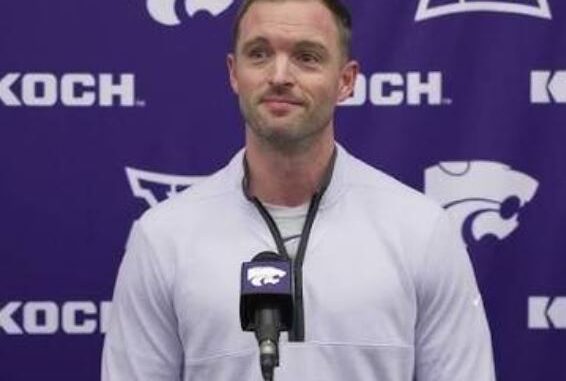
For Collin Klein, returning to Manhattan is far more than another coaching opportunity. It is a return to the place where he became one of the most recognizable players in Kansas State football history, developed his identity as a coach and built relationships that eventually helped bring him back to the Wildcats. Now, in 2026, Klein is standing on the opposite side of the program as its head coach, tasked with leading his alma mater into a new era.
Klein recently reflected on what it means to come home and take charge of the program he once represented as a quarterback. The move carries enormous personal significance, but it also comes with the pressure that naturally accompanies succeeding Chris Klieman and trying to restore Kansas State to the upper tier of the Big 12.

From K-State quarterback to head coach
Klein’s connection to Kansas State is unusually deep. He played quarterback for the Wildcats from 2008 through 2012 and developed into one of the greatest players in school history. His 2012 season in particular made him a national star, as he finished as a Heisman Trophy finalist while earning major conference and national recognition.
But Klein’s relationship with Kansas State didn’t end when his playing career did. He returned to the program as a coach and eventually became offensive coordinator. During his first major coaching stint at K-State, he helped develop the offense and played a significant role in the Wildcats’ Big 12 championship season in 2022. He then moved to Texas A&M, where he served as offensive coordinator during the 2024 and 2025 seasons.
When Chris Klieman announced his retirement following the 2025 season, Kansas State turned to a familiar face. The school announced Klein as its 36th head football coach on December 4, 2025, bringing him back to Manhattan as the person ultimately responsible for the program’s direction.
“Coming home” means something different for Klein
The emotional side of the appointment has been obvious from the beginning. Klein isn’t returning to a school where he has only a professional connection. He is returning to the university where he played, coached and built many of the relationships that shaped his career.
Yet Klein has acknowledged that actually becoming the head coach is different from imagining what the opportunity would be like.
In an interview highlighted by Reuters, Klein explained that even though he had mentally considered what taking over his alma mater might feel like, the reality was different once he was actually in the position. He noted that you don’t fully understand the experience until you are physically there and responsible for leading the program.
That distinction is important. As a former player, Klein could experience Kansas State as a competitor and teammate. As an assistant, he could focus primarily on coaching players and designing an offense. As head coach, every part of the program now ultimately falls under his leadership.
A familiar program with unfamiliar pressure
One of the biggest challenges for Klein is balancing familiarity with responsibility.
He knows Kansas State’s culture. He understands what the school means to its supporters. He knows the traditions, the expectations and the significance of playing at Bill Snyder Family Stadium.
But being familiar with the program doesn’t make winning automatically easier.
Kansas State finished the 2025 season 6-6 overall and 5-4 in Big 12 play, a disappointing result for a program that entered the year with much higher expectations. Klieman subsequently retired, and the Wildcats chose Klein to lead the next chapter.
That means Klein inherited a program with talent but also plenty to fix.
His challenge is not simply to maintain Kansas State’s identity. He must modernize it while keeping the qualities that have traditionally made the Wildcats successful.
Klein already understands the quarterback situation
Another advantage of Klein’s return is his existing relationship with quarterback Avery Johnson.
Klein was involved in recruiting Johnson during his previous time at Kansas State. When Klein left for Texas A&M, Johnson continued developing in Manhattan. Now the two are reunited, with Klein coaching the quarterback he originally helped bring into the program.
That familiarity could be important as Klein attempts to establish his offensive philosophy.
Johnson showed considerable promise during the 2024 season, although his numbers dipped during 2025. With Klein now back in charge, Kansas State has an opportunity to build the offense around a quarterback the new coach already knows well.
The relationship also gives Johnson access to a coach who understands his strengths and weaknesses from multiple perspectives.
Klein is building a staff he trusts
The new head coach has also surrounded himself with coaches who understand his vision.
Several members of his staff have connections to Klein and his previous coaching stops, while others were brought in because of their specific expertise. The staff includes coaches with experience at Kansas State, Texas A&M and other major college programs.
That approach reflects Klein’s understanding that he cannot rebuild Kansas State by himself.
One example is offensive line coach Mike Schmidt, who joined the Wildcats after working at San Diego State. Kansas State’s own reporting detailed how Schmidt was encouraged to speak with Klein and ultimately accepted the position after conversations with the new head coach.
The pattern is clear: Klein wants people around him who can execute his vision while bringing different areas of expertise to the program.
The NFL-style changes are coming to K-State
Klein’s return is also happening during a period when college football is becoming increasingly professionalized.
The transfer portal, NIL, roster management and player retention have transformed how programs operate. Kansas State has responded by adding personnel professionals, including general manager Trey Scott, who brings extensive NFL personnel experience.
That gives Klein an important partner as he tries to construct a competitive roster in the modern Big 12.
The coach can concentrate on football, development and game preparation while the personnel operation helps identify, acquire and retain the talent necessary to compete.
The 2026 season is the real test
The emotional story surrounding Klein’s return will eventually give way to wins and losses.
Kansas State’s 2026 season is therefore enormously important. The Wildcats enter a highly competitive Big 12 landscape in which Texas Tech, BYU, Utah, TCU, Houston and several other programs have ambitions of competing for the conference and College Football Playoff opportunities.
A recent Big 12 preview noted that Kansas State is looking for consistency under Klein after its uneven 2025 campaign. The Wildcats have returning talent, including Johnson, but Klein must turn that talent into a coherent team quickly.
The good news for K-State fans is that Klein already understands the environment.
He knows what the program expects.
He knows what the fan base wants.
And he knows what it feels like to wear the purple uniform.
Now he has to prove that the lessons he learned as a player and assistant coach can translate into success as the person making the final decisions.
A homecoming with enormous expectations
Klein’s story is one of the more compelling coaching narratives in college football. A former Kansas State star has returned to his alma mater, not simply to serve as an assistant or offensive coordinator, but to lead the entire program.
He is only 36 years old and is entering his first season as an FBS head coach, making the assignment both exciting and risky. Kansas State’s official profile notes that he enters 2026 as the sixth-youngest FBS head coach and begins his 13th year in coaching, with 10 of those seasons coming at Kansas State.
That combination of youth, familiarity and experience could ultimately become one of the defining characteristics of the new K-State era.
For Klein, though, the significance goes beyond football.
He has returned to the place that helped shape him as a player, coach and person. Now, instead of being introduced before games as the Wildcats’ quarterback, he is the man standing on the sideline responsible for preparing the entire team.
Collin Klein is home. The next challenge is proving that his homecoming can become the beginning of another successful chapter in Kansas State football history.
Leave a Reply