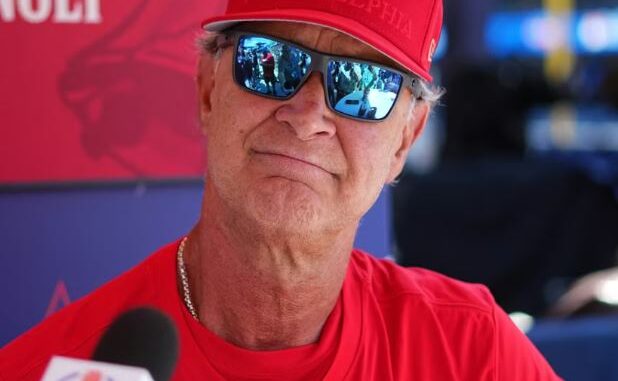
The Philadelphia Phillies entered the 2026 season expecting to make another serious postseason run, but once again their October journey ended earlier than anticipated. After being eliminated by the Atlanta Braves in a decisive Game 3 of the National League Wild Card Series, attention has quickly shifted toward what Philadelphia should change before the 2027 season.
One of the more surprising names to emerge in the early offseason trade conversation is Brandon Marsh. Despite enjoying the best season of his career and earning his first All-Star selection, Marsh has been identified as a potential trade candidate as the Phillies consider reshaping a roster that has repeatedly fallen short of its ultimate goal.
Marsh’s breakout season could make him valuable on the trade market
Marsh’s potential availability is particularly intriguing because he is coming off a career year.
The Phillies outfielder appeared in 155 games during the regular season and established career highs with 18 home runs and 62 RBIs, while batting .260. More importantly, he earned his first career All-Star selection, marking a major step forward for a player who had previously been viewed primarily as a defense-and-speed-oriented outfielder.
His offensive development was one of the pleasant surprises of Philadelphia’s season. Earlier in the year, Marsh’s breakout had become so significant that the Phillies were openly benefiting from his increased production. Heavy previously noted that he had transformed himself into one of the National League’s more productive hitters during the first half of the season.
That makes the possibility of trading him complicated.
Philadelphia would not simply be moving a struggling player. The organization would potentially be selling high on an All-Star outfielder who still has enough value to attract interest from clubs looking for help in the outfield.
Why Marsh has suddenly entered trade discussions
The argument for trading Marsh is less about his overall ability and more about timing, roster construction and his contract situation.
Sports Illustrated’s Nick Ziegler identified Marsh as the Phillies’ most likely player to be traded this offseason. The reasoning centers heavily on his second-half decline and his increasing role in a platoon.
Marsh is a left-handed hitter, and Philadelphia frequently sat him against left-handed pitching during the second half of the season. That situation became even more noticeable late in the year. The Phillies continued to platoon him during their postseason matchup with Atlanta, including Game 3, when Philadelphia started Bryan De La Cruz in left field against Braves left-hander Ray Kerr.
That does not mean the Phillies have lost confidence in Marsh.
Instead, it raises a larger question: If Philadelphia does not view Marsh as an everyday player against all types of pitching, could his trade value be better used to address another weakness?
That is the question the front office could have to answer this winter.
His contract situation makes the decision even more important
Another factor potentially pushing Marsh toward the trade market is his contract.
According to the Heavy report, Marsh can become an unrestricted free agent after the 2027 season. That means Philadelphia has a relatively narrow window to determine whether he belongs in the long-term core.
If the organization believes Marsh is part of its future, keeping him and eventually working toward an extension could make sense.
But if the Phillies believe they can replace his production—or if they want to use his value to address a more pressing need—moving him before his contract expires could be attractive.
The situation becomes particularly relevant because Marsh’s value may never be higher than it is coming off an All-Star campaign.
A team acquiring him would be getting a player who has demonstrated significant offensive improvement, has extensive major-league experience and still has another season of team control before reaching free agency.
Philadelphia may need a bigger offseason shake-up
The Marsh rumors are also part of a much larger conversation surrounding the Phillies.
Philadelphia’s core has remained together for several seasons, with Bryce Harper, Kyle Schwarber and Trea Turner forming the foundation of the lineup. Yet despite the enormous talent on the roster, the Phillies have repeatedly failed to reach the World Series during this era.
The latest disappointment came against Atlanta.
Philadelphia entered the Wild Card Series with expectations of advancing, but the Braves eliminated the Phillies in three games, winning the deciding game 6-2. The result immediately raised questions about whether the roster needs more than minor adjustments.
Heavy’s broader offseason analysis suggested that Philadelphia could finally be approaching the point where a significant roster move becomes necessary rather than simply making another small correction.
That is where Marsh becomes especially interesting.
Trading him would not necessarily mean the Phillies are tearing everything apart. Instead, it could be an attempt to turn one productive but potentially replaceable position player into a more pressing need.
The Phillies could receive a strong return
If Marsh is placed on the trade market, Philadelphia should have legitimate leverage.
Outfielders with All-Star credentials and recent offensive success remain valuable commodities. Teams searching for lineup help could view Marsh as a relatively attractive option, particularly because he would not require the type of enormous financial commitment associated with some established free agents.
His career numbers with Philadelphia also demonstrate that the 2026 season was not simply a one-month fluke.
Across 597 games with the Phillies, Marsh has produced 60 home runs, 240 RBIs and a .267 batting average. That gives potential suitors a substantial body of major-league experience to evaluate.
The question for opposing teams would be whether his 2026 breakout represents the beginning of a new level or the peak of his offensive development.
For Philadelphia, that uncertainty could actually strengthen the argument for a trade. If the front office believes another club will value Marsh more highly than it does, dealing him could provide an opportunity to acquire a player who addresses a more significant weakness.
His postseason usage could strengthen the trade argument
Perhaps the most revealing part of the situation was how Philadelphia used Marsh during the Wild Card Series.
Marsh did not start Game 1 against Chris Sale because Atlanta had a left-handed starter. He entered as a pinch-hitter and recorded a hit.
He then returned to the starting lineup in Game 2 against right-hander Tyler Mahle, batting sixth and playing left field.
In the decisive Game 3, however, Philadelphia again chose not to start him against another left-hander.
That usage illustrates the exact concern raised by the trade speculation: Marsh may be an All-Star-caliber player overall, but Philadelphia does not currently treat him as an unquestioned everyday option regardless of the matchup.
For a player coming off a career-best season, that is an important distinction.
What a Marsh trade could mean for Philadelphia
If the Phillies eventually trade Marsh, the move would likely have to accomplish something significant.
There would be little reason to move an All-Star outfielder simply for the sake of changing the roster. Philadelphia would need to receive meaningful value in return—either a proven player who fills a major hole or prospects capable of helping the organization in the future.
The Phillies’ farm system and roster construction will also factor into the decision. Philadelphia has spent years building around an expensive veteran core, and the organization could benefit from injecting younger talent into the roster.
At the same time, trading Marsh could create another hole in the outfield.
That means the front office would have to determine whether the return from a trade is more valuable than keeping a player who just demonstrated significant offensive growth.
The bigger question is whether the Phillies are ready to change
Ultimately, the Brandon Marsh trade speculation represents something larger than one player’s future.
Philadelphia has reached a crossroads.
The organization has built a roster capable of winning a lot of regular-season games, but the postseason results have not matched the talent level. Another early playoff exit could force the front office to consider changes that would have seemed unlikely a year or two ago.
Marsh is not necessarily the biggest problem on the roster. In fact, his 2026 performance makes him one of the team’s more attractive trade assets.
But that is precisely why his name is appearing in trade discussions.
The Phillies may have reached the point where improving the roster requires them to move a good player to acquire a better fit.
For Marsh, the situation is particularly interesting because he is coming off his first All-Star season, produced career-best power numbers and still has significant value around the league. For Philadelphia, meanwhile, the offseason could determine whether this core receives another opportunity or whether the organization finally begins making meaningful changes.
After another postseason disappointment, the Brandon Marsh situation could therefore become one of the most important offseason storylines surrounding the Phillies.
Leave a Reply