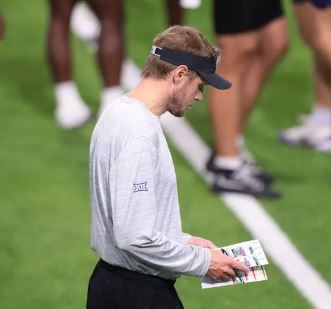
The 2026–27 Big 12 basketball season is shaping up to be another brutally competitive race, with several programs entering the year possessing legitimate championship credentials. Arizona currently sits at the top of the preseason picture, but the Wildcats are far from guaranteed to run away with the conference. Houston, Texas Tech, Iowa State and Kansas all have compelling arguments, while BYU is close enough to the top group that one major development could quickly change the hierarchy.
The depth of the Big 12 means there may be very little room for error. A team can have national-title aspirations and still find itself struggling to gain separation because virtually every week presents another difficult opponent. Depth, defensive consistency, health and the ability to perform in close games could ultimately determine which program survives the conference grind and enters March as the Big 12 champion.
Arizona: The Team to Beat
Arizona enters the season with perhaps the most complete foundation among the conference’s leading contenders. The Wildcats have size, athleticism and high-level young talent, giving them a combination that could make them extremely difficult to handle over an entire conference schedule.
The presence of 7-foot-2 center Krivas provides Arizona with an imposing interior option capable of influencing games defensively while also giving the Wildcats an important scoring and rebounding presence. Kharchenkov also returns with valuable postseason experience, while Holt brings the kind of talent that could dramatically raise Arizona’s ceiling if he adjusts quickly to the college game.
Dixon and Godfrey add further high-major talent to the roster, giving head coach Tommy Lloyd several options to work with. The biggest question may be how quickly the Wildcats establish their perimeter identity and determine who will consistently create offense when games become tight.
Arizona does not necessarily need Holt to become an immediate superstar. The roster already contains enough proven talent to survive an adjustment period. However, if the freshman quickly develops into the player many expect him to become, Arizona could move from preseason favorite to a legitimate national championship contender.
Houston: Defense Keeps the Cougars in the Race
It has become increasingly difficult to leave Houston out of any Big 12 championship conversation. Under Kelvin Sampson, the Cougars have developed one of the most dependable identities in college basketball: relentless defense, physical rebounding, toughness and an expectation that every possession matters.
That formula gives Houston a remarkably high floor, even when the roster changes from one season to the next. New players entering the program quickly learn that earning significant minutes requires them to embrace the defensive standards established by Sampson.
Tugler gives Houston an important defensive anchor, while Thomas provides experience in the backcourt. Weaver, Miller and Gillespie further strengthen the available options and give Sampson multiple experienced pieces to work around his returning core.
The biggest challenge could be on the offensive end. Houston may have to generate points differently than it has in previous seasons, particularly when facing opponents capable of matching its physicality. Still, the Cougars’ defensive identity gives them a reliable path to winning difficult games.
If Houston can find enough offensive consistency, there is little reason to believe it cannot once again finish at the top of the Big 12.
Texas Tech: A Healthy JT Toppin Could Change Everything
Texas Tech has quietly put together one of the most intriguing rosters in the conference. The Red Raiders have accumulated significant experience and appear capable of competing with the Big 12’s best from the beginning of the season.
The biggest factor, however, is JT Toppin.
Before suffering a torn ACL in February, Toppin was producing at an elite level, averaging 21.8 points and 10.8 rebounds per game. His return will therefore be one of the most closely watched developments surrounding Texas Tech throughout the season.
The Red Raiders must be careful not to rush him simply because they have legitimate championship expectations. Recovering from a major knee injury requires patience, and Toppin’s effectiveness could develop gradually rather than immediately returning to his previous level.
Fortunately for Texas Tech, the roster around him has become strong enough to remain competitive while he works his way back. Williams, Atwell, Davis, Gibbs-Lawhorn and Stillwell give the program experienced options and enough depth to reduce the pressure on Toppin.
If Toppin eventually returns to something close to his pre-injury form, Texas Tech could become one of the most dangerous teams in the conference during the second half of the season.
Iowa State: Lipsey’s Leadership Faces an Early Test
Iowa State remains firmly in the championship conversation largely because of what Tamin Lipsey brings to the program. His return gives the Cyclones an experienced point guard, elite perimeter defender and proven leader capable of stabilizing a team that has undergone significant roster changes.
Lipsey’s presence is particularly important because several players will be asked to assume larger roles. Rather than entering the season without a proven centerpiece, Iowa State can build around a player who already understands the demands of Big 12 basketball.
However, the Cyclones face an early obstacle with sophomore Killyan Toure sidelined following shoulder surgery. Toure started all 37 games as a freshman and was expected to play an important role again this season. His expected return in January means Iowa State will have to navigate the opening portion of conference play without him.
That could make the first half of the season particularly important.
If the Cyclones can remain near the top of the standings until Toure returns, his comeback could provide a significant boost at exactly the right time. Iowa State may not have the smoothest championship path among the favorites, but its combination of leadership, defense and late-season upside makes it a legitimate threat.
Kansas: Massive Upside Comes With Major Questions
Kansas might be the most difficult team among the top contenders to project because its championship hopes depend heavily on young players developing quickly.
The centerpiece is freshman Tyran Stokes, whose combination of size, athleticism and skill gives the Jayhawks an enormous amount of potential. If Stokes adjusts to college basketball faster than expected, he could become one of the most influential young players in the country before the season is over.
Kansas also has talented freshman guard Kinney, while Dawes, Reeves and Mbiya provide additional experience and size around the younger players.
The major question is whether the freshmen can become dependable contributors early enough. Talent alone is not enough to win the Big 12. Kansas will need its young players to handle hostile road environments, defensive pressure and the physical nature of conference basketball.
There is also uncertainty surrounding White’s status. Although reports have linked him with a potential return following legal developments, Kansas’ official 2026–27 roster does not currently list him. As a result, the Jayhawks’ championship outlook should be evaluated without assuming he will be available.
Even without him, Kansas has enough talent to win the league. The difference could come down to how quickly its young core matures.
BYU Could Crash the Top Five
BYU may currently sit just outside the top five, but the Cougars are close enough that they cannot be ignored.
Rob Wright III gives BYU one of the conference’s more intriguing veteran guards. His scoring ability, efficiency and playmaking could become especially valuable during close conference games, where experienced backcourt players often determine the outcome.
The biggest question involves Jaxon Kohler.
Kohler is enrolled and practicing with BYU and remains temporarily eligible under a court order, but his longer-term status remains unresolved. A preliminary injunction hearing is scheduled to continue Oct. 20, leaving uncertainty around his availability for the regular season.
If Kohler receives continued eligibility, BYU’s frontcourt situation could improve significantly. Combined with Wright’s presence in the backcourt, that could give the Cougars enough balance to move firmly into the championship conversation.
For now, however, the uncertainty keeps BYU just outside the primary group of five contenders.
The Big 12 Race Could Change Quickly
Arizona may enter the season as the safest preseason pick, but the conference is far too deep for any team to feel comfortable. Houston has the defensive foundation to beat anyone. Texas Tech could become a different team if Toppin returns to full strength. Iowa State has a proven leader in Lipsey and could receive a major boost when Toure returns. Kansas has enough young talent to dramatically exceed expectations if its freshmen develop quickly.
And just behind those teams sits BYU, waiting on an eligibility decision that could significantly alter its ceiling.
That is ultimately what makes the 2026–27 Big 12 so difficult to predict. The team sitting fifth or sixth in the preseason hierarchy could easily emerge as the strongest team in the conference by February.
Arizona currently has the strongest overall foundation, making the Wildcats the logical team to beat. But the Big 12 championship will not be decided in October. Every contender has a major question to answer, and the team that handles its biggest obstacle most effectively could be the one celebrating when March arrives.
Leave a Reply