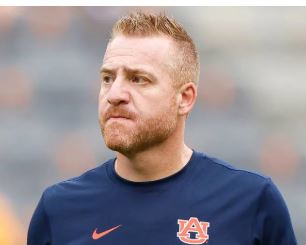
Auburn enters its bye week with plenty of questions to answer on offense after a frustrating loss to Tennessee exposed several of the Tigers’ biggest weaknesses. While Auburn’s defense repeatedly gave the team opportunities to stay competitive and even created chances for the offense to change the game, the Tigers struggled to take advantage of those opportunities. For first-year head coach Alex Golesh, whose reputation has been built largely around offensive innovation, the inability to consistently move the football has become an increasingly concerning issue.
The defeat at Tennessee was particularly frustrating because Auburn’s defense did much of what was expected of it. The Tigers created stops and gave the offense opportunities, but the offense repeatedly failed to capitalize. Instead of building momentum, Auburn struggled to establish any rhythm, and mistakes continued to put the team in difficult situations. Golesh openly acknowledged that the offensive performance fell well short of the standard he has established for himself throughout his coaching career. “I’ve prided myself for a long, long time on having answers offensively to be able to go,” Golesh said. “And we didn’t. And that’s the part that eats at me.”
One of the most obvious problems was Auburn’s discipline. Pre-snap penalties continued to hurt the Tigers throughout the contest, eventually contributing to 94 lost yards through penalties. Those mistakes repeatedly placed the offense behind the chains and made an already difficult situation even more challenging. Auburn could not sustain drives, and the offense struggled to consistently create favorable down-and-distance situations. The Tigers also continued to have difficulty establishing the running game despite having talented running backs capable of producing when given opportunities. Without a dependable rushing attack, Auburn placed even greater pressure on quarterback Byrum Brown, who has already absorbed 21 sacks this season.

The offensive line remains one of the biggest concerns heading into the bye. Golesh and his staff have spent much of the season searching for the right combination, with approximately 10 different players competing for various roles and rotations along the front. That constant experimentation reflects how difficult it has been for Auburn to find stability up front. The results have been inconsistent, with occasional encouraging stretches followed by major breakdowns. Golesh described the unit as having some “decently bright spots” while also acknowledging that some of the negative moments have been “catastrophically negative.” For Auburn to make meaningful progress during the second half of the season, the offensive line must become more dependable and give Brown enough time to operate the passing game.
Golesh believes part of the solution involves putting his offensive linemen in situations that better suit their strengths. Auburn began incorporating more outside-zone concepts against Tennessee, and the head coach felt that the adjustment allowed the linemen to find better footing and operate more effectively. That could provide an important clue for the coaching staff during the bye week. Rather than continuing to force the offense into schemes that have not consistently worked, Auburn can examine the successful portions of its recent games and build a more manageable system around them. The objective will be to simplify responsibilities, improve execution and create more opportunities for the offensive line to play with confidence.
The bye week therefore arrives at an important time for Auburn. Instead of immediately preparing for another opponent, Golesh and his staff have an opportunity to evaluate everything that has happened through the opening portion of the season. The coaches can identify the concepts that are producing results, determine which personnel combinations are most effective and find ways to reduce the mistakes that have repeatedly stalled drives. With the offensive line still unsettled and the running game struggling for consistency, Auburn cannot afford to waste the additional preparation time.
Perhaps most importantly, Golesh has refused to shift the blame to his players. The first-year coach has repeatedly accepted responsibility for Auburn’s offensive problems, insisting that it is the coaching staff’s responsibility to find solutions regardless of the limitations on the roster. “Whatever deficiencies we have, it’s our job as coaches to overcome those deficiencies and put us in positions to win,” Golesh said. He specifically pointed to Auburn’s first four offensive drives of the second half against Tennessee as an area where the coaching staff failed to put the team in the best position to succeed.
That accountability could become increasingly important as Auburn approaches a difficult stretch of its schedule. The Tigers will return from the bye week with arguably one of their toughest assignments of the season: a road trip to Athens to face the Georgia Bulldogs on October 17. The matchup will leave Auburn with little margin for offensive inconsistency. Georgia has the talent and depth to punish turnovers, negative plays and stalled drives, meaning the Tigers will need a far cleaner performance if they hope to compete.
For Golesh, the Georgia game also represents an opportunity to demonstrate whether the lessons from the Tennessee defeat have translated into meaningful changes. As an offense-minded head coach, he will be under pressure to produce tangible improvement. Auburn does not necessarily need to completely reinvent its offense during the bye, but it does need to discover what it can execute consistently. Better protection, fewer penalties, a more reliable running game and more efficient decision-making from Brown could dramatically change the team’s offensive outlook.
The Tennessee loss ultimately exposed a troubling imbalance for Auburn. The defense showed it could create opportunities and keep the Tigers within striking distance, but the offense repeatedly failed to turn those opportunities into points. That dynamic cannot continue if Auburn hopes to remain competitive in the SEC. The bye week gives Golesh and his staff a valuable opportunity to address those problems before the Tigers return to action.
The challenge is now clear: Auburn’s defense is giving the team chances, but the offense has to start taking them. Golesh has acknowledged the problem, accepted responsibility and promised to search for answers. The real test will come October 17 in Athens, when Auburn gets its first chance to show whether the bye week produced the offensive adjustments necessary to move forward.
Leave a Reply