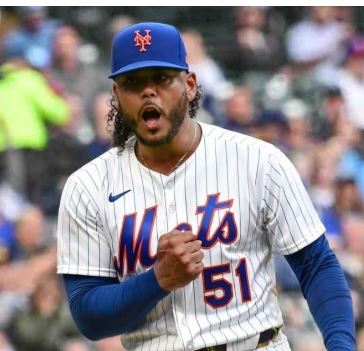
The New York Mets’ decision to trade Freddy Peralta at the 2026 deadline is beginning to look increasingly painful as the right-hander has rediscovered his best form with the Tampa Bay Rays. Acquired by New York during the offseason to become a potential ace at the top of its rotation, Peralta struggled badly during his brief Mets tenure before being dealt to Tampa Bay. Now, just months later, he is pitching in the American League Division Series and positioning himself for what could become a nine-figure contract in free agency.
The original Mets trade was viewed as one of the most aggressive moves of the 2026 offseason. New York acquired Peralta and right-hander Tobias Myers from the Milwaukee Brewers in exchange for highly regarded prospects Jett Williams and Brandon Sproat. The move was designed to give the Mets the frontline starter they had been missing, particularly after the club narrowly missed the playoffs in 2025. Peralta had just completed a spectacular 2025 campaign in Milwaukee, going 17-6 with a 2.70 ERA across 33 starts while finishing fifth in National League Cy Young voting. Over eight seasons with the Brewers, he had established himself as a dependable starter with two All-Star selections and a 3.59 career ERA.
Instead of becoming the stabilizing force New York expected, Peralta’s 2026 season quickly became a roller coaster. He initially looked like the pitcher the Mets had acquired, posting a 3.10 ERA through his first nine starts. But his performance deteriorated sharply as the season progressed. Over his final 13 starts with New York, he went 2-6 with a 6.44 ERA. By the time the trade deadline approached, Peralta was 5-9 with a 4.99 ERA in 22 starts, and the Mets were well out of the playoff race. His struggles became especially pronounced from early June onward, leaving the organization with little reason to keep a pending free agent on the roster if it could recover meaningful value in a trade.
The Mets ultimately sent Peralta to Tampa Bay on Aug. 2 in exchange for three prospects: outfielder Aidan Smith, right-hander Gary Gill Hill and infielder Émilien Pitre. All three were ranked among the Rays’ top 30 prospects at the time. For Tampa Bay, the deal represented a relatively modest financial commitment because Peralta was making $8 million in the final year of his contract. The Rays were looking for another established starter as they pushed toward the postseason, and they believed their pitching infrastructure could help Peralta regain the form that had made him so valuable in Milwaukee. (MLB.com)
That bet has paid off dramatically. Peralta has looked like an entirely different pitcher since joining Tampa Bay. In 10 starts with the Rays, he posted a 3.25 ERA and a 1.012 WHIP, a massive improvement from the numbers he produced in New York. His September was particularly impressive, as he recorded a 0.96 ERA over 28 innings and earned American League Pitcher of the Month honors. He also allowed only four runs over his final 38.2 innings heading into the postseason, giving Tampa Bay exactly the type of frontline performance it hoped to receive when it acquired him.
Peralta has credited Tampa Bay’s environment and pitching staff for helping him rediscover his confidence. Rays pitching coach Kyle Snyder made adjustments to his lower-half movement and arm angle, changes that helped Peralta regain some of the life on his fastball. His velocity returned to around 98 mph, while his changeup also improved. The combination allowed him to once again attack hitters more effectively and resemble the dominant pitcher who had previously excelled with Milwaukee.
The timing could not be more significant for Peralta. He is now pitching on one of baseball’s biggest stages while approaching free agency. After starting Game 2 of Tampa Bay’s ALDS matchup with the New York Yankees, Peralta has another opportunity to demonstrate that his poor stretch with the Mets was an exception rather than the beginning of a permanent decline. His postseason performance could have a direct impact on how much money teams are willing to commit to him during the offseason.
That is where the story becomes particularly uncomfortable for the Mets. Had Peralta remained in New York and performed at the level he has shown with Tampa Bay, the organization could have had the opportunity to build around a frontline starter or negotiate a long-term extension. Instead, the Mets traded him away after a disappointing half-season and will now watch another organization potentially benefit from his resurgence.
MLB Trade Rumors’ Steve Adams noted that Peralta’s recent performance could put him in position to secure a contract worth more than $100 million. The argument for a large deal is straightforward: despite his disastrous stretch in New York, Peralta has been consistently productive for most of his career. His six strong seasons surrounding the Mets struggles provide a much larger sample than the roughly six-week stretch in which he struggled most severely. A strong postseason could further strengthen the case for a nine-figure contract.
For potential suitors, however, Peralta’s Mets experience will remain part of the evaluation. Teams will have to determine whether his struggles in New York were simply a temporary slump or evidence of a deeper issue. The contrast between his 4.99 ERA with the Mets and his 3.25 ERA with Tampa Bay makes that question particularly difficult. The Rays’ ability to unlock his previous form may encourage other teams to believe that the right environment and coaching can produce the same results.
The Mets, meanwhile, are left trying to address their own rotation problems after a disappointing season. New York finished 74-88 and last in the NL East, with pitching instability contributing heavily to the club’s struggles. Only five Mets starters made at least 10 starts, while several pitchers moved between the rotation and bullpen throughout the season. Nolan McLean emerged as the team’s most dependable starter, but the club still needs additional frontline talent heading into 2027.
That makes the Peralta situation even more significant. New York originally surrendered two highly regarded prospects because it believed Peralta could anchor the rotation. Less than a year later, the Mets no longer have Peralta, while Williams and Sproat are now part of Milwaukee’s organization and Peralta is preparing for free agency after rebuilding his value. The Mets did receive three prospects from Tampa Bay in return, but the immediate contrast between the two sides makes the deal difficult to ignore.
Ultimately, Peralta’s resurgence does not automatically mean the Mets made the wrong decision at the trade deadline. New York was out of contention, Peralta was struggling and his contract was expiring. Trading a pending free agent for prospects was a logical move under those circumstances. The problem is the timing: Peralta immediately rediscovered his form with the Rays and is now entering the offseason with a chance to turn that rebound into a contract potentially worth more than $100 million.
For Mets fans, that creates one of the more frustrating endings imaginable. The pitcher acquired to become New York’s ace struggled, was traded away, and then transformed back into an elite starter with another team. Now, as Peralta continues his postseason run with Tampa Bay, every strong start could increase the value of the contract the Mets will watch him sign from the outside.
The biggest hook is the financial angle: Peralta could turn his Rays resurgence into a $100M+ free-agent payday, making the Mets’ decision to trade him even more painful.
Leave a Reply