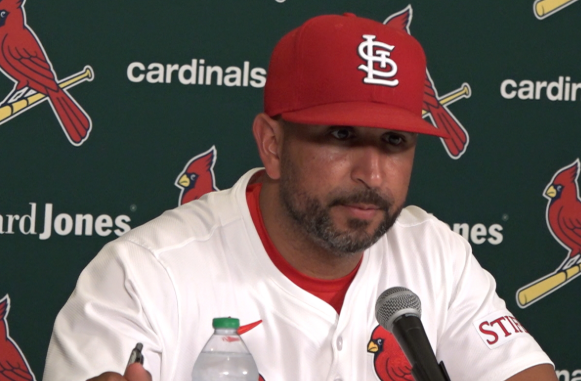
The St. Louis Cardinals are expected to explore the starting-pitching market this offseason, and while landing the biggest names may be unrealistic, there are several intriguing alternatives who could fit the team’s budget and roster needs.
One name worth watching is Trevor Rogers.
The left-handed starter is expected to be one of the more notable starting pitchers available in free agency, although he comes with enough questions that the Cardinals would need to carefully weigh the upside against the risk before committing significant money.
Rogers isn’t Tarik Skubal, and realistically, St. Louis has virtually no chance of landing Skubal. But outside of the elite options at the top of the market, Rogers could represent a more attainable target for a Cardinals organization looking for a legitimate rotation upgrade.
At 29 years old during the 2027 season, Rogers also fits the age profile teams generally prefer when handing out multiyear contracts to starting pitchers.
Why Rogers Could Interest the Cardinals
Rogers has been somewhat inconsistent throughout his career, but his recent performance suggests there could still be significant value in his arm.
Over his last 48 starts across two seasons with the Baltimore Orioles, Rogers has accumulated 7.3 fWAR, production that puts him comfortably within the territory of a potential top-of-the-rotation starter.
That’s important for the Cardinals.
St. Louis doesn’t necessarily need another pitcher who simply eats innings. The organization needs someone capable of taking meaningful pressure off its existing rotation and giving the club another reliable arm capable of starting important games.
Rogers has demonstrated that potential.
The biggest question is whether his recent success represents a sustainable version of the pitcher he’ll be over the next several seasons or whether some of his numbers have been helped by favorable circumstances.
His Fastball Is the Foundation
Rogers is heavily dependent on his fastball, and that isn’t necessarily a problem.
According to Statcast, he actually throws three different fastballs, but his four-seam fastball is easily his primary weapon.
He averaged 93.8 mph with the pitch in 2026 and threw it approximately 46.9% of the time.
Rogers appears to get the most from the four-seamer when he elevates it in or above the strike zone.
The pitch generated a whiff rate of roughly 25%, while opposing hitters struck out approximately 19% of the time when facing it in two-strike situations.
More importantly, the pitch has consistently been effective.
His four-seamer was worth approximately 1.0 run per 100 pitches in 2026 and an even more impressive 2.4 runs per 100 pitches in 2025.
That consistency is one of the strongest arguments for considering Rogers.
A pitcher who relies heavily on his fastball can become predictable, but when that fastball is genuinely difficult to hit, the approach becomes much easier to sustain.
Rogers Uses Different Approaches Against Righties and Lefties
The rest of Rogers’ arsenal becomes more interesting depending on the handedness of the hitter.
Against right-handed hitters, his changeup is his primary secondary pitch.
Of the 551 changeups he threw, approximately 89% were delivered to right-handed batters.
The basic approach is fairly straightforward: Rogers uses his four-seam fastball up in the zone and his changeup down or below the strike zone.
It is a relatively traditional pitching strategy, but it can be effective when executed properly.
The changeup isn’t primarily a strikeout pitch, however. In two-strike situations, Rogers generated a strikeout only about 10% of the time when throwing it.
His sweeper is much more dangerous in that regard.
The Sweeper Could Be His Secret Weapon
Rogers’ sweeper might be the most intriguing pitch in his arsenal.
The pitch produced a 31.7% whiff rate in 2026 and generated a strikeout on approximately 23.9% of two-strike counts in which he threw it.
That was the highest strikeout rate among his pitches in those situations.
The intriguing part is that Rogers doesn’t appear to use the sweeper as aggressively as he could.
He throws it at roughly the same rate against left-handed and right-handed hitters, even though one might expect a left-handed pitcher to lean more heavily on the pitch against lefties.
In 2025, the sweeper was even more dominant, producing a 39% whiff rate.
If Rogers can rediscover that version of the pitch and incorporate it more effectively into his arsenal, there could be another level of production waiting to emerge.
The Changeup Was a Concern in 2026
Not every part of Rogers’ arsenal was equally successful.
His changeup took a significant step backward in 2026 after being one of his better pitches in 2025.
That inconsistency is one of the reasons why evaluating Rogers isn’t straightforward.
His four-seamer and sweeper give him two legitimate weapons, but his ability to consistently get results from his secondary pitches could determine whether he’s a reliable top-of-the-rotation arm or something closer to an average starter.
His sinker is essentially an average pitch, while his cutter grades slightly better.
That leaves the four-seamer as the foundation and the sweeper as a potentially underused weapon.
The Home Run Question
Perhaps the biggest statistical question surrounding Rogers is his home-run rate.
His recent success has been helped by an unusually low home-run-to-fly-ball percentage, and that raises concerns about whether his results can continue.
Rogers posted a 4.03 ERA and 3.92 xFIP last season, showing a relatively small gap between his actual results and the underlying metrics.
His career ERA is also closer to his xFIP than his FIP, creating another reason to be cautious about projecting his future performance.
However, there is an important environmental factor working in his favor.
Rogers spent time pitching at Oriole Park at Camden Yards, which has been a favorable environment for home runs. Statcast’s park factors rated it at 109, making it one of the better home-run parks in baseball.
He also spent the season facing several teams in hitter-friendly environments, including the New York Yankees, Toronto Blue Jays and Tampa Bay Rays.
Then there is Busch Stadium.
St. Louis’ home park has historically been much more forgiving to pitchers when it comes to home runs.
That could make Rogers’ move to St. Louis particularly interesting.
If his reduced home-run rate is partly connected to his pitching environment and ability to suppress damaging contact, Busch Stadium could help him maintain some of that advantage.
Health Is Another Consideration
Rogers doesn’t have a perfectly clean injury history, but his record may look worse at first glance than it actually is.
He made 25 starts in 2021, missing time because of back spasms and a family emergency.
In 2022, he dealt with another bout of back spasms and later suffered a lat strain that ended his season slightly early. He still managed to make 23 starts.
The biggest interruption came in 2023, when a left biceps strain caused him to miss almost the entire season.
After the Marlins traded him to Baltimore in 2024, Rogers made five additional starts in Triple-A and finished the year with approximately 30 starts between the minors and majors.
His 2025 season began late, but he eventually made 18 MLB starts along with seven Triple-A appearances.
The overall pattern is worth noting.
Aside from 2023, Rogers has generally been capable of making around 25 starts per season.
That doesn’t make him a low-risk pitcher, but it does provide some reassurance for a team considering a multiyear contract.
Rogers Has Already Shown He Can Reach Another Level
Rogers’ career trajectory is another reason the Cardinals could be interested.
His official rookie season was impressive enough to earn him a second-place finish in Rookie of the Year voting, thanks to a 2.64 ERA and 4.3 fWAR in 25 starts.
He then struggled to maintain that level for several seasons before eventually rediscovering his form after changing teams.
His 2025 and 2026 seasons suggest that his earlier success wasn’t necessarily a fluke.
The challenge is determining how long that version of Rogers can remain the norm.
His 2026 Numbers Need Some Context
Rogers’ 2026 season was somewhat unusual.
His 69.3% left-on-base percentage was below his career rate of 71.7%, meaning more runners who reached base ultimately scored against him.
That could explain part of the gap between his ERA and some of his underlying metrics.
At the same time, his 84.2% left-on-base rate in 2025 and .226 BABIP from that season were unlikely to be sustainable.
In other words, there are reasons to believe Rogers could have been unlucky in certain areas in 2026, but there are also reasons to believe some of his 2025 success was boosted by numbers that were bound to regress.
That uncertainty makes projecting his next contract particularly difficult.
The Qualifying Offer Complicates the Situation
Another factor for the Cardinals will be the qualifying offer attached to Rogers.
If he receives and rejects a qualifying offer before signing elsewhere, St. Louis would have to surrender a draft pick to sign him.
For some teams, that alone could make the investment less appealing.
The Cardinals will therefore have to decide whether Rogers’ potential impact on the rotation is worth both the financial commitment and the draft-pick cost.
What Could Rogers Cost?
A five-year deal appears to be a reasonable possibility if the market cooperates.
One comparable contract is Eduardo Rodríguez’s four-year, $80 million deal, which he signed entering his age-31 season.
Rogers would be younger, but his qualifying-offer status and the uncertainty surrounding the upcoming offseason could complicate his market.
A rough projection could put Rogers in the neighborhood of five years and $85 million.
That would give him an average annual value of approximately $17 million.
The figure would represent a substantial commitment for St. Louis, particularly because Rogers isn’t viewed as a completely safe bet to remain a top-of-the-rotation pitcher throughout the entire contract.
Is Rogers the Right Fit for St. Louis?
That’s where the debate becomes complicated.
The Cardinals would be getting a 29-year-old left-handed starter with a legitimate fastball, an excellent sweeper and evidence that he can produce at a top-of-the-rotation level.
Those are significant positives.
But Rogers also has an inconsistent track record, a complicated injury history and some underlying numbers that raise questions about how sustainable his recent success will be.
There’s also the possibility that he remains only slightly above average rather than becoming the frontline starter the Cardinals would need him to be.
For a team operating under financial constraints, committing five years and $85 million to that uncertainty would be a significant gamble.
The Verdict Is Still Unclear
Rogers is arguably one of the most interesting free-agent pitchers for St. Louis because he offers something the Cardinals may struggle to find elsewhere: front-end potential at a potentially attainable price.
He isn’t the sure thing that a pitcher like Skubal would represent, but he may actually be within the Cardinals’ realistic spending range.
His fastball gives him a dependable foundation, while his sweeper provides another potentially elite weapon. His age also makes him more attractive than many veteran pitchers entering free agency.
Still, the Cardinals should probably do their homework before making a major commitment.
The questions surrounding his durability, home-run suppression and long-term consistency are significant enough to warrant caution.
At this point, Rogers looks like a fascinating player for St. Louis to consider — but whether he is worth something like five years and $85 million may depend heavily on how the rest of the free-agent pitching market develops.
For now, the Cardinals would be wise to keep Rogers firmly on their offseason radar while continuing to evaluate the other available starting pitchers.
Leave a Reply