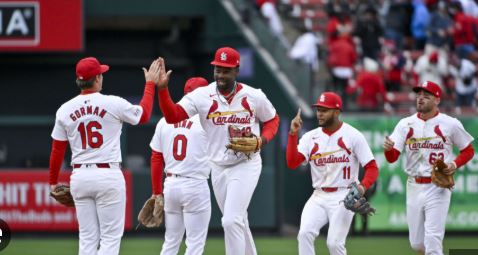
The St. Louis Cardinals continue to quietly strengthen their player development pipeline, creating a farm system that balances organizational depth with legitimate top-tier upside. While recent headlines focused on the Nolan Arenado trade, the prospect returned in that deal is not expected to materially affect the system in the near term. Instead, the bigger story lies in the Cardinals’ overall minor league structure.
Baseball America’s latest Top-30 prospect rankings offer an illuminating snapshot of where the organization stands. When compared with FanGraphs’ recent evaluations, the Cardinals’ system shows notable strength at the upper levels, though the two outlets approach player valuation differently.
Both Baseball America (BA) and FanGraphs (FG) use the traditional 20–80 scouting scale, but BA goes a step further by assigning a risk level to each player’s upside and adjusting the final grade accordingly. For example, Rainel Rodriguez receives a raw 60 scouting grade from BA, but his “average” risk reduces that to a 50 overall projection. FanGraphs, meanwhile, simply assigns him a 50 grade with “high” risk. Blending the two perspectives paints a picture of a talented but volatile young player, which is often the reality for teenage prospects in Single-A ball.
Rather than getting lost in methodology, a broader view highlights the system’s strength. FanGraphs projects the Cardinals as having two 55 FV prospects and five 50 FV players, meaning seven players expected to become at least league-average big leaguers. That alone represents a solid foundation, albeit somewhat concentrated at catcher.
Baseball America paints an even more optimistic picture. Their rankings include one 65 FV prospect, four at 60 FV, five at 55 FV, and five more at 50 FV. That totals 15 players who could reasonably develop into average or better major leaguers before accounting for risk adjustments, an impressive figure that underscores the system’s growing ceiling.

FanGraphs emphasizes a system-wide valuation approach, estimating future dollar value based on historical outcomes for each FV tier. In contrast, BA attempts to forecast individual player outcomes by incorporating risk into each grade. While neither approach is perfect, combining both perspectives provides a more realistic range of potential outcomes rather than a single, fixed projection.
Comparing the two evaluations reveals notable differences in how risk is perceived. Some players, such as Joshua Baez, Matt Mathews, Tink Hence, and Gordon Graceffo Roby, receive sharply contrasting risk labels between the two outlets, often driven by injuries, performance volatility, or timing of evaluations.
Beyond the elite tier, BA’s rankings highlight a wave of younger, high-upside prospects rated at 45 FV. Players like Crossland, Ortiz, Mautz, Braden Davis, Gurevitch, Chase Davis, and Aita stand out as developmental bets rather than simple organizational depth, signaling more potential growth ahead.
One intriguing trend is how recent acquisitions have reshaped the Top-30. Many prospects added via trade deadlines since 2023 and through the 2024 and 2025 drafts now dominate the list, pushing earlier additions down the rankings. This raises questions about whether older drafts underperformed, development lagged, or whether newer prospects simply benefit from freshness and optimism.
Finally, international talent continues to surface. Rainel Rodriguez has already drawn significant attention, but fellow young prospect Yairo Padilla also stands out. Though his 2025 Florida Complex League debut revealed areas for improvement, scouts praise his elite bat-to-ball skills and plate discipline. His next developmental step will be learning to be more aggressive on hittable pitches, a refinement that could unlock even more of his offensive potential.
Overall, the Cardinals’ farm system appears healthier than it has been in years, with both quantity and quality aligning in a way that suggests sustainable success ahead.
Leave a Reply