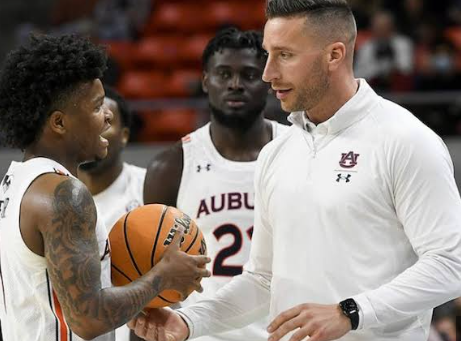
Texas A&M head coach Bucky McMillan recently added new perspective to the ongoing debate surrounding Auburn’s 2025–26 basketball season, suggesting that much of the criticism directed at Auburn head coach Steven Pearl may overlook deeper roster-related issues.
Speaking on The Next Round Live, McMillan reflected on his coaching experiences across different conferences, emphasizing that the Southeastern Conference operates largely as a “players’ league,” where team success is heavily shaped by roster talent, chemistry, and individual player execution rather than coaching alone. He contrasted this with his time in the Southern Conference, noting that every night demanded full focus regardless of personnel strength.
His comments have been interpreted as indirectly defending Steven Pearl, whose first season leading the Auburn Tigers ended with a mixed outcome. While Auburn managed to secure an NIT Championship run, the program’s absence from the NCAA Tournament fueled questions about whether the season should be considered a disappointment.
McMillan’s remarks also reinforced the idea that Pearl inherited a roster largely built under former head coach Bruce Pearl, limiting his ability to fully shape the team in his own image during his debut season. That transition reportedly created structural and cultural challenges, as several key players were not originally recruited with Steven Pearl as head coach in mind.
The season itself was marked by inconsistency and internal friction. Standout contributors such as Keyshawn Hall, the team’s leading scorer, and KeShawn Murphy, a major defensive presence and secondary scoring option, reportedly experienced tensions within the program that affected team chemistry and performance.
Murphy’s midseason suspension and eventual departure from the roster further complicated Auburn’s campaign, while lingering issues involving effort, role clarity, and internal alignment contributed to uneven results on the court. Hall’s production remained strong, but reported disconnects between players and coaching staff added to the instability.
Despite the setbacks, McMillan’s perspective suggests that Auburn’s struggles may not rest solely on coaching decisions, but rather on the inherent challenges of managing a roster assembled under different leadership expectations in a highly competitive conference environment.
As the Tigers look ahead, the focus now shifts toward whether Steven Pearl can fully reshape the program in his own direction and build a roster more aligned with his long-term vision.
Leave a Reply