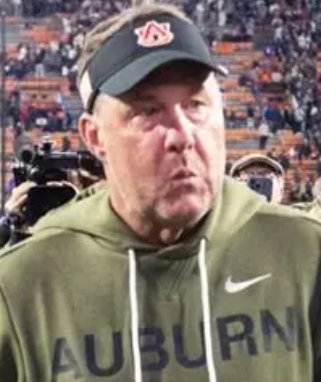
The countdown to another edition of the historic Iron Bowl has already begun, and while the rivalry remains one of college football’s biggest annual spectacles, the 2026 matchup will feature a dramatically different Auburn team under new head coach Alex Golesh.
As Alabama prepares for its third season under Kalen DeBoer, the Crimson Tide will once again close the regular season against its in-state rival on Nov. 28 at Bryant-Denny Stadium. Although kickoff is still months away, the Iron Bowl is already generating excitement because of the major changes taking place on the Auburn sideline.
Golesh enters his first season leading the Tigers after replacing Hugh Freeze, becoming Auburn’s third head coach since Gus Malzahn departed following the 2020 season. His hiring signals the beginning of a new era built around an aggressive offensive philosophy that helped him earn success as offensive coordinator at UCF, Tennessee, and most recently as head coach at South Florida.
His task, however, is enormous.
Auburn has lost six consecutive Iron Bowls to Alabama and has not celebrated a victory inside Bryant-Denny Stadium since 2010. Reversing that trend in his first season will require Golesh to quickly transform a roster that looks considerably different from the one Alabama defeated 27-20 last November.
Golesh Brings Familiar Faces to Auburn
One of Golesh’s first priorities after accepting the Auburn job was importing players who already understood his offensive system.
The new Tigers coach brought 13 transfers with him from South Florida, including 11 offensive players. That group is expected to accelerate Auburn’s transition into Golesh’s fast-paced offense by providing experienced leaders who are already comfortable with his schemes.
The biggest addition is quarterback Byrum Brown.
Brown enjoyed an outstanding career at USF, throwing for 3,158 yards, 28 touchdowns, and only seven interceptions last season while adding more than 1,000 rushing yards and 14 touchdowns on the ground. His dual-threat ability perfectly fits Golesh’s offensive philosophy and immediately gives Auburn one of the SEC’s most dynamic quarterbacks.
Brown is also familiar with Alabama, having started against the Crimson Tide in both the 2023 and 2024 seasons while at South Florida. Although he has yet to defeat Alabama, those experiences should help prepare him for the intensity of college football’s biggest rivalry.
Golesh also strengthened his receiving corps after losing leading wide receiver Cam Coleman through the transfer portal.
USF’s top returning receivers—Keshaun Singleton, Jeremiah Koger, Chas Nimrod, and Christian Neptune—all followed their head coach to Auburn.
Singleton finished last season with 50 receptions for 877 yards and eight touchdowns, while both Singleton and Koger tied for the team lead with eight receiving scores. Their familiarity with Golesh’s offensive concepts should allow Auburn’s passing game to develop quickly.
Offensive Line Faces Major Rebuild
While Auburn added significant skill-position talent, rebuilding the offensive line remains one of the team’s biggest concerns.
The Tigers lost multiple starters, including two NFL Draft selections and several additional transfers, forcing the coaching staff to reconstruct nearly the entire unit before the season begins.
The lone returning starter on offense is senior running back Jeremiah Cobb.
Cobb quietly produced one of the SEC’s strongest rushing seasons in 2025, finishing with 969 rushing yards to rank sixth in the conference. His experience and consistency should provide stability while Auburn’s new offensive line develops chemistry.
Defense Remains Auburn’s Strength
Unlike the offense, Auburn’s defense returns a strong core of experienced players.
That continuity played a major role in defensive coordinator DJ Durkin remaining on staff following the coaching change. Despite Auburn’s disappointing 5-7 season, the Tigers finished among the nation’s top 30 defenses, proving the defense was rarely responsible for the team’s struggles.
Leading the unit is linebacker Xavier Atkins, one of the SEC’s premier defensive playmakers.
The junior earned First-Team All-SEC honors after recording 84 tackles, 17 tackles for loss, and nine sacks during an outstanding 2025 campaign. His production makes him the centerpiece of Auburn’s defense heading into the new season.
The secondary also returns experienced contributors.
Senior cornerback Rashawn Pleasant and junior safety Kaleb Harris provide veteran leadership in the defensive backfield. Harris finished third on the team with 50 tackles last season, while Pleasant showcased his playmaking ability by recording two interceptions during Auburn’s SEC victory over Arkansas.
The defensive line, however, must replace first-round NFL Draft selection Keldrick Faulk.
To address that loss, Auburn added transfers Da’Shawn Womack from Ole Miss and Cody Sigler from Arkansas State, hoping both can immediately strengthen the pass rush.
Challenging SEC Schedule Awaits
Golesh’s first season will not offer many opportunities to ease into SEC competition.
After opening the year with Baylor in Atlanta before hosting Southern Miss, Auburn begins conference play with home games against Florida and Vanderbilt before facing consecutive road trips to Tennessee and Georgia.
The schedule remains difficult throughout October, with LSU and Ole Miss also appearing before November arrives.
Among Auburn’s conference opponents are Alabama, Georgia, and Ole Miss—all teams that reached last season’s College Football Playoff. Even more daunting, each of those matchups will take place away from Jordan-Hare Stadium.
November provides a somewhat lighter stretch.
The Tigers face Arkansas, Mississippi State, and Samford before closing the regular season with the annual Iron Bowl in Tuscaloosa.
Iron Bowl Still Favors Alabama
Despite Auburn’s offseason overhaul, Alabama will likely enter the rivalry as the favorite.
The game will once again be played at Bryant-Denny Stadium, where Auburn has not won in 16 years. Combined with Golesh’s status as a first-year head coach, the challenge of ending the Tigers’ six-game losing streak against Alabama becomes even greater.
Still, Golesh has previously shown he can compete with the Crimson Tide.
While coaching South Florida in 2024, his Bulls pushed Alabama deep into the fourth quarter before ultimately falling, demonstrating his ability to prepare competitive game plans against elite opponents.
If Auburn hopes to finally reclaim Iron Bowl bragging rights, much will depend on Byrum Brown’s performance.
The dual-threat quarterback will likely need one of the best games of his career, both passing and running, to challenge Alabama’s defense and give the Tigers an opportunity to pull off a rivalry upset.
New Era Begins on the Plains
Although expectations remain measured for Auburn’s first season under Golesh, optimism surrounding the program is growing.
His offensive creativity, successful track record developing quarterbacks, and willingness to bring proven players from South Florida have energized the Tigers entering 2026.
Whether that momentum translates into immediate victories remains to be seen.
For Alabama, the objective is straightforward—extend its dominance over its biggest rival and continue one of college football’s longest active winning streaks in a rivalry series.
For Auburn, the 2026 Iron Bowl represents more than just another rivalry game.
It is the first major opportunity for Alex Golesh to demonstrate that his vision can restore Auburn to SEC relevance and eventually end Alabama’s recent control of one of college football’s most celebrated rivalries.
Leave a Reply