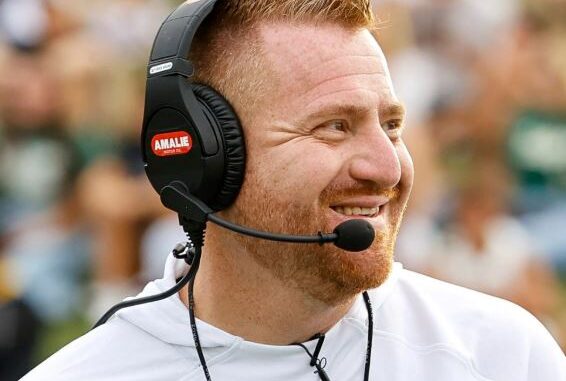
Auburn is entering the 2026 season with a major reset. The Tigers have a new head coach, a new quarterback and a new football philosophy. Since taking over, Golesh has had to rebuild several position groups, bring together a new-look roster and try to change a program that has struggled with consistency in recent years.
Interestingly, Golesh says the biggest concern isn’t Auburn’s talent.
His concern is whether the players have developed enough maturity, toughness, leadership and commitment to football to handle everything that comes with an entire season.
The central concern: Can the players lead themselves?
During his Wednesday press conference, Golesh explained that recruiting talented players can sometimes create its own challenges.
His fundamental question is whether a player loves football more than the benefits that football provides—such as money, NIL opportunities, the transfer portal, agents and the lifestyle surrounding modern college football.
Golesh’s point is that simply having talented players isn’t enough.
A player must also be willing to:
Work consistently.
Handle adversity.
Stay focused when things aren’t going well.
Put the team ahead of individual interests.
Accept coaching.
Hold teammates accountable.
Remain committed throughout the week, not just on game day.
Continue working when there isn’t immediate recognition or reward.
Golesh’s definition of experience is particularly important
One of the most revealing parts of his comments was his definition of experience.
For Golesh, experience isn’t simply the number of games a player has played or how many seasons he has been in college.
Instead, he wants players who have gone through difficult situations and come out the other side having learned what really matters.
That’s particularly significant for a young roster.
A young player may possess tremendous physical ability, but that doesn’t necessarily mean he knows how to respond when:
The team loses an important game.
He makes a critical mistake.
He loses his starting position.
Injuries affect the roster.
The team faces a difficult stretch of games.
Outside distractions become overwhelming.
Expectations and pressure increase.
Golesh is essentially saying that Auburn needs players who have already experienced adversity and learned from it.The maturity question
This is where Golesh appears most uncertain.
He acknowledged that Auburn may not yet be where it needs to be from a maturity standpoint.
That doesn’t mean he believes his players are bad or incapable. Rather, he is acknowledging that the team is still developing the collective maturity required to compete consistently.
The coach’s concern is therefore bigger than an individual player.
He wants to know whether the entire locker room can establish its own standards.
In a successful football program, coaches shouldn’t have to police every detail. Veteran players and team leaders eventually take ownership.
For example, players should be able to tell a teammate:
You’re not working hard enough.
or:
That’s not how we do things here.
That kind of internal accountability is what Golesh is trying to build.
“Can we lead ourselves?”
This is arguably the most important message from the article.
Golesh said that, apart from the two-minute drill, the question that keeps him up at night is essentially whether Auburn’s players can lead themselves sufficiently from inside the locker room to play the season the way the program needs to play it.
That is a significant admission from a head coach.
He’s not saying:
“I don’t know if we’re talented enough.”
He’s saying:
“I don’t know if we’re mature enough and self-directed enough yet.”
That distinction could have a major impact on Auburn’s season.
How Golesh is trying to solve the problem
Golesh and his coaching staff aren’t simply waiting for leadership to develop naturally. They’ve been deliberately creating an environment designed to develop the team’s culture.
1. Intensive summer workouts
The Tigers have gone through demanding summer workouts under a new strength and conditioning coach.
These workouts are about more than simply getting bigger and stronger.
The coaching staff wants the players to develop a mentality built around:
discipline → consistency → toughness → accountability → preparation.
The idea is that the team’s habits during the week will eventually determine what happens on Saturdays.2. Keeping the players together
Golesh has also tried to accelerate team chemistry.
During fall camp, Auburn kept the team at a hotel for two weeks.
That type of arrangement gives players significantly more time together and limits outside distractions.
It also creates opportunities for players to form relationships and develop the trust necessary for a functioning locker room.
For a team undergoing a major coaching and roster transition, that can be especially important.
3. Changing the daily mindset
Golesh wants players to understand that football isn’t simply about what happens on Saturday.
The preparation from Monday through Friday is just as important.
His philosophy is essentially:
If players aren’t focused during the week, they won’t suddenly become disciplined and focused when the game begins.
Therefore, the goal is to establish consistent habits throughout the entire week.Why NIL and the transfer portal matter
The article also highlights an issue that virtually every college football coach has to deal with today.
Players operate in an environment involving:
NIL
Money
Agents
The transfer portal
Recruiting
Individual branding
Increased outside attention
None of these things automatically make a player less committed.
But they can create additional distractions and competing priorities.
Golesh wants his players to remain focused on the team’s mission rather than allowing those outside factors to dominate their attention.
His challenge is therefore partly cultural: How do you build a team-first mentality in an era when players have more individual opportunities and options than ever before?Golesh isn’t questioning Auburn’s talent
This is an important distinction.
The article specifically says Golesh isn’t worried about the level of talent on his roster, even though some players are young or inexperienced.
That means his concern isn’t:
“Can these guys play?”
It’s closer to:
“Will these guys consistently do everything necessary to win?”
College football teams can have outstanding athletes and still struggle because of:
Poor preparation
Lack of discipline
Inconsistent effort
Turnovers
Poor communication
Lack of leadership
Failure to respond to adversity
Players becoming distracted
Golesh appears determined to prevent those problems from becoming Auburn’s story.
Why this could determine Auburn’s 2026 season
Auburn’s new era under Golesh will ultimately be judged by results, but the article suggests that the foundation of those results will be the team’s culture.
If the players successfully develop internal leadership, Auburn could potentially get more out of its talent than expected.
But if the locker room doesn’t mature quickly enough, Auburn could struggle even if the roster is physically talented.
That’s why Golesh’s comments are significant.
He’s effectively identifying leadership and maturity as Auburn’s biggest internal question mark before the season begins.
The story can be boiled down to four major points:
1. Auburn has talent.
Golesh isn’t particularly concerned about whether his players are talented enough.
2. Auburn has a young/new-look roster.
That creates questions about experience and maturity.
3. Golesh wants players to lead themselves.
He needs the locker room to develop enough internal accountability that coaches aren’t the only people enforcing standards.
4. The modern college-football environment makes the challenge harder.
NIL, money, agents and the transfer portal provide players with opportunities and distractions that didn’t exist to the same degree in previous eras.
Bottom line
Alex Golesh’s biggest concern isn’t whether Auburn has enough talent. It’s whether the Tigers are mature, disciplined and internally accountable enough to turn that talent into a successful season.
He wants Auburn’s players to reach a point where football and the team’s mission take priority, where teammates hold each other accountable, and where the locker room can lead itself through adversity.
The encouraging part for Auburn is that Golesh appears to recognize the issue early and is actively trying to address it through demanding workouts, team-building and a highly structured camp environment.
The ultimate test will come when Auburn encounters its first serious adversity of the season. That is when Golesh will find out whether the maturity and leadership he is trying to build are truly there.
Leave a Reply