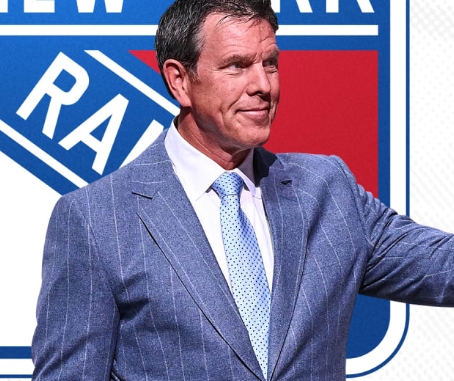
The New York Rangers endured a frustrating 2025-26 campaign, but their power play remained one of the few consistently productive areas of the team. Despite struggling to generate offense at even strength and finishing near the bottom of the NHL standings, New York converted 24.7 percent of its power-play opportunities, good for fifth in the league. Now, with the addition of Pavel Dorofeyev, the Rangers believe their biggest offensive weapon could become even more difficult for opponents to defend.
The Rangers’ power-play success was particularly impressive considering the circumstances surrounding the team last season. New York ranked just 23rd in overall scoring, was shut out a league-high 10 times and finished with the NHL’s third-worst record. On top of those struggles, defenseman Adam Fox, the team’s primary power-play quarterback, missed 27 games because of two lengthy injury absences. Even without Fox, the unit remained competitive, but his presence clearly elevated its creativity, puck movement and ability to generate quality chances.
Fox still managed to produce 24 power-play points in only 55 games, finishing second among Rangers players in that category. Mika Zibanejad led the club with 35 power-play points and 16 power-play goals, establishing himself as one of the team’s most dangerous weapons with the extra skater. But the Rangers now have another proven scorer capable of changing the way opposing penalty kills approach them.
That player is Dorofeyev, who arrives from the Vegas Golden Knights after an explosive offensive season. The 25-year-old scored 20 power-play goals last season, ranking second in the NHL, while also producing 17 goals at even strength for a career-best total of 37. His ability to attack from the flank and unleash a dangerous one-timer gives New York another shooting option alongside Zibanejad.
That is exactly what Fox believes could make the Rangers’ power play more threatening. With Zibanejad and Dorofeyev potentially operating from opposite flanks, penalty killers will face an uncomfortable decision every time New York establishes possession in the offensive zone. If defenders concentrate on Zibanejad, Dorofeyev can find space on the opposite side. If they shade toward Dorofeyev, Zibanejad can become the open target. That two-sided shooting threat could force opposing penalty-killing units to make quicker decisions and create additional passing lanes for Fox and the other Rangers.
Zibanejad also acknowledged the tactical difference Dorofeyev can bring to the unit. His presence introduces a type of scoring threat that opponents may not have had to account for in quite the same way in previous seasons. Rather than relying heavily on one primary shooting option, New York could have dangerous one-timer threats coming from both sides of the formation.
The Rangers will have to adjust elsewhere, however, because two important pieces from their previous power-play structure are no longer with the team. Artemi Panarin was traded to the Los Angeles Kings during the season, while Vincent Trocheck was dealt to the Utah Mammoth during the offseason. Trocheck’s ability to win faceoffs, battle for loose pucks and help establish possession had been an important part of New York’s special-teams success over the previous four seasons.
Still, the arrival of Dorofeyev provides the Rangers with a significant new dimension. Along with Fox and Zibanejad, the Rangers can also lean on Alexis Lafreniere and J.T. Miller for playmaking, puck protection and offensive creativity. The result could be a first power-play unit capable of attacking penalty kills in several different ways rather than depending on a single scoring pattern.
Dorofeyev’s Even-Strength Impact Could Matter Just as Much
While his potential impact on the power play is receiving considerable attention, Dorofeyev was not acquired solely for his special-teams production. The Rangers also need a substantial improvement in five-on-five scoring, an area that hurt them throughout the previous campaign. His ability to score consistently at even strength could therefore be just as important to New York’s overall offensive transformation.
Dorofeyev recorded 17 even-strength goals last season and has demonstrated that his offensive production is not limited to situations where the Rangers have an extra attacker. His scoring ability gives coach Mike Sullivan another legitimate top-six option and potentially allows New York to distribute offensive responsibilities more evenly throughout the lineup.
The Rangers demonstrated that plan when training camp opened. Dorofeyev was initially placed on a line with J.T. Miller and Oliver Bjorkstrand, giving Sullivan an intriguing combination of size, skill, puck possession and scoring ability. Miller welcomed the opportunity to play alongside a forward who has already established himself as a dangerous goal scorer.
Miller’s role could be especially useful for Dorofeyev because of his willingness to work below the goal line and create space through forechecking. If Miller can draw defenders toward the corners and behind the net, Dorofeyev may have more opportunities to operate in open ice and use his shooting ability.
Sullivan, meanwhile, appears to be experimenting early because the Rangers have limited time to prepare before the regular season begins. New York’s opener is scheduled for Sept. 29 against the Boston Bruins, leaving the coaching staff with a relatively short window to establish combinations and determine how its new-look roster will function.
The early camp configuration also keeps Zibanejad, Lafreniere and Gabe Perreault together after that trio finished last season strongly. Will Cuylle, a two-time 20-goal scorer, is projected to occupy a third-line role, potentially giving New York considerably more scoring depth than it had previously.
Of course, none of these combinations are guaranteed to remain unchanged. Sullivan has made clear that the early training-camp lines are part of an evaluation process rather than permanent decisions. But one element appears far less complicated: Dorofeyev’s presence on the Rangers’ first power-play unit is difficult to overlook after the offensive season he just produced.
For a Rangers team looking to rebound from a disappointing season, the combination of Fox’s passing ability, Zibanejad’s shooting and Dorofeyev’s proven power-play scoring could become one of the club’s defining strengths. The Rangers already had a top-five power play despite significant offensive problems last season. Adding one of the league’s most productive power-play scorers could give Sullivan another weapon that forces opponents to make difficult choices.
And that is the central appeal of the new-look unit. Opposing penalty killers may no longer be able to focus primarily on stopping Zibanejad. With Dorofeyev threatening from the opposite side and Fox controlling the puck from the blue line, New York could create a situation where defending one option consistently exposes another.
For the Rangers, that is the kind of problem they want their opponents to have all season: pick your poison.
Leave a Reply