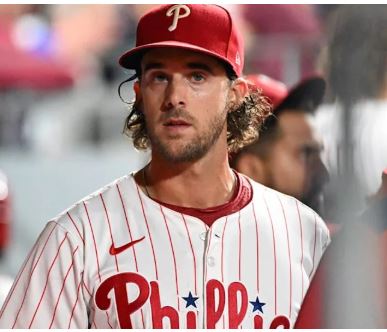
The Philadelphia Phillies have a major financial and roster decision to consider following their disappointing postseason exit, with veteran starting pitcher Aaron Nola still carrying a contract worth nearly $100 million in remaining commitments. After Philadelphia’s season ended with a 6-2 loss to the Atlanta Braves in the decisive game of the National League Wild Card Series, Nola’s recent struggles have placed renewed attention on the long-term agreement that keeps him in Philadelphia through 2030.
The financial commitment is significant because the Phillies signed Nola to a seven-year, $172 million contract in November 2023, securing a pitcher who had spent his entire major-league career with the organization. At the time, the agreement reflected the club’s desire to retain an established starting pitcher with a history of durability and postseason experience. However, his recent results have raised questions about whether he can consistently deliver the level of performance Philadelphia needs from one of its highest-paid rotation members.

Nola’s expensive contract becomes a major offseason talking point
The most striking detail is the amount of money Philadelphia remains committed to paying Nola. According to Heavy’s report, he is owed nearly $100 million through the end of the 2030 season, with annual salaries of just under $25 million. That commitment makes his performance an important consideration as the Phillies evaluate their roster following another postseason disappointment.
Nola’s contract was designed to keep a proven starter in Philadelphia for the long term. When the deal was announced in November 2023, the Phillies emphasized his durability, leadership, and value to the organization. He had established himself as one of the club’s most recognizable pitchers after being selected seventh overall in the 2014 MLB Draft and spending his entire major-league career with Philadelphia. He also earned an All-Star selection in 2018 and helped the franchise remain competitive over multiple seasons.
However, a long-term contract can become more complicated when a player’s recent performance falls below expectations. The Phillies now have to consider how Nola’s current results fit into their plans for a rotation expected to help the club compete for a championship. His remaining salary does not automatically mean the contract was a mistake, but it does increase the importance of getting stronger production from him over the next several seasons.
A difficult 2026 season raises concerns
Nola’s 2026 regular-season numbers illustrate the challenge facing both the pitcher and the organization. He finished with a 7-12 win-loss record and a 4.67 ERA across 33 starts. Those results left questions about his consistency, particularly given the financial commitment attached to his place in the rotation.
The number of starts is also relevant. Nola remained part of the rotation throughout the season, but durability alone was not enough to offset the runs he allowed. For a team with postseason ambitions, the goal is not simply to have a starter available every fifth day; it is to receive dependable innings and keep games within reach.
The Phillies will therefore need to determine whether Nola can rediscover the form that made him such an important part of their pitching staff. A return to more effective pitching would help stabilize the rotation and give the club greater flexibility when constructing its roster for 2027. If his struggles continue, however, the team could face additional pressure to find alternatives while still carrying his substantial salary.
His playoff performance added to the frustration
Nola’s season ended in difficult circumstances during Philadelphia’s decisive Wild Card Series game against the Atlanta Braves. The right-hander allowed a three-run home run to Michael Harris II in the first inning and was removed after recording only five outs, or 1⅔ innings. Atlanta went on to win 6-2, eliminating the Phillies from the postseason.
The early exit was particularly painful because Philadelphia needed a strong performance to keep its season alive. Instead, the early deficit forced the club to play from behind, and the offense could not produce enough to overcome the gap.
Nola’s outing also intensified the attention surrounding his contract. When a pitcher earns close to $25 million annually, expectations naturally include the ability to handle high-pressure assignments. Nevertheless, one postseason appearance should not be treated as a complete assessment of a player’s value. The larger concern is the combination of his 2026 regular-season numbers and the difficult ending to his campaign.
The Phillies must now evaluate the full body of work rather than make a long-term decision based solely on one elimination game.
The Phillies face important roster and payroll decisions
Philadelphia finished the 2026 regular season with an 88-74 record, placing second in the National League East, but its campaign ended without a sustained postseason run. The team now enters the offseason needing to assess its pitching staff and determine which changes could improve its chances of advancing further next year.
Nola’s contract will be part of that discussion because guaranteed salary affects how much financial flexibility a club has for other roster needs. The Phillies must balance their commitment to an established veteran with the need to build a rotation capable of competing against the National League’s strongest teams.
That does not necessarily mean Philadelphia will attempt to trade Nola or remove him from the rotation. His contract is a substantial commitment, and any potential roster move would depend on the team’s evaluation of his future performance, the available alternatives, and the financial implications. The report does not establish that the Phillies are preparing to move him.
Instead, the immediate question is whether Nola can return to a level of performance that justifies his place among the club’s major financial commitments. A rebound could help the Phillies avoid spending additional resources to replace production they already expect from their veteran starter. Continued inconsistency could make adding starting-pitching depth a higher priority.
What the remaining $100 million means for Philadelphia
The nearly $100 million remaining on Nola’s deal represents more than a headline-grabbing figure. It is a long-term obligation that will remain on the Phillies’ books through 2030, making his performance relevant to several future seasons rather than just the next campaign.
The financial commitment also highlights the challenge of building a championship roster around established stars. Teams must account for the possibility that performance will fluctuate over the course of a long contract, even when the original agreement was based on a strong record of success. The Phillies will need to manage that reality while deciding how to strengthen their roster after their latest early postseason exit.
For Nola, the upcoming season offers an opportunity to respond on the mound and rebuild confidence in his ability to lead the rotation. For Philadelphia, the priority will be determining how to get the most from a pitcher who remains under contract for several more years while addressing the weaknesses exposed during the 2026 campaign.
The bottom line: Aaron Nola remains a significant part of the Phillies’ financial and pitching plans, with nearly $100 million still owed through 2030. His 7-12 record and 4.67 ERA in 2026, followed by a short outing in the elimination game against Atlanta, have made his next chapter an important offseason storyline. The central question is whether he can rebound and deliver the consistency Philadelphia needs while the club continues pursuing its championship ambitions.
Leave a Reply