
Joshua Báez has officially earned his long-awaited opportunity in the majors after putting together one of the most powerful offensive seasons in the minor leagues. The St. Louis Cardinals are preparing to promote their No. 3 prospect for his Major League debut Saturday against the Chicago Cubs at Wrigley Field, giving the organization another promising young power bat to add alongside Jordan Walker.
The promotion represents a major milestone for Báez, who was selected by St. Louis in the second round of the 2021 MLB Draft. His path to the majors has not been straightforward, however. Early in his professional career, significant strikeout problems caused his prospect stock to decline, but he has gradually rebuilt his reputation by making adjustments at the plate while continuing to develop his considerable power.
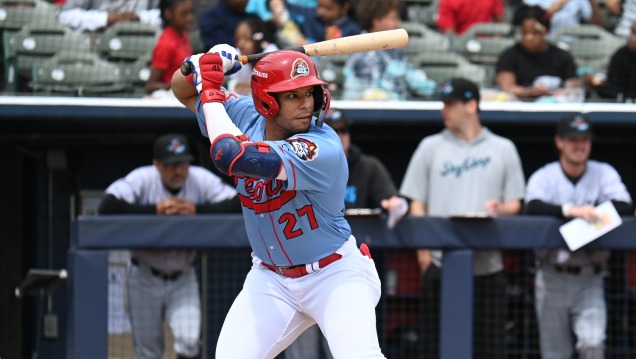
Báez has been one of the most productive power hitters in the minor leagues this season. Playing 103 games for Triple-A Memphis, the 23-year-old right-handed hitter posted a .256/.328/.573 slash line while launching 34 home runs. That total leads all Triple-A hitters in 2026 and ranks second among all Minor League players, trailing only Milwaukee prospect Andrew Fischer, who has 36.
His production goes well beyond home runs. Báez has accumulated 59 extra-base hits, second-most in the Minors, while his 235 total bases rank third. His .317 isolated power percentage also ranks among the best marks among qualified full-season minor leaguers, highlighting just how much damage he has been capable of doing when he connects.
Perhaps the most impressive evidence of his power comes from Statcast data. Báez has recorded 55 barrels this season, easily the most in Triple-A. The next-highest player has 43. Only Yordan Alvarez and James Wood have produced more barrels in the Major Leagues, putting Báez’s raw impact in some impressive company.
His ability to hit the ball hard has also been remarkable. More than half of his balls in play, 51.1%, have been hit at 95 mph or harder. His maximum exit velocity has reached 115.4 mph, while his 90th-percentile exit velocity sits at 108.5 mph. Those numbers are comparable to the elite contact quality produced by established stars such as Mike Trout and Matt Olson.
The challenge for Báez will be proving that his impressive power can translate against Major League pitching.
Strikeouts remain the biggest concern surrounding his offensive profile. Earlier in his career, Báez routinely posted strikeout rates above 35%, which caused evaluators to question whether his swing-and-miss tendencies would prevent his power from becoming a consistent weapon.
He made meaningful progress last season, cutting his strikeout rate to just 20.6% while splitting time between High-A Peoria and Double-A Springfield. That improvement helped restore his status as a highly regarded prospect and convinced the Cardinals to add him to their 40-man roster before he became eligible for the Rule 5 Draft.
His strikeout rate has climbed again during his first Triple-A season, reaching 29.5% before his promotion. Báez has been particularly vulnerable against high fastballs and sliders on the outer portion of the plate. There have been encouraging signs recently, though, as he reduced his strikeout rate to 25.6% over 10 games in August.
Major League pitchers will provide a much tougher examination. Báez will immediately face harder fastballs, sharper breaking pitches and more sophisticated sequencing, making his ability to adjust within at-bats one of the biggest storylines surrounding his debut.
There is more to Báez’s game than simply power, however. Despite standing 6-foot-3 and carrying the profile of a traditional slugger, he possesses surprising speed. He recorded nine sprint speeds above 30 feet per second with Memphis and stole 21 bases in 24 attempts this season. That follows a breakout 54-steal campaign last year.
His defensive tools could also allow the Cardinals to find immediate uses for him. Báez has an impressive throwing arm capable of reaching the mid-90s from the outfield and has the physical tools to handle a corner position. St. Louis has increasingly given him experience in left field, with nine of his final 13 Triple-A starts coming at that position.
That preparation appears particularly relevant now. With Lars Nootbaar dealt to Arizona at the trade deadline, the Cardinals have been rotating Bryan Torres, Everson Pereira and José Fermín through left field. Báez could quickly become another option there while Jordan Walker handles right field and Nathan Church occupies center.
The timing of his promotion is significant for another reason. By bringing Báez to the majors this late in the season, the Cardinals can give him valuable experience without necessarily using up his rookie eligibility for 2027. He will not have enough time to exceed the 45-day service-time threshold this season, and as long as he stays below 130 at-bats, he can remain eligible for Rookie of the Year consideration next year.
That gives St. Louis the best of both worlds: the club can evaluate one of its most exciting young hitters against Major League competition now while potentially preserving a full rookie campaign for him in 2027.
The Cardinals also have plenty of motivation to see what Báez can provide immediately. Despite taking a more future-oriented approach at the trade deadline, St. Louis remains within striking distance of the National League playoff picture. Following Friday’s 3-0 loss to Chicago, the Cardinals sit 3½ games behind the Phillies.
Báez’s arrival therefore comes at an intriguing point in the season. He could provide an offensive spark for a team attempting to close the gap in the playoff race, while simultaneously gaining experience that could accelerate his development into a long-term piece of the Cardinals’ lineup.
Just a year ago, Báez’s path to the majors appeared far less certain because of his strikeout problems. Now, after leading Triple-A in home runs and producing elite contact-quality numbers, the once-questioned prospect has forced his way onto the biggest stage.
The next question is simple: Can Báez’s extraordinary power survive against Major League pitching? His debut with the Cardinals will provide the first real answer.
Leave a Reply