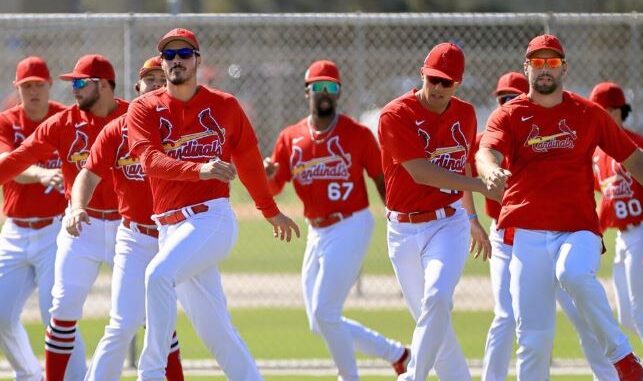
The St. Louis Cardinals have officially reached the end of the 2026 season, and although the final weeks left plenty of frustration, the bigger picture provides reason to view the year as a meaningful step forward. The Cardinals finished with a 77-85 record, but the win-loss mark alone does not fully explain what the organization accomplished during a season that was designed primarily around the future.
The ending certainly made the season feel worse than it probably should. St. Louis went just 9-15 during September, creating a sour final impression after the club had spent much of the year showing signs of progress. A 15-9 finish over the same 24-game stretch would have produced an entirely different mood, even though the overall record would have remained exactly the same. The late slide overshadowed some of the developments that made 2026 an important season for the organization.
From the Cardinals’ perspective, the season was always supposed to be about development, evaluation and establishing a foundation for the next competitive window. The organization entered the year after making several major decisions that prioritized the future rather than attempting to squeeze another postseason appearance out of the previous roster. That strategy included moving established players, including Nolan Arenado, and accepting the possibility of short-term pain in exchange for younger talent and greater flexibility.
That approach makes the 77 victories more significant than they might appear at first glance. Most preseason projections did not expect St. Louis to reach that number. Several projection systems had the Cardinals finishing with substantially fewer wins, and although some observers pushed back against those projections before the season, few expected the team to finish with 77 victories after undergoing such a significant transition.
The bigger accomplishment, however, was the number of questions the Cardinals managed to answer.
Heading into the season, St. Louis needed to determine which young players could realistically become part of the next competitive roster. By the end of 2026, several positions looked considerably clearer. The Cardinals now have a much better idea of what they have at second base, first base, catcher and the corner outfield, while several minor-league players have also strengthened their cases for future opportunities.
JJ Wetherholt emerged as one of the clearest pieces of the long-term plan. The young infielder established himself as the organization’s second baseman of the future and further strengthened that status with his extension. His defensive performance provided a higher floor than some expected, while his offensive underlying numbers suggested there could still be another level to his game.
Although his second half was not as impressive as his first, the overall indicators remained encouraging. His batting average on balls in play was relatively low compared with some of his minor-league numbers, while his expected offensive production suggested that his actual results may not have fully reflected the quality of his contact. For St. Louis, having a young player who can potentially anchor second base for years removes one major problem from the offseason checklist.
Alec Burleson also strengthened his case as a long-term option, particularly after moving to first base. His defensive improvement at the position actually increased his overall value, while his offensive production showed that his previous season was not simply a temporary spike. Burleson demonstrated more power, drew more walks and posted stronger underlying offensive numbers than he had the year before.
That combination gives the Cardinals another important piece to evaluate going forward. Instead of entering the offseason wondering whether Burleson belonged in their plans, the organization can now focus on determining exactly how he fits into the larger roster.
Then there was Jordan Walker, arguably one of the biggest developments of the entire season.
Coming into 2026, Walker was surrounded by uncertainty after struggling to establish himself consistently at the major-league level. Even his spring training performance had raised additional questions. Yet he responded with a season that dramatically changed his outlook, finishing with a 120 wRC+ and 2.8 fWAR while also reaching the 20-homer and 20-steal territory.
Whether the Cardinals eventually view Walker as a long-term cornerstone or as a valuable trade asset, his season increased his value. A player who entered the year needing to prove he still belonged firmly in the organization’s plans finished it as one of the more intriguing pieces of the roster.
The Cardinals also received encouraging answers behind the plate and in left field. Leonardo Bernal emerged as a legitimate candidate to become the organization’s catcher of the future, while Joshua Baez gave the team another young position player worth watching closely.
Baez’s major-league production was particularly encouraging. He hit seven home runs and seven doubles in only 29 games, giving the Cardinals a glimpse of the offensive upside that had made him an interesting prospect. There are still questions about his plate discipline and whether the production can be maintained over a full season, but his late-season performance significantly improved his position heading into 2027.
Bernal may have been an even bigger surprise. His transition to the majors was smoother than many expected, especially considering how young he had been throughout his progression through the minor leagues. His early success gives St. Louis considerably more flexibility when evaluating the other catchers in the organization. Instead of feeling compelled to hold every catching prospect, the Cardinals can now consider trades involving players such as Jimmy Crooks, Pedro Pagés or Ivan Herrera without the same level of uncertainty.
Five positions, therefore, became considerably clearer during the 2026 season. Some developments were expected, while others came as genuine surprises. For an organization in the middle of a rebuild, that kind of information can be just as valuable as another handful of victories.
The starting rotation also provided several positives, although St. Louis did not discover a new ace. Andre Pallante bounced back impressively, while Kyle Leahy showed enough to suggest that he could become a legitimate starting option. Dustin May also delivered value in a different way, as his eventual trade brought back two significant prospects and accomplished the primary reason the Cardinals signed him.
The rotation was not perfect, but it provided the organization with more information heading into the offseason.
There were also areas where the Cardinals did not find the answers they wanted. Third base remains one of the clearest unresolved positions. Nolan Gorman received an opportunity to play there and performed better defensively than expected, but his offensive struggles continued to limit his overall value.
The Cardinals did not discover their obvious long-term third baseman in the majors, but the minor-league system provided some encouragement. Jesús Báez enjoyed a huge season, including 41 home runs when his minor-league playoff production is included. Deniel Ortiz also quietly put together a strong campaign, while Blaze Jordan forced his way into a larger role before an injury interrupted his season.
Center field remains another area of uncertainty. Nathan Church did not produce the kind of breakthrough some had hoped to see, leaving St. Louis without a definitive answer at the position. However, the organization did receive encouraging minor-league developments from players such as Tai Peete and Josiah Ragsdale, giving the Cardinals additional options for the future.
Matthew Liberatore represents another complicated evaluation. His strikeout rate improved substantially, which is an encouraging development, but it remains unclear whether that improvement will translate into a long-term starting role. One possibility is that Liberatore can continue refining his arsenal and become a more dependable starter. Another is that his future could ultimately be in the bullpen, where his strikeout ability could become particularly valuable.
The bullpen itself was one of the weaker areas of the team, but that problem may be easier to address than some of the other roster issues. Relief pitching is notoriously unpredictable from one season to another, meaning the Cardinals do not necessarily need to make a massive long-term commitment to fix it. Internal improvement, new additions and unexpected breakouts could all change the picture quickly.
Ultimately, the 2026 Cardinals were not judged solely by their 77-85 record. The more important question was whether the organization entered the offseason with a clearer understanding of which players belong in its next competitive team.
The answer appears to be yes.
Wetherholt has strengthened his position at second base. Burleson looks increasingly comfortable at first. Walker dramatically improved his value. Bernal emerged as a potential long-term catcher, while Baez gave the organization another young offensive piece to monitor. The minor leagues also produced several developments that could become important over the next few seasons.
That does not mean the rebuild is complete. Far from it. St. Louis still needs answers at third base, center field, in the bullpen and potentially in the starting rotation. The organization will also have to decide which veterans should remain and which could be moved for additional young talent.
The offseason therefore becomes extremely important. The Cardinals have created some momentum with their young players, and the next challenge is turning that progress into a stronger 2027 roster rather than simply continuing to plan for some distant future.
For all the frustration created by the September collapse, the broader 2026 season gave St. Louis something valuable: clarity. The Cardinals entered the year with numerous questions about their roster and their direction. They finished it with several important answers.
The final record may not look impressive, but the development of the young core and the information gained throughout the season make 2026 an important chapter in the Cardinals’ rebuilding process. The next step will be determining how aggressively the organization builds on those gains during the offseason.
Leave a Reply