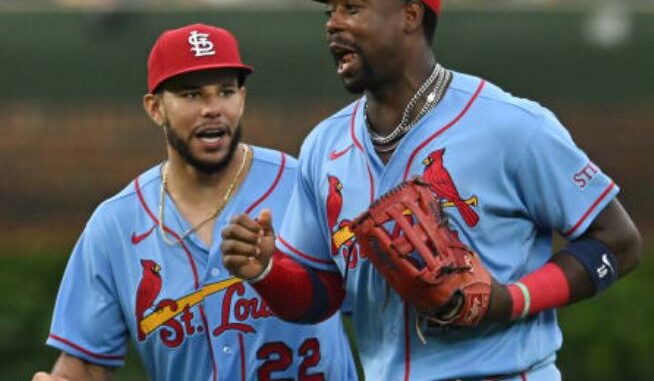
The St. Louis Cardinals may be discovering that their next generation of offensive stars is already beginning to take shape. After a remarkable weekend that highlighted the enormous power of Jordan Walker and Joshua Báez, the Cardinals suddenly have the makings of an imposing right-handed-hitting outfield combination.
It is rare for a major-league club to have even one young outfielder with elite power, speed and physical tools. Having two players with those characteristics on the same roster could give St. Louis a significant advantage if both continue developing as expected.
Walker, listed at 6-foot-6, and Báez, at 6-foot-3, immediately stand out because of their size and athleticism. Both possess the kind of raw power that can change a game with one swing, while their speed gives them another dimension beyond simply hitting home runs.
Báez made that potential impossible to ignore during his MLB debut. The 23-year-old made history by becoming the first player ever to hit three home runs in his first three major-league at-bats, turning his debut into one of the most memorable performances in Cardinals history.
Walker, meanwhile, has already enjoyed his own breakthrough moment this season after winning the 2026 Home Run Derby, adding another major accomplishment to what has been an increasingly encouraging year.
Two Young Players Who Refused to Give Up
The excitement surrounding Walker and Báez is particularly meaningful because neither player reached this point without significant questions.
Walker, once viewed as one of baseball’s premier young prospects, struggled after reaching the majors. His defensive inconsistencies, high strikeout totals and difficulty consistently elevating the baseball prevented his tremendous exit velocities from translating into the production many expected.
Rather than abandoning him, however, the Cardinals worked with Walker to rebuild his approach.
The 24-year-old spent much of the previous year refining his swing and making adjustments. By the end of Spring Training, the organization began seeing signs that the changes were working. Once the regular season arrived, Walker started looking much more like the potential star St. Louis envisioned when he first reached the majors in 2023.
Báez followed a different path.
His biggest challenge in the Minor Leagues was making enough contact to allow his tremendous raw power to become game-changing production. The Cardinals placed him on the Development List for four weeks in 2024, giving him additional time to work with the organization’s player-development staff.
The results were dramatic.
Báez emerged as a significantly improved prospect in 2025. At the beginning of that season, he was not even ranked among St. Louis’ Top 30 prospects by MLB Pipeline. By the end of the year, he had climbed all the way into the Top 100, eventually ranking No. 59.
His development culminated in a historic major-league debut.
The Power Is Already Showing Up
The numbers suggest that the Cardinals aren’t simply dreaming about what Walker and Báez could become—their power is already translating into production.
Walker has 24 home runs this season, putting him among the top home-run hitters in baseball. Among right-handed hitters, he ranks particularly high, demonstrating just how rare his combination of size and power can be.
Báez was even more prolific in Triple-A before his promotion. He had blasted 34 home runs, leading the level, before immediately carrying that power into the major leagues with his unforgettable three-homer debut.
That type of right-handed power is extremely valuable in today’s game. Few teams have multiple young hitters capable of consistently threatening 30-plus home runs.
For the Cardinals, the possibility of Walker and Báez developing into complementary middle-of-the-order bats could transform the club’s offensive outlook.
St. Louis Has the Pieces to Protect Them
The Cardinals also have the opportunity to surround the two right-handed sluggers with hitters who can create favorable matchups.
Alec Burleson could be an ideal complement. The left-handed hitter has been especially dangerous against right-handed pitching, posting a .989 OPS in those matchups. Placing Burleson ahead of or between Walker and Báez could force opposing managers to make difficult pitching decisions.
JJ Wetherholt and Iván Herrera could also play important roles near the top of the lineup. When healthy and performing at their best, both have the ability to get on base and create opportunities for the Cardinals’ power hitters.
That combination could eventually give St. Louis a lineup with a strong balance of contact, on-base ability, speed and overwhelming power.
Báez Still Has Plenty to Prove
Despite the historic debut, the Cardinals will understandably remain patient with Báez.
His second game provided a reminder that he is still a developing hitter. After his three-home-run explosion, Báez went 0-for-5 and struck out three times. That type of inconsistency is hardly surprising for a young player who has battled swing-and-miss issues throughout his development.
The Cardinals won’t expect him to continue hitting three home runs every game. Instead, the organization will be focused on helping him adjust to major-league pitching, improve his contact rate and learn how to consistently turn his extraordinary raw power into production.
The same patience that helped Walker and Báez reach this point will likely be necessary moving forward.
Still, the ceiling is difficult to ignore.
Walker has already established himself as one of the Cardinals’ most dangerous young power hitters, while Báez has announced his arrival in spectacular fashion. If both players continue progressing, St. Louis could have one of the most physically imposing young outfield combinations in baseball.
For a franchise determined to build around young talent, the emergence of Walker and Báez could be one of the most important developments of the season—and potentially the beginning of something much bigger.
Leave a Reply