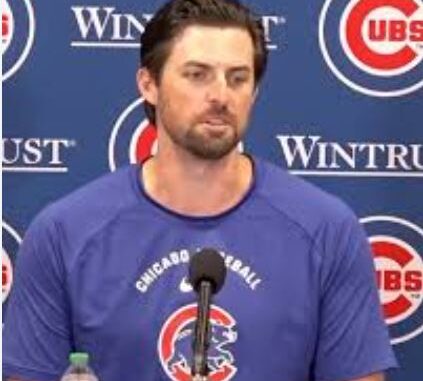
The Chicago Cubs made one of the biggest pitching moves of the 2026 trade deadline when they acquired Clay Holmes from the New York Mets, hoping the veteran right-hander could become a major piece of their postseason rotation.
However, Holmes has made it clear that his recovery from a serious leg injury remains a work in progress, and Cubs fans should expect some inconsistency as he continues rebuilding his form.
Holmes was sidelined after suffering a fractured right fibula in May, an injury that interrupted what had been an outstanding season. Before getting hurt, he had established himself as one of the Mets’ most effective starters, posting a 2.39 ERA through nine starts.

The Cubs nevertheless believed his upside was too significant to ignore.
Cubs Bet Big on Holmes
Chicago acquired Holmes and outfielder Tyrone Taylor from the Mets on Aug. 3 in exchange for highly regarded infield prospect Jefferson Rojas. The trade was part of an aggressive deadline push by the Cubs, who also added other pitching help as they positioned themselves for a postseason run.
Holmes was viewed as a particularly intriguing addition because of his successful transition from reliever to starting pitcher.
After spending much of his career working out of the bullpen, Holmes became a full-time starter with New York and delivered a breakthrough 2025 season. He threw 165⅔ innings and won 12 games, demonstrating that he could handle a significantly larger workload while remaining effective.
The Cubs therefore weren’t simply acquiring a temporary rotation piece. They were betting that the version of Holmes who dominated before his injury could return in time to help them make a deep October run.
Rough Cubs Debut Shows the Rust
Holmes’ first outing in Chicago offered a reminder of the risk involved.
After completing three minor-league rehab starts, he returned to the Major Leagues and made his Cubs debut against Kansas City. The results were understandably uneven.
He worked four innings, allowing four earned runs on six hits while walking two and striking out one. The performance was far from the level Holmes had established before his injury, but the circumstances surrounding the outing made it difficult to draw any major conclusions.
He had spent months recovering from the fractured fibula and was facing Major League hitters again for the first time since May.
Rather than viewing the outing as a sign that the trade had gone wrong, the Cubs understood that Holmes would likely require time to regain his rhythm.
Holmes Responds With Dominant Start
His second start provided a much more encouraging picture.
On Friday against the St. Louis Cardinals, Holmes delivered one of his best performances of the season. He worked 6⅔ scoreless innings, allowed just one hit, walked one batter and struck out three as Chicago shut out St. Louis, 3-0.
The performance immediately demonstrated why the Cubs were willing to surrender a highly regarded prospect to acquire him.
Holmes attacked the Cardinals’ lineup, generated weak contact and relied on the Cubs’ defense to help complete the job. His outing also came at an important time for Chicago, which has been building momentum in the playoff race.
The Cubs have now won nine of their last 11 games, and Holmes’ dominant performance provided another reason for optimism about the club’s rotation.
But Holmes Is Warning Against Overreaction
Despite the dramatic improvement, Holmes himself is urging everyone to remain realistic.
He acknowledged that returning from a major injury is a gradual process and that his two early Cubs starts should not be viewed as definitive representations of where he currently stands.
Holmes explained that his first outing probably wasn’t as poor as the statistics suggested, while his second outing probably wasn’t quite as dominant as the numbers indicated.
His message was simple: the recovery process will include ups and downs.
That is an important warning for Chicago.
The Cubs cannot assume that every Holmes start will resemble his shutout performance against St. Louis. At the same time, they should not overreact when he has an occasional difficult outing.
The goal is to gradually build his strength, command and consistency as the postseason approaches.
His Arsenal Fits the Cubs
There is another reason Chicago remains confident in the acquisition.
Holmes is primarily a sinker-oriented pitcher who relies heavily on inducing ground balls rather than overwhelming hitters with strikeouts. His sinker has averaged around 94 mph, and he throws the pitch roughly half the time.
That approach could work particularly well in Chicago because the Cubs have an excellent defensive infield.
If Holmes can consistently generate ground balls, Chicago’s defense can help convert those balls into outs and keep his pitch counts manageable.
His ability to limit walks and avoid excessive hard contact also gives him a potentially valuable profile for postseason baseball.
The Timing Could Be Crucial
The Cubs did not acquire Holmes simply for the regular season.
Their larger goal is October.
Chicago made an aggressive series of moves at the deadline because the organization believes it has a legitimate opportunity to compete for a championship. Holmes was arguably the most important part of that pitching overhaul.
The Cubs know they will need reliable starting pitching if they advance deep into the postseason.
That makes Holmes’ recovery particularly important.
If he can regain the form he showed before his injury, he could become one of the most valuable additions Chicago made at the deadline. His pre-injury 2.39 ERA demonstrated just how effective he can be when healthy.
But if his recovery stalls or he struggles to maintain his velocity and command, the Cubs could find themselves depending more heavily on their other rotation options.
A High-Risk, High-Reward Trade
The price Chicago paid also makes the Holmes storyline more significant.
The Mets received Jefferson Rojas, a highly regarded Cubs infield prospect, in the deal. Chicago was essentially exchanging part of its future for immediate Major League impact.
That is the type of move contenders make when they believe their championship window is open.
The Cubs clearly believe Holmes can justify that investment.
They also added Taylor as part of the deal, giving Chicago additional roster flexibility while strengthening the team’s overall depth.
For now, the early returns are encouraging.
Holmes struggled in his first appearance, then responded with a dominant performance against St. Louis. That contrast perfectly illustrates the uncertainty surrounding his recovery.
Cubs Fans Have Reason to Be Encouraged
The biggest takeaway from Holmes’ latest start is not necessarily the six-plus scoreless innings.
It is the fact that he was able to handle a significantly larger workload and perform effectively after his difficult first outing.
That suggests his arm and body are progressing.
The Cubs will still need to manage his workload carefully and avoid pushing him too quickly. There is little reason to expect him to immediately resemble the pitcher he was before the injury every time he takes the mound.
Holmes himself understands that.
His warning about the recovery process should therefore be viewed as a reminder rather than a concern: there will be good starts, difficult starts and everything in between.
For a Cubs team chasing October success, the objective is to have Holmes at his best when the games matter most.
And if Friday’s dominant outing is any indication, there is plenty of reason for Chicago to believe its blockbuster investment could eventually pay off.
The Cubs took a calculated risk when they traded a top prospect for an injured starter.
Now, Holmes’ recovery will determine whether that gamble becomes one of the most important moves of Chicago’s 2026 season.
Leave a Reply