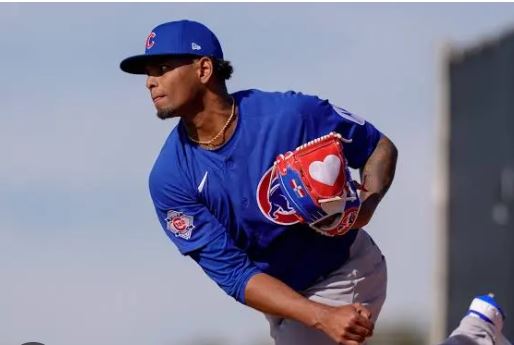
The Chicago Cubs’ Sunday afternoon against the St. Louis Cardinals turned into a frustrating setback on multiple fronts. Chicago suffered an 11-4 defeat at Wrigley Field, but the bigger concern may be the condition and performance of starting pitcher Edward Cabrera, who was making his return from the injured list.
Cabrera had been sidelined since late June after suffering a moderate left hamstring strain. The Cubs activated him Sunday and handed him the ball against St. Louis, hoping his return would strengthen a rotation that has already dealt with its share of injuries and inconsistency.

Instead, Cabrera struggled badly in his first outing back.
The right-hander lasted only 3 2/3 innings and was charged with seven runs on six hits while walking three and striking out two. He had difficulty locating his pitches, and the Cardinals repeatedly took advantage of mistakes in the strike zone. His outing quickly became the central problem in a game that eventually got away from Chicago.
The poor performance was particularly disappointing because Cabrera had looked much sharper during his rehabilitation assignments. He had recently completed a five-inning outing for Double-A Knoxville in which he did not allow a hit and struck out seven while issuing only one walk. Those results had provided optimism that he was ready to return to the Cubs’ rotation.
However, the transition back to a major league game was far more difficult.
Cabrera Also Dealt With a Blister
Adding another layer of concern, Cabrera developed a blister on his right middle finger during Sunday’s start.
That is notable because the pitcher previously missed time earlier this season because of a blister issue. While Cabrera indicated that he remains hopeful of making his next scheduled start, the recurrence is something the Cubs will have to monitor closely.
The combination of his rough outing and the finger issue creates an uncomfortable situation for Chicago. Cabrera was expected to provide additional stability to the rotation after returning from the hamstring injury, but now the Cubs must determine whether the blister will affect his availability or pitching effectiveness going forward.
Cabrera’s next scheduled opportunity is expected to come against the Seattle Mariners, although the Cubs have some flexibility in their pitching schedule because of an upcoming off day.
Cardinals Took Advantage Early
St. Louis wasted little time putting pressure on Cabrera.
The Cardinals eventually broke the game open with a six-run fourth inning, turning what had been a manageable contest into a one-sided affair. Alec Burleson and Jordan Walker were particularly damaging, with both players recording three hits, a home run and four RBIs in the victory.
Burleson started the scoring with a two-run homer and later delivered a two-run single during the decisive fourth inning. Walker added a two-run homer during the same frame, giving the Cardinals a commanding advantage.
St. Louis continued adding insurance throughout the afternoon, eventually finishing with 19 hits and 11 runs.
The Cubs simply could not keep pace.
Chicago’s Offense Showed Some Fight
There were a few positive moments for Chicago despite the lopsided defeat.
Pete Crow-Armstrong continued his impressive power season by hitting a two-run home run, his 28th of the year. Miguel Amaya also connected for a solo homer as the Cubs attempted to remain competitive.
But the offensive contributions were not enough to overcome the pitching problems.
Chicago’s bullpen was forced to cover significant innings after Cabrera’s early exit, and the game became increasingly difficult to manage once the Cardinals established a large lead.
The loss also highlighted a broader concern for the Cubs: their pitching staff has struggled to consistently keep opponents off the scoreboard. Chicago has now surrendered at least six runs in seven of its last 11 games, putting additional pressure on an offense that must produce consistently to compensate.
Cabrera’s Season Has Been Uneven
Sunday’s struggles also continued a difficult season statistically for Cabrera.
Before his injury, the 28-year-old had gone 5-4 with a 5.10 ERA, a 1.40 WHIP and 65 strikeouts against 29 walks over 72 1/3 innings and 14 starts.
Cabrera was acquired by Chicago from the Miami Marlins during the offseason with the hope that his powerful arsenal and strikeout ability could give the Cubs another quality option in the rotation.
The talent is obvious, but consistency has remained the challenge.
Cabrera’s fastball can reach the upper 90s, and when his command is working, he has the ability to overwhelm hitters. The problem is that walks, missed locations and occasional lapses in command have made it difficult for him to consistently pitch deep into games.
His return was therefore viewed as an important opportunity to turn his season around.
Instead, he immediately encountered another obstacle.
Cubs Need Cabrera to Stabilize the Rotation
The timing of Cabrera’s return makes Sunday’s developments especially important.
Chicago strengthened its pitching depth around the trade deadline, giving manager Craig Counsell more options than he had earlier in the season. Cabrera’s return was supposed to further improve that depth.
His activation also forced the Cubs to make a difficult roster decision, with Javier Assad being optioned to Triple-A Iowa to make room for Cabrera.
Assad had performed well this season, posting a 3.59 ERA and 1.120 WHIP across 21 appearances, including 10 starts. The Cubs were nevertheless willing to make the move because they believed Cabrera could provide more upside and eventually become an important part of the rotation.
Now, after one disastrous outing, the Cubs have to hope the performance was simply a case of rust following a lengthy absence.
The Blister Could Be the Bigger Story
While Cabrera’s seven-run outing is concerning from a performance standpoint, the finger blister could ultimately be more important.
Pitchers rely heavily on the condition of their fingers to maintain grip, spin and command. Even a relatively minor blister can affect pitch quality and force a pitcher to alter his mechanics or grip.
For Cabrera, who already missed significant time because of the hamstring injury, another physical issue would be particularly frustrating.
The Cubs therefore have to balance two priorities: getting Cabrera back into a consistent pitching rhythm while making sure the blister does not develop into another extended absence.
If the blister clears quickly and Cabrera is able to make his next start, Sunday’s outing could eventually be viewed as nothing more than a difficult first step in his return.
If the issue persists, however, the Cubs could be forced to reconsider their plans for him.
A Rough Day Gets Even Worse for Chicago
The Cabrera situation was only part of Chicago’s difficult afternoon.
Dansby Swanson also left the game after suffering an injury during an at-bat. The shortstop reportedly sustained a left oblique injury and is expected to undergo further evaluation, with an injured-list stint a possibility.
That creates another significant problem for a Cubs team already fighting to remain competitive in the National League playoff race.
With Swanson potentially unavailable, Chicago could shift Nico Hoerner to shortstop while Pedro Ramirez takes over at second base. That would create another adjustment for Counsell as the Cubs attempt to maintain their defensive stability.
The combination of Swanson’s injury, Cabrera’s rough return and the heavy defeat made Sunday one of Chicago’s more frustrating games of the season.
Cubs Must Quickly Move Forward
Despite the disappointment, the Cubs cannot afford to dwell on Sunday’s loss.
The team remains in the middle of a competitive playoff race, and there is still time for Cabrera to regain his form. His previous rehabilitation outings showed that his arm strength and strikeout ability are still there.
The biggest question is whether he can translate those positive signs into major league results.
The Cubs will also be watching his finger closely over the coming days. If the blister heals and he is cleared to pitch, his next outing could provide an important indication of whether Sunday’s performance was simply rust or a sign of deeper problems.
For now, Cabrera’s return has raised more questions than answers. After missing nearly two months with a hamstring injury, he was expected to give Chicago’s rotation a boost. Instead, he was knocked around by the Cardinals and developed another finger issue, leaving the Cubs hoping that both problems prove temporary as they enter an increasingly important stretch of the season.
Leave a Reply