
The New York Rangers entered the offseason hoping for a favorable bounce in the NHL Draft Lottery but instead, a drop to the No. 5 overall pick has reshaped their entire draft landscape and cast new uncertainty over the future of defenseman Braden Schneider.
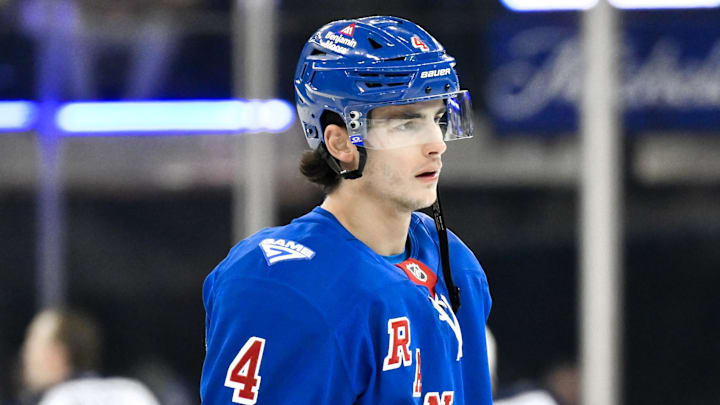
For Schneider, a 2020 first-round selection, the past season was widely viewed as a critical audition. He was given an expanded role and a meaningful opportunity to establish himself as a long-term piece on the Rangers’ blue line. However, inconsistent performance left his standing within the organization less secure than expected, and even Schneider himself acknowledged during breakup day that his future in New York wasn’t fully settled.
Now, the results of the lottery have only intensified that uncertainty.
By sliding down the board, the Rangers lost access to the very top tier of prospects they had been targeting players who could have immediately reshaped their roster trajectory. Instead, they now sit in a draft range where defensive talent is abundant but less definitive, and where their selection could directly overlap with Schneider’s position group.
One of the teams that leapt ahead of them, the San Jose Sharks, now hold the No. 2 pick after a significant jump. While most projections have them leaning toward high-end forward talent such as Ivar Stenberg, their position also gives them flexibility to pivot toward defense or even trade down. Options like selecting a right-shot defender such as Chase Reid or moving slightly back in the draft to accumulate assets all remain on the table. That kind of uncertainty only adds complexity to how the draft board will ultimately unfold and indirectly impacts how many potential landing spots for Schneider-related movement might even exist.
For the Rangers, however, the more pressing issue is internal.
With the No. 5 selection, New York general manager Chris Drury could realistically be choosing from a cluster of defensemen who project as long-term NHL contributors but not immediate franchise changers. Names such as Keaton Verhoeff, Carson Carels, or Alberts Smits could all be in play depending on how the board breaks. While none are expected to step directly into the lineup right away, their presence adds another layer to the organization’s blue-line planning.
That reality puts Schneider’s future in a delicate position.
If the Rangers believe another young defenseman is on the way, it raises the possibility that Schneider becomes a trade asset or is evaluated more as a short-term piece rather than a long-term cornerstone. With his contract situation approaching a pivotal point, the organization must weigh whether to extend him meaningfully or pivot toward a new internal pipeline of cost-controlled defensive talent.
At the same time, New York remains under pressure to build a competitive roster around its current core. Players like Adam Fox and Igor Shesterkin are still in or nearing their prime years, and the front office is aware that stagnation is not an option. The challenge is balancing development, asset management, and immediate competitiveness in a single draft window.
For now, nothing is finalized.
The Rangers could still retain Schneider for another year, effectively delaying any major decision while reassessing the roster after the draft and free agency. But with expectations high and patience thinning among fans following a disappointing season and an underwhelming lottery outcome, the pressure on Drury to chart a clear direction is only increasing.
What was once a straightforward defensive evaluation has now become a broader organizational crossroads one where the draft, development timeline, and Schneider’s future are all tightly intertwined.
Leave a Reply