The New York Rangers’ history is filled with legendary players who made their mark while wearing iconic numbers, but the numbers from 41 through 50 have a much shorter and more diverse history. Unlike lower jersey numbers that have been associated with franchise icons for decades, the Rangers did not begin regularly using numbers in this range until the 1980s. Eddie Mio became the first Ranger to wear No. 41, and since then, every number from 41 through 50 has been worn by at least two players.
Interestingly, none of these numbers has produced a Ranger who played more than 250 regular-season games while wearing that specific number. Several players on this list also became far more recognizable under different numbers, making this group an interesting blend of short-term wearers, dependable role players, rising young talents and established veterans.
Here is a closer look at the most notable Rangers associated with Nos. 41 through 50 during the franchise’s first century.
No. 41 – Jed Ortmeyer (2003–07)
Jed Ortmeyer became the standout player associated with No. 41 after arriving in New York as an undrafted forward following four seasons at the University of Michigan. He made his NHL debut on Nov. 15, 2003, and scored his first NHL goal only 10 days later against the Tampa Bay Lightning.
Ortmeyer spent the 2004–05 lockout season with Hartford in the AHL before returning to New York full-time the following year. He became a trusted defensive forward and penalty killer, skating on the memorable “HMO Line” alongside Dominic Moore and Ryan Hollweg. His value was never measured simply by offensive production; his energy, defensive commitment and willingness to do the difficult work made him a popular player among Rangers fans.
His career took an especially challenging turn in 2006 when he suffered a pulmonary embolism. Despite the serious health scare, Ortmeyer fought his way back and returned to the Rangers in January 2007. At the conclusion of that season, he won the Steven McDonald Extra Effort Award for the second time, an honor that reflected his determination and team-first attitude.
Ortmeyer eventually played for three other NHL teams before retiring in 2012. He later returned to the Rangers organization as director of player development, a position he held for nine years before departing in 2026. His No. 41 tenure remains closely associated with his grit and perseverance.
Rangers totals while wearing No. 41: 177 games, 9 goals, 15 assists, 24 points.
No. 42 – Artem Anisimov (2009–12)
Artem Anisimov is the clear choice for No. 42. The Russian forward was selected by the Rangers in the second round, 54th overall, of the 2006 NHL Draft and made his NHL debut in February 2009.
He became a regular the following season and developed into a dependable middle-six forward. Anisimov consistently provided secondary scoring, averaging approximately 15 goals and 36 points during his most productive stretch with the Rangers while rarely missing games.
His combination of size, skill and offensive instincts made him a useful piece of New York’s lineup, although his time with the organization ended in July 2012 when he was included in the blockbuster trade that sent him to the Columbus Blue Jackets in exchange for Rick Nash.
Anisimov went on to spend another nine seasons in the NHL and reached the 20-goal plateau five times. He eventually returned to the Rangers organization at the AHL level, finishing his professional career with Hartford during the 2023–24 season.
Rangers totals wearing No. 42: 244 games, 46 goals, 62 assists, 108 points.
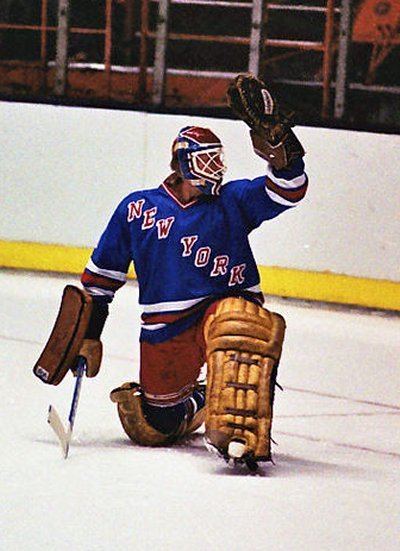
Martin Biron – No. 43
Martin Biron’s time with the Rangers was relatively brief, but the veteran goaltender provided valuable insurance behind Henrik Lundqvist. Biron arrived in New York in July 2010 after a lengthy NHL career that had already included stops with Buffalo, Philadelphia and the New York Islanders.
He was brought in primarily to serve as Lundqvist’s backup, a role that required reliability whenever the Rangers’ superstar needed a rest. Biron delivered respectable numbers during his three seasons on Broadway, posting a 2.47 goals-against average and a .908 save percentage.
Biron appeared in 46 games for New York and finished with a 22-15-3 record. His Rangers tenure ended after a difficult start to the 2013–14 season, when the organization waived him. Rather than report to the AHL, Biron chose retirement, bringing the curtain down on a career that had begun when he was only 18 years old.
Rangers totals: 46 games, 22-15-3 record.
No. 44 – Vladislav Gavrikov (2025–present)
Vladislav Gavrikov represents one of the more recent additions to this list and has quickly established himself as arguably the most accomplished player currently associated with No. 44.
The Rangers made Gavrikov one of their major free-agent additions during the summer of 2025, signing the experienced Russian defenseman to a seven-year contract. He immediately demonstrated why the organization viewed him as a cornerstone piece of its blue line.
During the 2025–26 season, Gavrikov produced the best offensive numbers of his NHL career while playing an important role on the Rangers’ defense. When Adam Fox was healthy, the two formed a formidable pairing capable of handling heavy minutes against opposing teams’ best players.
Gavrikov’s value extends beyond scoring. His defensive awareness, physicality, puck movement and ability to contribute at both ends of the ice have made him an important part of New York’s long-term plans. If he and Fox remain healthy, the Rangers could have one of the league’s more dependable defensive partnerships for years to come.
Rangers totals through 2025–26: 82 games, 14 goals, 21 assists, 35 points.
No. 45 – Braden Schneider (2022–present)
Braden Schneider briefly wore No. 45 after being promoted to the Rangers during the 2021–22 season before eventually switching to No. 4, the number he wears today.
Selected 19th overall in the 2020 NHL Draft, Schneider was viewed as a defenseman with considerable potential. His junior career did not feature overwhelming offensive numbers, and his NHL game has followed a similar pattern. He has instead built his reputation through defensive reliability, physical play and responsible puck management.
During his first several NHL seasons, Schneider has yet to exceed six goals or 21 points in a single campaign, but his contributions cannot be measured entirely by offensive statistics. He has become a useful defensive option and continues to develop his overall game.
The 2026–27 season could be particularly important for Schneider. Turning 25 at the beginning of the campaign, he entered the year on a one-year contract, giving him an opportunity to establish himself as a more permanent part of New York’s defensive plans.
Rangers totals while wearing No. 45: 368 games, 20 goals, 67 assists, 87 points.
No. 46 – Dan Girardi (2007)
Dan Girardi is easily the most recognizable name connected to No. 46, even though Rangers fans overwhelmingly remember him as No. 5.
Girardi arrived in New York as an undrafted free agent and was assigned No. 46 when he made his Rangers debut in January 2007. He wore the number for the remainder of that season before switching to No. 5, which he would wear for the next decade.
Although his time in No. 46 was extremely short, Girardi’s overall Rangers career was significant. He became one of the franchise’s most trusted defensive defensemen, playing nearly 800 regular-season games for New York. His physical style, shot-blocking ability and willingness to sacrifice his body made him a key component of several successful Rangers teams.
Girardi ultimately became the first player in franchise history to wear No. 46. Only two other Rangers followed him in using the number, and it has not been worn since Rob O’Gara in 2018.
Rangers career: 788 games, 46 goals, 184 assists, 230 points.
No. 47 – Rich Pilon (1999–2001)
Rich Pilon brought a rugged, physical identity to No. 47 during his time with the Rangers. Pilon had worn the same number for 12 seasons with the New York Islanders, so he kept it after New York acquired him off waivers in October 1999.
The defenseman was never known for offensive production. Instead, his game centered on physicality, intimidation and making life difficult for opposing forwards. He continued that role with the Rangers, providing toughness and defensive depth.
Pilon scored only eight goals during his NHL career, but two of those came during his final season with New York in 2000–01. The Rangers opted not to re-sign him that summer, and he spent one final season with the St. Louis Blues before retiring.
Rangers totals wearing No. 47: 114 games, 2 goals, 13 assists, 15 points.
No. 48 – Brendan Lemieux (2019–21)
Brendan Lemieux, son of longtime NHL star Claude Lemieux, brought a familiar brand of agitation and physicality to the Rangers after joining the organization in February 2019.
New York acquired him from the Winnipeg Jets in the trade that sent veteran center Kevin Hayes to Winnipeg. Lemieux quickly established himself as a classic bottom-six forward whose primary responsibilities included bringing energy, finishing checks and getting under opponents’ skin.
Although he did not possess his father’s offensive ability, Brendan was more than willing to fight and could contribute occasional scoring. During his Rangers tenure, he recorded 11 goals and 20 assists in 109 games.
New York eventually traded him to the Los Angeles Kings in March 2021. He later spent time with the Philadelphia Flyers and Carolina Hurricanes before continuing his career overseas in Switzerland.
Rangers totals wearing No. 48: 109 games, 11 goals, 20 assists, 31 points.
No. 49 – Jaroslav Chmelar (2025–present)
Jaroslav Chmelar has quickly become the most statistically accomplished player to wear No. 49 in Rangers history, despite having only a short NHL résumé so far.
Only four players have worn No. 49 for New York, and Chmelar has already surpassed the others in games played, goals and points. The Czech forward was selected by the Rangers in the fifth round of the 2020 NHL Draft and has gradually developed into an intriguing combination of size, speed and offensive potential.
His performance late in the 2025–26 season caught the attention of head coach Mike Sullivan. Chmelar showed that he could compete physically while also using his skating ability to create opportunities.
With offseason trades creating openings within the Rangers’ bottom six, Chmelar has a significant opportunity ahead of him. A strong training camp and start to the 2026–27 season could allow him to secure a regular NHL role and potentially turn No. 49 into a more prominent number in Rangers history.
Rangers totals through 2025–26: 28 games, 4 goals, 2 assists, 6 points.
No. 50 – Will Cuylle (2023–present)
Will Cuylle has quickly made No. 50 his own and could ultimately become the most accomplished player on this list if his development continues.
The Rangers selected Cuylle in the second round, 60th overall, of the 2020 NHL Draft. He has developed into a physical, energetic left wing capable of contributing offensively while also imposing himself physically on games.
What makes Cuylle particularly intriguing is the combination of scoring and physicality he has displayed at a young age. He has produced consecutive 20-goal seasons while also recording more than 300 hits in each of those campaigns, a combination that illustrates his willingness to play a hard-nosed style without sacrificing offensive production.
At just 24 years old, Cuylle already looks established as a dependable middle-six forward, but there is still plenty of room for his game to evolve. If he can continue improving his scoring, puck possession and overall consistency, he has the potential to become one of the Rangers’ most important homegrown forwards.
Cuylle is only the second player in franchise history to wear No. 50, and his rapid development has given the number a distinct identity in New York.
Rangers totals through 2025–26: 249 games, 53 goals, 51 assists, 104 points.
The Bigger Picture
The Rangers’ Nos. 41 through 50 do not feature the same collection of franchise legends found in some of the lower-numbered groups, but the list still contains several players who played meaningful roles in New York.
Ortmeyer represented perseverance and defensive commitment, Anisimov provided valuable secondary scoring, Biron offered dependable goaltending behind Lundqvist, and Girardi became a major defensive presence despite wearing No. 46 for only a few games. More recent players such as Gavrikov, Chmelar and Cuylle could significantly reshape this ranking in the coming years.
Among the established players, Girardi’s overall Rangers career clearly stands out, while Cuylle has perhaps the most intriguing opportunity to climb the franchise’s historical rankings. With several younger players still developing, the story of Nos. 41–50 is far from finished.
Leave a Reply