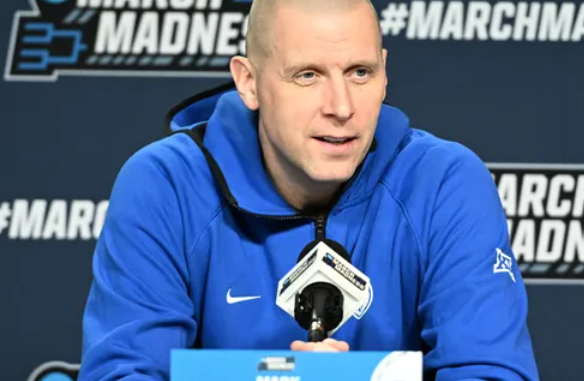
The 2026-27 season could represent a defining chapter in Mark Pope’s tenure at Kentucky. After two seasons that have produced flashes of promise but also increasingly concerning trends against elite competition, the Wildcats enter the new campaign with a significantly reshaped roster and enormous expectations.
Kentucky has remained respectable under Pope, but the program has not yet consistently looked like the national powerhouse its history demands. The Wildcats won 22 games last season and reached the second round of the NCAA Tournament despite dealing with major injuries, including setbacks involving point guard Jaland Lowe and big man Jayden Quaintance.
The more troubling statistic, however, came from Kentucky’s performance against high-major opponents. According to CBB Analytics, the Wildcats posted a minus-2.4 net rating against high-major competition, the worst mark for Kentucky over the last 15 seasons.
That number helps explain why the upcoming season carries so much weight.
Kentucky suffered several emphatic defeats last season, including a 17-point loss to Michigan State, a 35-point blowout against Gonzaga and a 25-point defeat against Vanderbilt. The season ended with another disappointing performance, as Iowa State eliminated the Wildcats 82-63 in the NCAA Tournament after Kentucky struggled offensively for much of the game.
At the same time, the broader SEC landscape has changed dramatically. Programs throughout the conference are pouring significant financial resources into basketball, dramatically increasing the level of competition. Kentucky can no longer rely solely on its brand and tradition to separate itself from the rest of the league.
Pope’s latest roster appears designed to address some of those issues. The Wildcats have added size, shooting, versatility and several players capable of playing multiple positions. The challenge will be turning those individual pieces into a cohesive team quickly enough to compete in what has become one of the deepest conferences in college basketball.
Projected Kentucky Starting Five
PG: Zoom Diallo — 6-6, 195 pounds, Junior
Zoom Diallo could become one of the most important pieces of Kentucky’s new roster. The Washington transfer brings a physical, aggressive style and some of the qualities that made Lamont Butler so valuable.
Diallo is a competitive guard who plays with intensity and is not afraid to attack. He will occasionally force difficult shots or make questionable decisions, but his effort level is rarely in doubt.
The key for Pope will be getting Diallo to play under control. Kentucky does not necessarily need him to dominate the ball or attempt nearly 20 shots every night. His greatest value could come from learning when to attack, when to distribute and when to operate away from the ball.
His defensive development could be equally important. Kentucky lacks an obvious lockdown perimeter defender who can consistently take the opponent’s most dangerous guard. If Diallo embraces that responsibility, his physical tools could make him a disruptive presence at the point of attack.
SG: Alex Wilkins — 6-6, 170 pounds, Sophomore
Alex Wilkins is another fascinating piece because his role will change considerably after transferring from Furman.
Wilkins developed into a dangerous offensive player at Furman, where he frequently operated with the ball and was heavily involved in ball-screen situations. He also attempted numerous difficult pull-up three-pointers.
Kentucky, however, may ask him to spend more time as an off-ball shooter.
That could actually maximize one of his most valuable skills. Wilkins converted 37% of his 108 catch-and-shoot three-point attempts last season, suggesting that he could become a major floor-spacing threat if defenses are forced to focus on Diallo and Kentucky’s other creators.
His long-term ceiling may ultimately depend on how much physical strength he adds. At roughly 175 pounds, he will have to deal with considerably more physical defenders in the SEC. If he becomes stronger while maintaining his shooting ability, he could eventually develop into Kentucky’s primary offensive initiator.
SF: Milan Momcilovic — 6-9, 220 pounds, Senior
Milan Momcilovic represents one of the biggest additions to Kentucky’s roster.
The veteran forward is an exceptional shot-maker who can hit difficult jumpers from virtually anywhere. His ability to knock down movement threes, pull-ups and contested shots should fit naturally into Pope’s offensive system.
His shooting could also help fix one of Kentucky’s biggest problems from last season. The Wildcats ranked just 14th among SEC teams in halfcourt offensive efficiency, according to Synergy. Momcilovic gives Kentucky another player capable of generating quality shots without requiring extensive isolation possessions.
His size and shooting ability could create matchup problems, particularly when he operates in transition or uses off-ball screens.
Still, Kentucky will need more than scoring from its highest-profile addition. Momcilovic must improve his rebounding and defensive impact if the Wildcats are going to compete with the SEC’s elite teams.
He also shot an extraordinary 49% from three-point range last season, a number that is unlikely to remain that high. Even so, his presence should improve Kentucky’s overall shot quality and spacing considerably.
PF: Ousmane N’Diaye — 7-0, 210 pounds
Ousmane N’Diaye is currently projected to occupy the power-forward position, particularly after Kam Williams underwent a second surgery on his foot.
At seven feet tall, N’Diaye gives Kentucky an unusual combination of size and perimeter skill. He is comfortable operating away from the basket, can run the floor effectively and has demonstrated legitimate three-point shooting ability.
That skill set should fit especially well with Pope’s preference for transition offense.
N’Diaye could also address a weakness from last season. Kentucky’s power-forward combination produced only 27 three-pointers, while N’Diaye offers the possibility of keeping a legitimate floor spacer on the court alongside another big.
His rebounding and decision-making will determine how valuable he becomes. If he can consistently run the floor, attack the offensive glass, make smart passes and knock down open threes, his seven-foot frame becomes extremely difficult to defend.
C: Malachi Moreno — 7-0, 245 pounds, Sophomore
Malachi Moreno may have the highest developmental upside among Kentucky’s frontcourt players.
He combines size, rim protection, rebounding ability and passing instincts, giving him the tools to become one of the SEC’s better centers.
The biggest question is physicality.
Kentucky needs Moreno to become the team’s interior enforcer. Against the SEC’s powerful centers, he cannot simply rely on length. He will have to play through contact, protect the rim and establish position on both ends.
His offensive finishing also needs improvement. Moreno converted only 46% of his layup attempts last season, leaving considerable room for improvement.
More strength, confidence and consistency could dramatically change his production around the basket. If he becomes more aggressive while expanding his passing ability, Moreno could emerge as a legitimate first-round NBA prospect.
Key Players Off the Bench
C: Franck Kepnang — 7-0, 275 pounds, Graduate
Kepnang’s role will be primarily defensive.
His impact at Washington was especially noticeable on that end, with the team’s defense becoming significantly stronger when he was on the floor. He ranked third in Big Ten play in block rate last season and gives Kentucky another legitimate rim protector.
His offensive game remains limited, however. Most of his scoring will likely come through lobs, putbacks and offensive rebounds.
If he stays healthy, Kepnang should provide valuable defensive minutes, although his injury history makes durability an important concern.
G: Kam Williams — 6-7, 210 pounds, Junior
Williams could become an important three-and-D option if he can fully recover from his foot injury.
He does not need to create much offense because Kentucky now has several capable ballhandlers. Instead, his role could center on perimeter defense, cutting and spot-up shooting.
If he returns healthy, his shooting could approach the 40% range from three, making him a valuable complementary piece.
F: Justin McBride — 6-8, 250 pounds, Senior
The James Madison transfer gives Kentucky another physical scoring option.
McBride shot approximately 40% from three last season and has the strength to attack closeouts and finish through contact. He can also operate in the post and create mismatches against smaller defenders.
Defense is the major concern. His lateral mobility has been inconsistent, and he has struggled to prevent straight-line drives.
His playing time will therefore depend heavily on whether he can become a reliable defender.
F: Braydon Hawthorne — 6-8, 195 pounds, Redshirt Freshman
Hawthorne could be one of the roster’s biggest swing pieces.
The 6-foot-8 forward has intriguing athletic tools and considerable long-term potential, but he still needs to add strength to withstand the physical demands of SEC basketball.
A full offseason in Kentucky’s strength program could make a significant difference. If his physical development catches up with his natural ability, he could force his way into a meaningful rotation role.
G: Jerone Morton — 6-4, 190 pounds, Senior
Morton brings experience and versatility after transferring from Washington State.
He shot 39% from three on 79 attempts last season and can operate both on and off the ball. He is also capable of creating his own shot when Kentucky needs an emergency scoring option.
His path to consistent minutes will largely depend on how much trust he earns from the coaching staff.
G: Trent Noah — 6-6, 225 pounds, Junior
Noah offers another valuable skill: size combined with perimeter shooting.
However, Momcilovic’s arrival could significantly reduce Noah’s opportunities. Kentucky may struggle to play both players together consistently because of defensive concerns and overlapping offensive roles.
Still, Pope has shown a willingness to use deep rotations, so Noah should receive opportunities throughout the season.
G: Mason Williams — 6-3, 210 pounds, Freshman
Mason Williams looks physically ready for college basketball despite being a freshman.
He is a powerful guard with an impressive work ethic, slithery drives and promising pull-up shooting ability. However, playing point guard as a freshman in the SEC is an enormous challenge.
With Diallo and Wilkins expected to handle most of the backcourt responsibilities, Williams will likely begin as a depth option. His long-term potential, however, is intriguing.
Additional Roster Pieces
Kentucky also has 7-foot-1 redshirt junior Reece Potter and freshman guard Zyon Hawthorne available as additional depth options.
Those players could become increasingly important if injuries or foul trouble force Pope to expand his rotation.
Kentucky’s Biggest Strengths and Concerns
The Wildcats’ biggest potential strength is offensive versatility.
Diallo and Wilkins can create opportunities, Moreno can facilitate from the interior, and Momcilovic provides elite shot-making ability. N’Diaye adds another seven-foot shooting threat, while Kentucky has multiple players capable of spacing the floor.
Pope’s teams have traditionally been effective in transition, and this roster appears well suited to playing quickly.
Kentucky could realistically develop into a top-25 offensive team if the backcourt develops chemistry and the frontcourt consistently creates high-quality opportunities.
The concerns are more pronounced defensively.
The Wildcats will be big and long, with every projected starter standing at least 6-foot-5. Moreno and Kepnang should provide reliable rim protection, but Kentucky still lacks an obvious elite point-of-attack defender.
That means Diallo’s defensive development could become critical.
The Wildcats will also need improved physicality and rebounding. If Kentucky cannot consistently control the glass or generate pressure at the rim, it may become overly dependent on outside shooting.
And that creates another potential weakness: three-point variance. Kentucky should be a good shooting team, but there will inevitably be games when jump shots do not fall. The Wildcats need other ways to manufacture points.
Overall Outlook
Kentucky enters the 2026-27 season with enough talent to be a very good team, but the roster still has several unanswered questions before it can reasonably be labeled a national championship favorite.
The Wildcats’ projected ceiling is heavily dependent on whether Diallo and Wilkins develop into a dynamic backcourt combination, whether Moreno takes a major sophomore leap and whether Momcilovic can provide consistent two-way production.
The SEC is also becoming increasingly difficult, meaning Kentucky cannot afford to simply be good. The Wildcats will have to become excellent in specific areas if they want to compete with the conference’s strongest programs.
With current odds of +4500 to win the 2027 NCAA Tournament, Kentucky sits outside the group of primary championship favorites.
There is a path to a deep NCAA Tournament run. The offense could become dangerous, the frontcourt has considerable size and several players possess legitimate NBA potential.
But for Kentucky to reach the Final Four, something significant probably needs to break right. Moreno could develop into an elite center. Diallo could emerge as a dominant lead guard. Wilkins could make a major leap. Or the Wildcats could unexpectedly become a top-tier defensive team.
Without one of those developments, Kentucky looks more like a strong NCAA Tournament team than a legitimate national championship favorite.
For Mark Pope, that makes 2026-27 an especially important season. The roster is more reflective of his vision, the talent level is rising, and the expectations are increasing. Now the Wildcats have to turn that collection of talent into the kind of team capable of restoring Kentucky to the sport’s highest level.
Leave a Reply