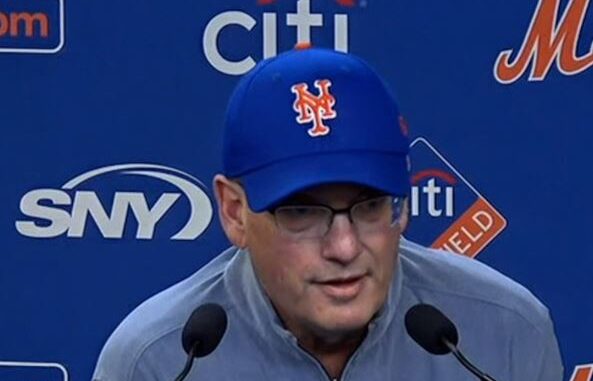
Kodai Senga has found an entertaining way to change the narrative surrounding his season. With Michael Jackson songs such as “Smooth Criminal” and “Beat It” accompanying him to the mound, Senga has quickly become one of the more intriguing stories in the New York Mets’ bullpen. More importantly, his recent performances are giving fans a reason to believe that his transition into the closer role could actually work.
Senga’s transformation also provides a useful lesson for several other Mets players who have struggled to meet expectations in 2026. Unlike Senga, however, these players will need more than a memorable entrance song to repair their reputations. Some need a strong finish to the season, others need to prove they still have a role on the roster, and a few may have to wait until 2027 for their redemption opportunity.


Sean Manaea has already begun his own attempt to change the perception surrounding his season, but several other Mets players still have plenty to prove before the year ends.
Mark Vientos — Make Left-Handed Pitchers Pay
Mark Vientos’ future with the Mets appears increasingly uncertain. With the roster becoming crowded and his defensive limitations continuing to complicate his path to regular playing time, it is difficult to envision him returning as a major piece in 2027.
Still, Vientos has one potential avenue to improve his standing: continue punishing left-handed pitching.
He has been particularly effective against southpaws this season, batting .281 with a .316 on-base percentage and a .539 slugging percentage against them. Six of his 11 home runs have also come against left-handed pitchers. Those numbers show that there is still a useful offensive weapon hiding inside his inconsistent season.
If Vientos can return from the injured list and consistently produce against lefties, he could make himself more attractive to another club—or at least give the Mets a reason to believe he still has trade value. His defensive problems, particularly at first base, remain significant, but a productive offensive specialist could still have value.
Brett Baty — Find One Offensive Skill and Master It
Brett Baty’s career has reached another critical point. The former highly regarded prospect has struggled to establish himself as a dependable major league hitter, and his 2026 offensive numbers have done little to silence the doubts surrounding his future.
The problem is not necessarily that Baty lacks talent. It is that he has yet to consistently excel in one particular area.
He does not need to suddenly become a superstar to change the conversation. A strong finish built around one dependable skill could be enough. He could demonstrate legitimate power, raise his batting average, or become a significantly more disciplined hitter who consistently gets on base.
Baty showed during his hot finish in 2025 that he is capable of putting together productive stretches. What the Mets need now is evidence that those flashes can become something sustainable. Even one clear offensive strength would make his future easier to evaluate.
Marcus Semien — Give the Mets a Gold Glove-Level Season in 2027
There may not be much Marcus Semien can do during the remainder of 2026 to completely erase the disappointment surrounding his season. Expectations were high when the Mets brought him aboard, and his defensive performance has not matched the standard associated with his reputation.
The good news is that Semien is expected to remain with the Mets into 2027, giving him another opportunity to change the story.
A Gold Glove-caliber campaign next season would go a long way toward repairing the perception of the trade. The Mets have not had a Gold Glove winner at the position in a while, and Semien delivering elite defense would provide tangible value even if his offensive production remains inconsistent.
It is a long-term redemption plan rather than an immediate solution, but Semien has the experience and track record to make it realistic.
Devin Williams — Stop Making Fans Search for the Positives
Devin Williams has made his 2026 season unnecessarily difficult to defend.
His 4.66 ERA with the Mets is only slightly better from a run-prevention standpoint than what he produced with the New York Yankees last season. His overall value has also declined, with his bWAR sitting at -0.6 compared with -0.3 last year.
And yet, there are still signs that the pitcher everyone remembers is somewhere underneath the ugly results.
His 3.09 FIP suggests that his underlying performance has been considerably better than his ERA indicates. Unfortunately, that is not enough when opposing hitters are consistently finding success against him. Williams has surrendered roughly 10 hits per nine innings and owns a troubling 1.65 WHIP.
For Williams, redemption is simple: make the good numbers visible again.
Instead of forcing fans to dig through advanced statistics to explain why he might still be effective, he needs to deliver dominant innings, limit baserunners and consistently protect leads. The Mets did not acquire him to be a statistical mystery. They acquired him to be a reliable late-inning weapon.
Bo Bichette — Eliminate Every Remaining Doubt
Bo Bichette’s season is perhaps the most difficult to summarize because it has contained both encouraging and deeply disappointing stretches.
His opening months were poor enough that a complete statistical rescue is probably impossible at this point. However, Bichette has shown signs of improvement and has been putting together another productive month.
That late-season progress matters because the Mets need to determine whether Bichette can genuinely be part of their long-term solution.
There is no single statistic that will define his redemption. He needs to look comfortable at third base, produce consistently in the middle of the batting order and provide meaningful protection around Juan Soto. More than anything, Bichette has to make his presence feel necessary.
The Mets do not need him to finish the year with video-game numbers. They need him to eliminate the uncertainty surrounding whether he belongs in their plans beyond 2026.
If Bichette can finish strongly, he could enter the offseason with considerably more confidence from the organization and the fan base.
Jorge Polanco — Embrace a Smaller Role and Excel at It
Jorge Polanco probably should not enter 2027 expecting to be an everyday starter for the Mets. Given his recent performance, relying on a major bounce-back as the foundation of the roster would be a risky strategy.
That does not mean Polanco has no value.
His best opportunity for redemption could come from accepting a reduced role and becoming genuinely useful off the bench. As a switch-hitter, he can provide flexibility and potentially serve as an alternative to Jared Young depending on how the Mets construct their roster.
Polanco does not need to become an All-Star. He needs to become dependable.
If he can provide quality at-bats, contribute against certain pitching matchups and handle multiple positions when needed, the Mets could still find a practical role for him. By the end of 2027, describing Polanco as a reliable part-time contributor would represent a much more positive outcome than the expectations surrounding him today.
The Mets Have Plenty of Redemption Stories to Watch
Senga has shown that a player can dramatically change the narrative with the right combination of confidence, performance and opportunity. His music may have helped create the atmosphere, but ultimately, his pitching is what is winning people over.
The same principle applies to the rest of the Mets.
Vientos needs to turn his success against lefties into trade value. Baty needs to establish one dependable offensive skill. Semien needs to rediscover his defensive excellence. Williams must turn promising underlying metrics into actual results. Bichette needs to remove the uncertainty surrounding his future, while Polanco needs to embrace a role that matches his current value.
None of them needs Michael Jackson to save the day. They simply need to give Mets fans something tangible to believe in before the 2026 season disappears and, for some, before the organization makes important decisions about 2027.
Leave a Reply