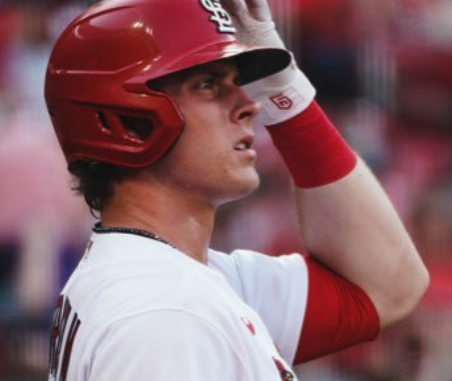
Nolan Gorman’s future with the St. Louis Cardinals has become one of the more intriguing questions surrounding the organization as the 2026 season moves into its final stretch. The former first-round pick was demoted to Triple-A Memphis on June 11 after enduring an extended offensive collapse, but his recent resurgence in the minors has reopened the possibility of another opportunity in St. Louis.
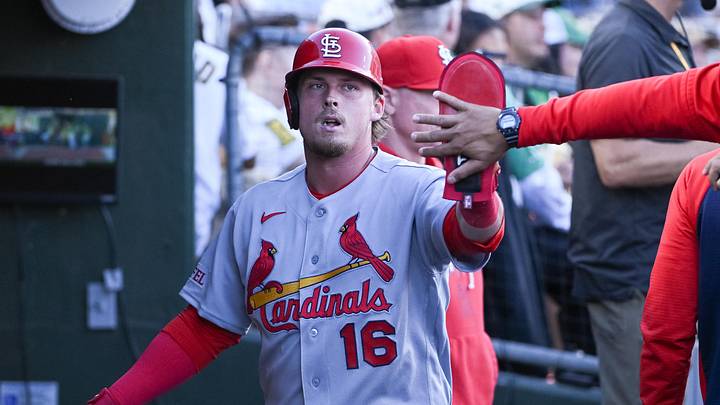
Gorman’s demotion came after an especially difficult stretch at the plate. Between May 20 and June 11, he went just 3-for-55, producing an alarming 49.1% strikeout rate and a -22 wRC+ over 17 games. With his confidence and swing mechanics clearly out of sync, the Cardinals decided that simply keeping him in the major-league lineup was no longer the best option for either the player or the team.
In his absence, St. Louis turned primarily to Blaze Jordan at third base. Jordan has provided respectable defense and some stability, but his offensive production has been limited. He has posted a .255/.279/.372 slash line with only one home run, which came in just his second major-league game, and his .651 OPS remains below the level expected from a productive everyday corner infielder.
Defensively, however, Jordan has exceeded expectations. His +4 Outs Above Average indicates that he has been a valuable defender at the position. He has also avoided striking out at an impressive 13.6% rate, although his 3.2% walk rate shows how little pressure he puts on opposing pitchers. His 34.7% chase rate is another area the Cardinals will likely want him to improve, particularly if he is expected to have a larger role in the future.
Jordan has also displayed a significant platoon split. Against left-handed pitching, he has produced a 122 wRC+, while his performance against right-handers has fallen to just 52 wRC+. That disparity makes him more attractive as a complementary or platoon option than as an unquestioned everyday third baseman.
Jose Fermin has also spent considerable time at third base while moving around the diamond. His overall .240/.307/.359 line does not immediately jump off the page, but his approach at the plate has been one of his more encouraging qualities. Fermin owns a 21.9% chase rate, a 13.9% whiff rate and a 12.9% strikeout rate, all signs that he generally controls the strike zone well.
The problem is that Fermin does not provide enough impact with his contact to project as a long-term answer at third base. His bat speed, hard-hit percentage and expected slugging remain below league-average levels. His versatility is valuable, but his best fit may ultimately be as a utility player capable of filling multiple positions rather than as a primary offensive weapon.
That leaves the Cardinals with a fairly obvious question: if Jordan and Fermin are primarily depth or complementary options, where does Nolan Gorman fit into the picture?
JJ Wetherholt should remain at second base. His defensive ability and overall impact up the middle make him significantly more valuable there than they would be at a corner position. The Cardinals should allow him to continue developing into what they hope can become one of baseball’s premier second basemen.
Other internal options also come with significant limitations. Bryan Torres lacks the arm strength and quality of contact necessary to project as an ideal everyday third baseman, while Cesar Prieto has primarily looked like a second baseman defensively and has yet to record a hit in his 26 plate appearances in 2026. Ramon Urias could eventually return from injury, and a defense-first, Gold Glove-caliber third baseman who performs better against left-handed pitching can certainly have value, but that profile alone does not solve the Cardinals’ larger offensive problems.
Most of those players therefore appear to be depth pieces rather than definitive answers.
That is where Gorman becomes particularly important.
After being optioned, Gorman spent more than a week at the Cardinals’ revamped spring-training facility in Jupiter, Florida. During that period, the organization worked with him on changes to his swing mechanics, approach and attack angle. The program reportedly resembled the developmental process used with prospect Joshua Baez before Baez experienced his own offensive breakthrough.
Gorman understandably struggled when he first arrived in Memphis while attempting to incorporate those changes during the season. Over his first 18 games, he hit just .113/.304/.274, struck out 41% of the time and produced a 61 wRC+.
But the story has changed considerably since July 18.
Gorman has begun to show signs that the mechanical adjustments are translating into actual production. Over a 17-game stretch, he has hit .230/.347/.590, good for a .937 OPS, a massive .361 isolated power mark and a 133 wRC+. His 30.6% strikeout rate remains a concern, but the fact that he has paired it with a 15.3% walk rate is encouraging.
The power is particularly significant.
Since Gorman was demoted on June 11, only Alec Burleson and Jimmy Crooks among Cardinals hitters have posted an ISO above the league-average mark of .140. Only Burleson and Wetherholt have produced an above-average wRC+ during that same period.
That highlights the central argument for giving Gorman another opportunity: even with his considerable flaws, he possesses a level of offensive upside that few of the Cardinals’ current third-base alternatives can match.
There is still no indication that a promotion is imminent. Reports suggest the Cardinals are not rushing Gorman back to St. Louis because there are still elements of his swing and approach that need additional refinement. His recent two-week surge is encouraging, but the organization appears determined to make sure the underlying adjustments are sustainable rather than simply reacting to a hot streak.
That patience makes sense.
If St. Louis had completely given up on Gorman, it is difficult to imagine the organization investing this much time and developmental energy into rebuilding his swing. Cardinals president of baseball operations Chaim Bloom has emphasized the importance of making the organization a place where struggling players can be developed and corrected rather than allowing talent to leave St. Louis and flourish elsewhere.
The organization has already seen examples of players benefiting from that approach. Jordan Walker and Andre Pallante are among the players who have shown improvement after receiving additional development and opportunities within the organization, while others such as George Soriano and Riley O’Brien illustrate the Cardinals’ broader attempt to maximize talent rather than immediately move on from it.
Gorman could ultimately become another test of that philosophy.
At some point, the Cardinals will have to make a decision. If he returns to St. Louis and demonstrates that the mechanical and approach changes have genuinely addressed his problems, the organization could have a legitimate middle-of-the-order power bat for the stretch run. If he struggles again, however, the Cardinals may finally have enough evidence to determine that a long-term relationship between Gorman and St. Louis is simply not going to work.
There is also an interesting developmental factor looming behind him.
Double-A infielder Jesus Baez has been one of the most impressive hitters in the Cardinals’ minor-league system this season. His emergence has led some evaluators to wonder whether he could eventually become the organization’s better Baez, a remarkable possibility considering the offensive ceiling attached to Joshua Baez.
That does not necessarily mean Gorman has no future in St. Louis. Instead, it could mean his role becomes more complicated. If the Cardinals successfully rebuild his value and Jesus Baez continues progressing toward the majors, Gorman could eventually become a valuable trade asset at a point when the younger prospect’s timeline better matches the organization’s competitive window.
For now, though, the Cardinals have a reason to keep Gorman in the conversation.
Imagine a September lineup in which Gorman and Josh Baez are both contributing consistently. The top portion of the order could look considerably more dangerous:
- JJ Wetherholt — 2B
- Ivan Herrera — C/DH
- Alec Burleson — 1B
- Jordan Walker — RF
- Nolan Gorman — 3B
- Josh Baez — LF
- Jimmy Crooks / Pedro Pagés — C
- Masyn Winn — SS
- CF option
That lineup would provide considerably more power and offensive balance than the Cardinals have shown for much of the season. More importantly, it would give St. Louis multiple hitters capable of changing a game with one swing rather than relying almost entirely on contact and situational hitting.
The key phrase, however, is “a fixed Nolan Gorman.”

The Cardinals do not need the version of Gorman who struggled to make consistent contact, chased pitches outside the zone and repeatedly found himself behind in counts. They need the version capable of combining his elite raw power with improved swing decisions, better contact quality and enough plate discipline to make opposing pitchers pay for mistakes.
His recent Triple-A production suggests that version may still exist.
Whether Gorman gets another opportunity in St. Louis will ultimately depend on whether the Cardinals believe the changes he is making are real, sustainable and capable of translating against major-league pitching. If they are, abandoning him now could mean giving up on one of the few players in the organization who still has the potential to significantly transform the offense.
For a Cardinals lineup that has lacked consistent power and impact for much of the summer, Gorman may not simply have a place on the 2026 roster—he may represent one of the organization’s most intriguing remaining offensive bets.
Leave a Reply