The Philadelphia Phillies are approaching a critical stretch of the 2026 season, and with the postseason picture becoming increasingly important, there is growing pressure for the organization to find another reliable pitching option. One increasingly popular solution is already within the organization: top prospect Gage Wood.
The Phillies entered the season with significant expectations and have received excellent work from the top portion of their rotation. Cristopher Sánchez, Zack Wheeler and Jesús Luzardo have provided the club with the kind of frontline pitching expected from a serious postseason contender. However, the situation becomes considerably less certain beyond those three starters.
That depth issue became especially noticeable because Philadelphia did not acquire the additional starting pitcher many expected at the Trade Deadline. With the team now trying to navigate the stretch run without that reinforcement, some analysts believe the Phillies should look internally and give Wood an opportunity.
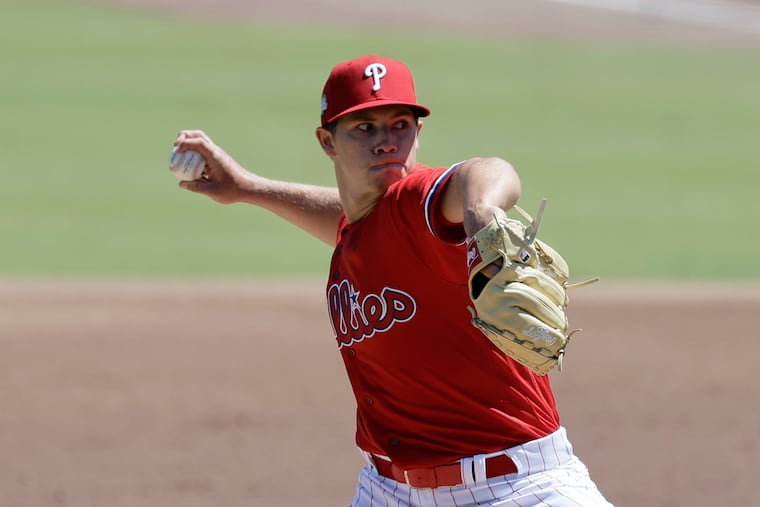
Wood has emerged as Philadelphia’s No. 1 prospect and is currently ranked No. 33 overall among prospects in baseball. Although he remains in Double-A, his combination of velocity, strikeout ability and developing secondary pitches has made him one of the most intriguing arms in the organization’s system.
Why Gage Wood is attracting attention
Wood’s overall minor-league statistics are not necessarily overwhelming on the surface. He has posted a 4.38 ERA through 21 starts this season. However, his underlying stuff has continued to attract considerable attention from scouts and prospect evaluators.
His fastball is regarded as one of the best pitches in the minor leagues and carries a 70-grade evaluation. The pitch can reach approximately 99 mph and features the kind of movement and life that can make it extremely difficult for hitters to square up.
Wood also possesses promising breaking and offspeed offerings. His slider, in particular, has been an area of development, and the improvement of that pitch could give him another weapon capable of generating swings and misses against major-league hitters.
His strikeout numbers are perhaps the most compelling reason for Philadelphia to consider an aggressive promotion. Across 76 innings between Low-A and Double-A, Wood has recorded 112 strikeouts while issuing only 25 walks.
At Double-A Reading, he has continued to miss bats at an impressive rate. His strikeout rate has been around 13 per nine innings, while his walk rate has remained relatively low at approximately 2.4 per nine. His overall miss rate at the level has also been strong.
Those numbers suggest that even though Wood’s ERA may not immediately jump off the page, his raw arsenal and ability to control the strike zone could make him a useful option in Philadelphia.
The Phillies’ rotation needs help
The argument for promoting Wood is largely connected to the Phillies’ current pitching situation.
Philadelphia’s first three starters have performed well, but Aaron Nola and Andrew Painter have created uncertainty behind them. Nola has shown signs of improvement recently, posting a 3.60 ERA over his last seven appearances, but his season-long ERA remains at 5.12.
Painter’s situation has been even more complicated. The highly regarded young pitcher has struggled to establish consistency and has posted a 6.43 ERA. His difficulties have resulted in multiple trips back to the minor leagues as Philadelphia continues to manage his development.
That leaves the Phillies with a significant question heading into the most important part of the schedule: who can consistently provide quality innings behind the club’s established frontline starters?
Wood could potentially provide an unconventional answer.
Wood may not necessarily need to start
Interestingly, the Phillies would not necessarily have to immediately insert Wood into the starting rotation.
One possibility would be using him out of the bullpen, where his high-end fastball could become even more dangerous. His velocity could potentially increase when he is asked to throw shorter outings, possibly pushing his fastball beyond 100 mph.
That could make him a particularly intriguing weapon in high-leverage situations.
Instead of asking Wood to provide five or six innings every fifth day, Philadelphia could initially deploy him for one or two innings at a time. Such a role would allow the Phillies to take advantage of his elite stuff while limiting the workload placed on a young pitcher who is still developing.
His injury history and carefully managed workload could also make a bullpen role more practical than immediately throwing him into a major-league starting rotation.
The Phillies could use Wood as a traditional reliever, a multi-inning weapon, an opener or even a spot starter when necessary.
Philadelphia’s bullpen provides another reason
The bullpen is another area where Wood could potentially make an immediate difference.
Philadelphia ranks around the middle-to-lower portion of MLB in bullpen ERA, and the club’s trade-deadline efforts have not completely solved the problem.
Brooks Raley was brought in to strengthen the relief corps, but his early results in Philadelphia have been underwhelming. He has posted a 4.05 ERA in seven appearances with the Phillies after producing a much stronger 1.96 ERA with the Mets earlier in the season.
That inconsistency has left Philadelphia searching for additional reliable options.
A pitcher with Wood’s velocity and strikeout potential could therefore become an intriguing addition to the late-inning mix. If he adapts quickly, the Phillies could potentially have another power arm capable of handling difficult situations against dangerous hitters.
The biggest risk is development
There is, however, a legitimate argument against rushing Wood to the majors.
He is still pitching at Double-A and has not accumulated extensive experience at the upper levels of the minor leagues. His 4.38 ERA also indicates that he has not completely dominated his competition despite his impressive strikeout numbers.
Promoting him now could expose him to major-league hitters before his command and secondary pitches are fully developed.
There are also concerns about workload management. Wood has been used carefully this season, beginning the year in Single-A before being aggressively promoted to Double-A. The Phillies have intentionally kept his outings relatively short as they gradually increase his workload.
That development plan suggests the organization still views him primarily as a long-term pitching asset rather than an immediate emergency solution.
A premature promotion could potentially interfere with that carefully designed progression.
Why the playoff race changes the equation
Under normal circumstances, Philadelphia might have little reason to accelerate Wood’s development. But the Phillies are not simply playing for the future. They are attempting to compete for a postseason berth right now.
That changes the calculation.
If the Phillies believe their current roster is capable of making a deep playoff run, adding another high-upside arm could provide an important advantage. Wood does not necessarily need to become a traditional starter immediately. Even a limited bullpen role could give the club another weapon during the final weeks of the season.
The idea is essentially to maximize what Wood already does well rather than ask him to become a finished product overnight.
His elite fastball, developing slider, ability to generate strikeouts and relatively strong control could make him difficult for major-league hitters to handle in short appearances.
The Phillies have a difficult decision
Ultimately, Philadelphia must decide whether the potential benefit of promoting Wood now outweighs the developmental risks.
Keeping him in Double-A would allow the organization to continue building his workload and refining his secondary pitches. Calling him up, meanwhile, could provide the major-league club with an explosive arm during a postseason race where every game carries additional significance.
The Phillies’ need for pitching makes the decision even more compelling. Their top starters have performed at a high level, but the uncertainty behind them remains one of the team’s biggest potential weaknesses.
Wood could potentially address that weakness without requiring the Phillies to make another trade.
For now, the decision remains with the organization. But as Philadelphia enters the most important portion of its season, the argument for giving its No. 1 prospect a chance at the major-league level is becoming increasingly difficult to ignore.
Leave a Reply