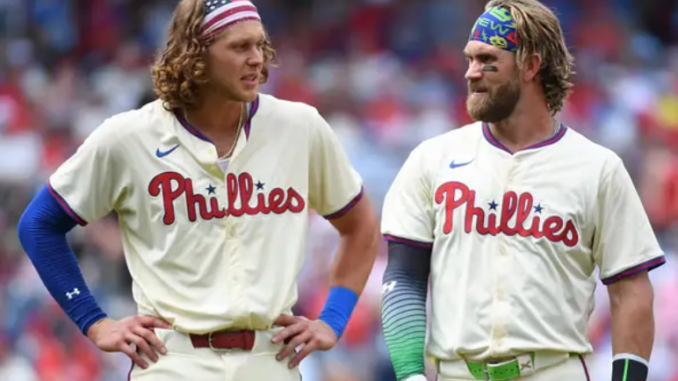
The Philadelphia Phillies’ decision to rearrange their infield and outfield following the acquisition of Luis Arraez has created a problem that could become far more damaging than the lineup upgrade was intended to solve. Instead of simply improving the offense, the roster shuffle has forced Bryce Harper back into the outfield, raised concerns about his physical workload and continued to prioritize Alec Bohm despite his disappointing 2026 production.
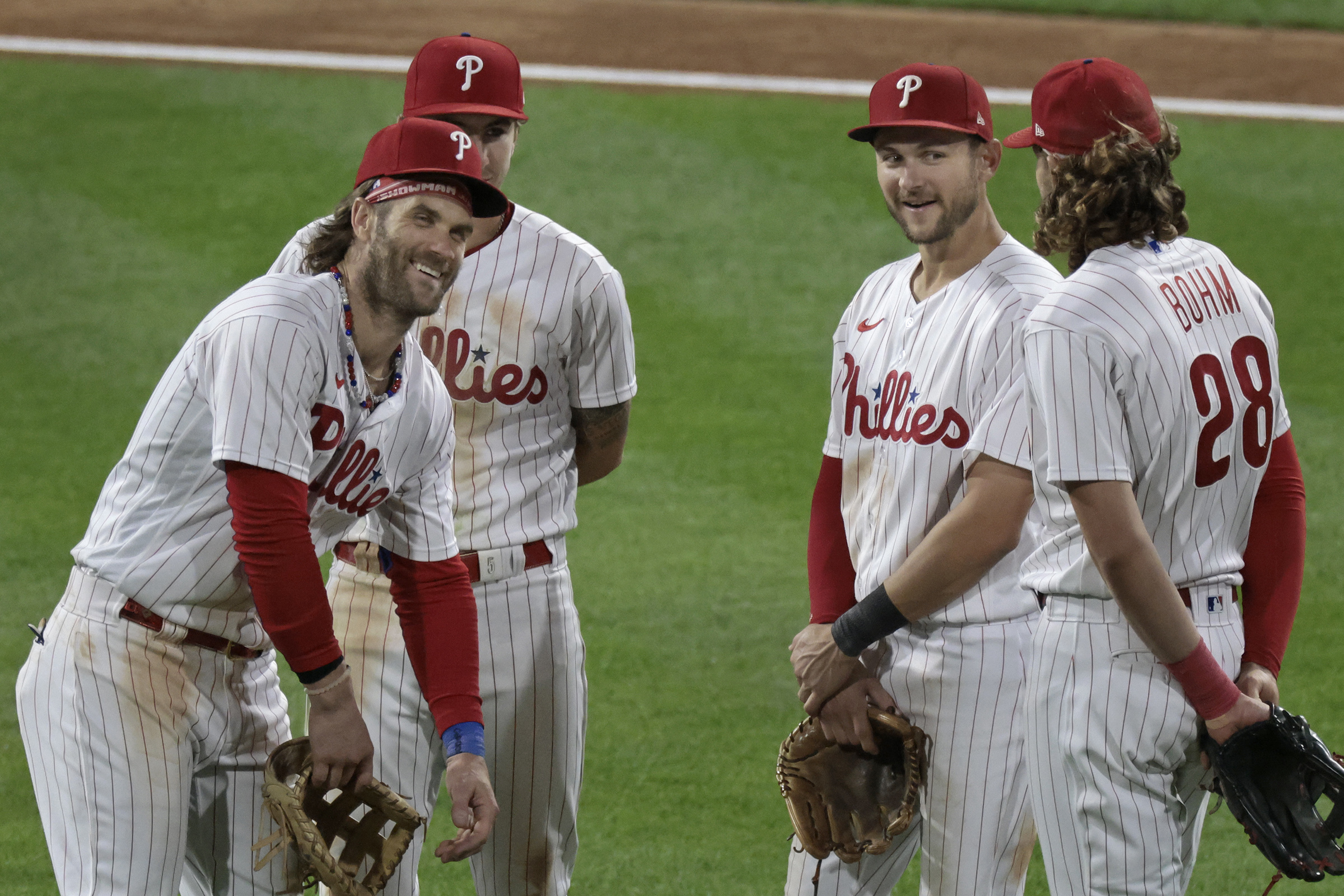
The central question surrounding Philadelphia is becoming increasingly difficult to ignore: Why are the Phillies willing to compromise the comfort and health of one of their most important players simply to keep Bohm in the starting lineup?
Harper had not played the outfield since suffering an elbow injury in 2022. For more than three seasons, he has primarily handled first base, where he became a dependable part of the Phillies’ defensive alignment while allowing the organization to manage his workload more carefully.
At 33 years old and deep into his career, Harper is no longer the same explosive outfielder he was earlier in his career. His transition to first base made sense for both the player and the team, particularly after Rhys Hoskins’ departure. Harper had spent years patrolling right field, but moving him to first allowed Philadelphia to preserve his offensive value while reducing some of the physical demands associated with playing the outfield every day.
The Phillies’ outfield has remained one of the weaker areas of the roster, with Brandon Marsh experiencing stretches of inconsistency and the organization cycling through players such as Johan Rojas, Max Kepler and Adolis García. Despite those concerns, Harper’s return to the grass appeared unlikely because Philadelphia had effectively built its roster around him remaining at first base.
That changed when the Phillies acquired Arraez.
The three-time batting champion was brought in to inject more contact and offensive consistency into a lineup that had struggled to generate reliable production. Arraez is one of the game’s premier pure hitters, making the acquisition understandable from an offensive perspective. However, his defensive limitations meant Philadelphia had to find a new place for him while reshuffling several other positions.
The resulting chain reaction moved Bryson Stott from second base to third, shifted Bohm from third to first and sent Harper back to right field.
On paper, the move appeared to be a creative solution for incorporating Arraez into the lineup. In practice, however, the decision has created a much larger issue because of Bohm’s continued presence in the everyday lineup.
Bohm has struggled throughout the 2026 season, producing a .647 OPS that ranks last among Philadelphia’s regular hitters. After seven major-league seasons, the former third overall pick has yet to establish himself as the consistently productive middle-of-the-order bat the Phillies once envisioned.
Despite those struggles, Bohm has continued to receive prominent opportunities, including regular appearances in the cleanup spot.
That decision has become increasingly difficult to justify.
The arrival of Arraez should have provided Philadelphia with an opportunity to remove its least productive regular hitter from the lineup while improving the overall offensive balance. Instead, the Phillies have kept Bohm involved, essentially forcing the organization to sacrifice Harper’s preferred position to preserve Bohm’s role.
Since the trade deadline, Bohm has done little to make that decision look better. He has collected only five hits in his first 25 at-bats following the roster reshuffle, continuing an offensive slump that has made his place in the lineup increasingly controversial.
His struggles have become even more costly because Philadelphia has other options. Bryan De La Cruz has shown flashes of offensive ability and could have been given a larger opportunity rather than having his role reduced to accommodate Bohm.
The biggest concern, however, is now Harper.
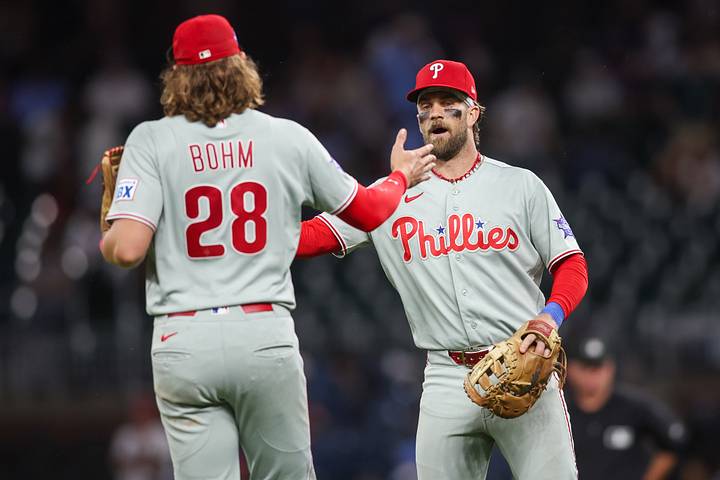
Moving him back into the outfield was always going to carry some risk, given how long he had been established at first base. That concern became more significant when Harper experienced knee soreness and was removed from the starting lineup against the St. Louis Cardinals.
Even if the issue proves minor, the situation should serve as a warning to Philadelphia.
The Phillies cannot afford to jeopardize Harper’s availability for the sake of keeping a struggling hitter in the lineup. Harper remains one of the franchise’s most important offensive players and one of the few hitters capable of dramatically changing a game. Any decision that increases his injury risk needs to be justified by a significant corresponding benefit.
Keeping Bohm in the lineup does not appear to provide that benefit.
Philadelphia’s offense has already experienced too many stretches of inconsistency, making Harper’s health even more important as the team pushes toward the postseason. Losing him for an extended period would create a much larger problem than whatever offensive value Bohm is currently providing.
The Phillies could have handled the Arraez acquisition differently.
Stott could have moved to third base, allowing Arraez to occupy second. Bohm could then have been moved to the bench while Harper remained at first base. Philadelphia could also have explored giving De La Cruz a more substantial role.
That alignment would have allowed the Phillies to add Arraez’s elite contact skills without requiring Harper to return to the outfield.
Instead, the organization chose the more complicated route.
The decision becomes even harder to understand when considering Bohm’s contract situation. He is scheduled to reach free agency after the season, meaning Philadelphia does not necessarily have a long-term reason to force him into the lineup. If the organization does not envision him as part of its future, prioritizing his playing time over the health and comfort of Harper becomes even more difficult to defend.
The Phillies are now approaching a critical point in their season. Their postseason ambitions remain alive, but the margin for error is shrinking. Offensive inconsistency, bullpen concerns and roster-management decisions have already created frustration among fans.
The Arraez acquisition itself was not the problem. In fact, bringing in a hitter of his caliber could ultimately prove to be one of Philadelphia’s most important moves. The problem is how the Phillies have chosen to accommodate him.
The organization now has to decide whether preserving Bohm’s role is worth the consequences.
If Harper’s knee soreness develops into a larger issue, the criticism surrounding the decision will only intensify. Philadelphia has spent years building its roster around Harper, and the idea of exposing its franchise cornerstone to additional physical stress simply to preserve a struggling player’s lineup spot could become one of the team’s most costly mistakes.
There is still time to correct course.
Phillies president of baseball operations Dave Dombrowski and interim manager Don Mattingly can still acknowledge that the current arrangement is not working. They can keep Harper at first base, allow Stott to remain at third, give Arraez the role he was acquired to fill and reduce Bohm’s playing time.
It would require admitting that the original plan was flawed, but the priority at this stage of the season should not be protecting reputations or preserving previous decisions. It should be maximizing the Phillies’ chances of making a deep postseason run.
Harper’s health has to take precedence.
The Phillies did not acquire Arraez to create another problem. They acquired him because their offense needed more consistency, contact and offensive pressure. If incorporating him into the lineup requires moving Harper into a position that increases his physical burden while continuing to play one of the team’s least productive hitters, then the roster construction has defeated its own purpose.
Philadelphia still has an opportunity to fix the situation before it becomes irreversible.
But the solution may require the organization to finally accept that Alec Bohm’s role needs to change. If the Phillies truly believe their World Series window is open, they cannot afford to compromise Bryce Harper’s health simply to keep an underperforming impending free agent in the starting lineup.
Leave a Reply