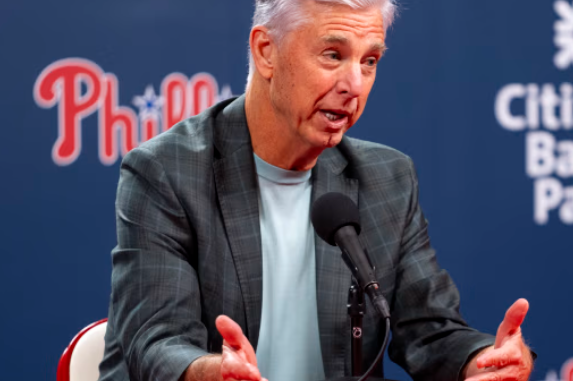
The Philadelphia Phillies entered the 2026 MLB trade deadline with clear objectives and a roster that many believed needed multiple upgrades to remain a legitimate World Series contender. By the time the deadline passed, president of baseball operations Dave Dombrowski had completed several respectable deals that strengthened portions of the roster. However, despite making a handful of quality acquisitions, many analysts believe the Phillies ultimately fell short of doing enough to maximize their championship aspirations.
Rather than making one blockbuster splash or aggressively filling every obvious weakness, Philadelphia settled for a series of targeted additions that improved the club in certain areas but left several significant concerns unresolved. The result was a deadline that featured few questionable trades individually, yet still left many wondering whether the front office missed an opportunity to truly elevate the team for the postseason race.
Luis Arraez Trade Provides Offensive Boost but Comes at a Significant Cost
Grade: B
Philadelphia’s biggest acquisition came when the club landed three-time batting champion Luis Arraez along with reliever Caleb Kilian from the San Francisco Giants. In exchange, the Phillies parted with highly regarded pitching prospect Ramon Marquez, one of the organization’s fastest-rising young arms, and pitching prospect Marty Gair.
The addition of Arraez immediately improves a lineup that has struggled with consistency throughout the season. While stars Bryce Harper and Kyle Schwarber have continued producing offensively, several other hitters have experienced lengthy slumps, including Brandon Marsh, whose strong first half has been followed by declining production.
Arraez brings one of baseball’s most dependable bats to the top of Philadelphia’s lineup. Known for his elite contact skills, exceptional batting average, and ability to consistently reach base, he gives the Phillies a true table-setter capable of creating more scoring opportunities for the middle of the order. His arrival also lengthens the lineup and provides much-needed balance for an offense that too often relied on home runs rather than sustained rallies.
Caleb Kilian could also become a valuable addition. The 29-year-old reliever has quietly enjoyed a breakout season and could emerge as another reliable late-inning option if he continues pitching at his current level.
Still, the trade required Philadelphia to surrender one of its brightest pitching prospects. Marquez had developed into one of the most exciting young arms in the organization after posting a remarkable 1.68 ERA across two levels of the minor leagues. His rapid rise had begun generating discussion that he could soon become one of baseball’s top-ranked pitching prospects.
Although giving up a potential frontline starter is never easy, many believe Arraez’s offensive impact justifies the aggressive price, particularly considering the Phillies’ shrinking championship window.
Brooks Raley Fills Critical Bullpen Need
Grade: A-
Among Philadelphia’s most important deadline moves was the acquisition of veteran left-handed reliever Brooks Raley from the New York Mets.
The Phillies had desperately needed another dependable left-handed arm throughout the season. Former All-Star José Alvarado has struggled badly after previous success, while veteran Tim Mayza has failed to provide reliable production. The lack of trustworthy left-handed options frequently limited manager Don Mattingly’s flexibility during late-game situations.
Raley immediately solves much of that problem.
Despite being 38 years old, the veteran southpaw has enjoyed one of the finest seasons of his career, compiling a sparkling 1.96 ERA over more than 41 innings while recording nearly one strikeout per inning. His ability to retire both left-handed and right-handed hitters gives Philadelphia another dependable bridge to closer Jhoan Duran during the final innings.
Perhaps even more impressive was the relatively modest price the Phillies paid. Philadelphia surrendered outfield prospect John Spikerman and pitcher Luke Gabrysh, neither of whom ranked among the organization’s elite prospects.
Spikerman offers speed and strong defense but projects more as a fourth outfielder than an everyday starter. Gabrysh, meanwhile, has struggled to establish himself in High-A and appeared unlikely to become a major contributor in Philadelphia’s long-term plans.
Given Raley’s production and the Phillies’ pressing bullpen needs, this transaction is widely viewed as one of Dombrowski’s strongest moves.
Colby Thomas Deal Represents a Low-Risk Gamble
Grade: C+
Philadelphia also completed a change-of-scenery trade with the Athletics, acquiring outfielder Colby Thomas in exchange for former first-round pick Seth Johnson.
Neither player had firmly established himself at the major league level, making the deal more of a developmental gamble than an immediate upgrade.
Thomas has displayed athleticism, speed, and defensive ability, but offensive inconsistency has prevented him from becoming a regular major leaguer. His career batting line in the majors remains underwhelming, though his impressive Triple-A production suggests there is still untapped offensive potential.
Because Thomas still has multiple minor league options remaining, the Phillies gain roster flexibility while evaluating whether he can eventually become a useful contributor.
Johnson, meanwhile, had struggled to capitalize on repeated opportunities in Philadelphia. Despite possessing quality raw stuff, the former first-round draft pick consistently failed to translate his talent into major league success, posting disappointing numbers throughout the season.
For Philadelphia, moving on from Johnson in exchange for an athletic outfielder with upside represented a reasonable gamble, even if the trade is unlikely to dramatically impact the team’s postseason hopes.
Minor Deal Adds Organizational Pitching Depth
Grade: C-
The Phillies also completed a relatively minor transaction by sending veteran reliever Nolan Hoffman to the Kansas City Royals for 19-year-old pitching prospect Manuel Colon.
Hoffman had spent years working through the minor leagues but never established himself as a consistent major league contributor. At nearly 29 years old, he no longer projected as a meaningful part of Philadelphia’s future.
Colon, meanwhile, remains an intriguing but raw developmental project. Although his early professional numbers have been inconsistent, the young Dominican pitcher still possesses time to refine his skills within Philadelphia’s farm system.
While neither player is expected to make an immediate impact, the deal gives the Phillies another young arm to develop without sacrificing an important piece of the current roster.
Where the Phillies Fell Short
Although each individual trade made logical sense, criticism of Philadelphia’s deadline centers far more on what the organization failed to accomplish than on the moves it actually completed.
The Phillies entered the deadline with multiple obvious weaknesses.
The outfield remained one of the club’s biggest concerns, particularly the lack of a reliable right-handed hitter capable of consistently producing against left-handed pitching. Several quality outfielders changed teams before the deadline, including Taylor Ward, yet Philadelphia never landed the impact bat many believed the lineup desperately needed.
The starting rotation also continues to carry significant uncertainty behind its front-line starters. While the Phillies possess elite arms at the top of the rotation, questions remain regarding the fourth and fifth spots. Veteran Aaron Nola has struggled to regain his previous form, while highly regarded prospect Andrew Painter is still developing into a dependable major league starter.
Several proven starting pitchers reportedly became available during deadline discussions, yet Philadelphia declined to pursue another established arm.
Overall Assessment
Overall Grade: D
The Phillies unquestionably improved their roster.
Arraez gives the offense another elite hitter capable of transforming the top of the lineup. Raley significantly strengthens the bullpen. Thomas offers intriguing upside, while the Colon acquisition adds organizational depth.
The problem is that those improvements may not be enough.
Philadelphia still enters the final months of the regular season with lingering weaknesses in both the lineup and the rotation. Compared to fellow National League contenders including the Los Angeles Dodgers, Atlanta Braves, and Chicago Cubs, all of whom made aggressive deadline additions—the Phillies appear to have done considerably less to strengthen their postseason chances.
With an aging core and limited opportunities remaining to capture another championship, many expected Dombrowski to push all his chips to the center of the table. Instead, the front office opted for a measured approach that made the team incrementally better without fundamentally changing its outlook.
The Phillies leave the trade deadline as an improved club compared to where they started, but many observers believe they missed a valuable opportunity to transform themselves into one of baseball’s clear championship favorites. Whether Dombrowski’s conservative strategy proves wise or costly will ultimately be determined once October baseball begins.
Leave a Reply