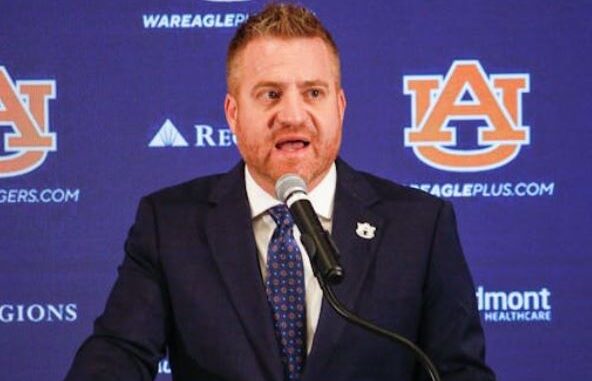
Alex Golesh is heading back to Knoxville, but this time he will not be standing on the Tennessee sideline. The Auburn head coach will return to Neyland Stadium on Saturday as the leader of the Tigers, facing the program where he helped build one of the most productive offenses of the Josh Heupel era. The reunion adds an intriguing personal storyline to an important SEC matchup, but Golesh has made it clear that his focus is on Auburn’s development rather than the emotion surrounding his return.
Auburn enters the matchup at 3-1 overall and 1-1 in SEC play after defeating Vanderbilt 21-15. Tennessee is also 3-1, but the Volunteers are coming off a narrow 20-17 loss to No. 1 Texas. That result gives Tennessee an immediate opportunity to respond, while Auburn is preparing for its first true road game of the season. The Tigers have shown encouraging signs during Golesh’s first season, but their trip to Neyland represents a substantially different environment and another test of whether the new program can execute away from home.
Golesh and Heupel: From Mentor and Assistant to SEC Opponents
The most compelling part of the matchup is the relationship between Golesh and Heupel. Golesh worked with Heupel at UCF before following him to Tennessee, where he served as offensive coordinator and tight ends coach during the 2021 and 2022 seasons. During his second season in Knoxville, Golesh was a finalist for the Broyles Award, which recognizes college football’s top assistant coach. He later left Tennessee for South Florida, where he spent three seasons as head coach before Auburn hired him following the 2025 season.
Golesh has been particularly complimentary of Heupel while discussing the reunion. He credited his former boss with giving him an opportunity in 2020 and helping shape the way he thinks about offensive football and running a program. Golesh also described Heupel as an important mentor, leader and friend who supported him as he pursued his first head-coaching opportunity. Despite the personal connection, however, Golesh emphasized that Saturday’s objective is straightforward: Auburn must prepare to beat Tennessee.
That familiarity also extends beyond the two head coaches. Several members of Auburn’s current staff previously worked alongside Heupel and other Tennessee coaches. Heupel acknowledged that the crossover works both ways, meaning neither side should expect the coaching familiarity to provide an overwhelming advantage. Both staffs understand elements of the other’s philosophy, but several years have passed since Golesh was calling plays in Knoxville, and both programs have changed substantially since then.
Golesh Is Trying to Keep Auburn Focused on the Process
One of the strongest themes from Golesh’s comments ahead of the Tennessee game was his insistence that Auburn cannot become distracted by the magnitude of the occasion. Neyland Stadium will provide the Tigers with their first genuine road environment of the season, but Golesh does not want his players obsessing over the crowd, travel or the emotional element of facing his former program.
Instead, he wants Auburn to remain focused on fundamentals, preparation and execution.
That philosophy has been central to Golesh’s first season. From the beginning of his tenure, he has repeatedly spoken about establishing an Auburn identity based on physical and mental toughness, attention to detail, player leadership and winning the small moments that decide close games. Auburn’s official preseason messaging similarly emphasized that Golesh wants to establish a foundation that can continue developing beyond his first season.
The Vanderbilt game provided both encouragement and evidence that Auburn still has work to do. Golesh praised the team’s effort and credited the Tigers’ special teams for making major plays, including a blocked punt returned for a touchdown and a blocked field goal. But he also pointed to missed tackles, problems in short-yardage situations and inconsistencies in the running game as areas requiring immediate improvement.
Auburn’s Defense Has Become a Major Part of the Story
Although Golesh arrived at Auburn with an offensive reputation, the Tigers’ defense has quickly become one of the more notable parts of the team’s early-season identity.
Auburn entered Tennessee week with 29 tackles for loss, fourth in the SEC and tied for 16th nationally. The Tigers also had five interceptions, placing them third in the conference. Defensive coordinator DJ Durkin has helped establish an aggressive unit capable of creating negative plays and putting opposing offenses behind schedule.
The challenge now is whether Auburn can combine that disruption with more consistent tackling. Golesh acknowledged that the Tigers missed 16 tackles for 68 yards against Vanderbilt. Some of those misses came in difficult one-on-one situations in space, but he stressed that Auburn cannot repeatedly allow missed tackles to turn into explosive plays.
That becomes especially important against Tennessee.
Heupel’s offense is built around tempo, spacing and forcing defenses to make decisions quickly. Tennessee’s receivers have the speed to punish defensive mistakes, while the Volunteers’ quarterback can create additional problems as a runner. Golesh knows that Auburn cannot simply rely on pressure; the Tigers must also maintain discipline once Tennessee’s offense gets into space.
Tennessee’s Young Quarterback Becomes Another Key Battle
For Tennessee, much of the attention will be on freshman quarterback Faizon Brandon.
Brandon struggled at times during Tennessee’s 20-17 loss to Texas, but Heupel has continued to emphasize his confidence in the young quarterback’s ability to develop. Heupel acknowledged that Brandon needs to improve in certain situations, particularly when opportunities are available downfield, while also stressing that the players surrounding him must execute at a high level.
Golesh offered a similarly detailed assessment of Brandon. He pointed to the quarterback’s arm talent, intelligence, quick decision-making and ability to make plays with his legs. Auburn therefore expects Brandon to be a significant part of Tennessee’s rushing threat in addition to his responsibilities as a passer.
That creates a difficult assignment for Auburn’s defense. The Tigers must account for the running backs while also preventing Brandon from escaping the pocket and creating extra yards. Heupel similarly noted that Auburn’s running game features a quarterback component, making defensive alignment and gap discipline especially important.
Auburn’s Running Game Could Decide Its Offensive Ceiling
Another major concern for Golesh is Auburn’s rushing attack.
The Tigers have been inconsistent on the ground at times, particularly early in games. Against Vanderbilt, Golesh said Auburn occasionally forced the running game instead of allowing the offense to develop naturally. He also pointed to small technical issues involving blocking angles and execution that prevented plays from producing more yardage.
However, Auburn eventually found a way to finish the game with the running attack. With Vanderbilt still within one score late, the Tigers continued to run the ball and eventually produced an important late drive that helped them protect the lead. Jeremiah Cobb’s ability to get around the edge, aided by a strong block from Keshaun Singleton, became one of the key moments.
Golesh also continues to consider how much designed rushing responsibility should be given to quarterback Byrum Brown. Brown brings a dual-threat dimension to Auburn’s offense, and Golesh believes his ability to create yards independently can sometimes be more valuable than a designed quarterback run. At the same time, Auburn has to balance that weapon with the need to protect its quarterback throughout a long SEC season.
The Familiarity Factor Could Make the Game Even More Interesting
Golesh believes the familiarity between the programs could cause both coaching staffs to think twice about certain decisions, but he does not expect either team to completely reinvent itself because of what the opponent knows.
That is particularly relevant offensively. Tennessee knows many of the concepts associated with Golesh’s system, while Auburn has a good understanding of Heupel’s offensive philosophy. But Golesh noted that four years of evolution have changed both sides.
Personnel has changed. Schemes have evolved. Coaches have developed new ideas. And the Auburn offense Golesh runs today is not identical to the system he operated in Knoxville.
His broader offensive philosophy has remained centered on putting players in advantageous situations, using formations and motion to create favorable matchups and adjusting the system according to the strengths of the personnel. That evolution is one reason Golesh does not believe familiarity alone will determine the outcome.
A Major Test for Golesh’s First Auburn Season
The Tennessee game therefore represents much more than a sentimental homecoming for Golesh. It is Auburn’s first true road test, its first opportunity to demonstrate that its new identity can survive in a hostile SEC environment and another chance for the Tigers to show how quickly the program is developing under its first-year coach.
Tennessee has its own reasons for treating the game as important. The Volunteers are trying to respond after their narrow loss to top-ranked Texas, while Heupel’s offense must find more consistency after struggling to produce against one of the country’s strongest defenses. Tennessee also has to deal with an Auburn defense that has already demonstrated an ability to create pressure, tackles for loss and turnovers.
For Golesh, however, the message remains consistent: the Tigers cannot allow the storyline surrounding his return to Knoxville to become bigger than the football itself.
He knows Neyland Stadium. He knows Heupel. He knows several members of Tennessee’s staff. He knows the environment and understands the offensive philosophy on the other sideline.
But Saturday will be about whether Auburn’s players can execute.
The Tigers will need to protect Brown, establish the running game, tackle consistently in space, handle Tennessee’s tempo and survive the noise. Tennessee, meanwhile, will be looking for Brandon and its offensive line to respond after the Texas defeat while trying to avoid giving Auburn’s disruptive defense opportunities to control the game.
The result will provide another important piece of evidence about where both programs stand early in the 2026 season — and for Golesh, it will be the first time he walks into Neyland Stadium as an opposing head coach rather than one of the coaches helping build Tennessee’s offense.
Tennessee vs. Auburn is scheduled for Saturday at 3:30 p.m. ET at Neyland Stadium, with ESPN televising the game.
Leave a Reply