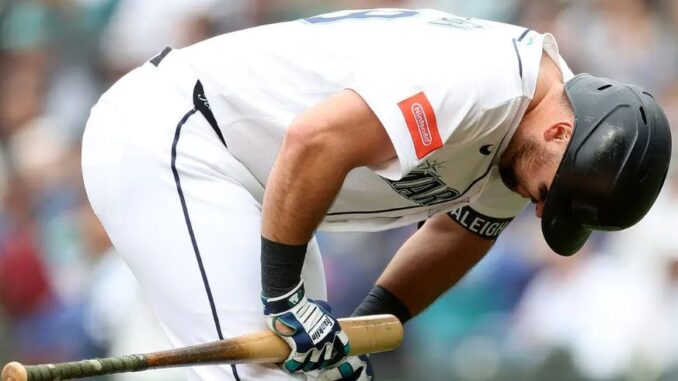
Cal Raleigh’s dramatic decline from one of baseball’s most feared power hitters to one of the league’s biggest offensive disappointments has become one of the most intriguing stories surrounding the Seattle Mariners. With Seattle set to face the Houston Astros on Sunday Night Baseball, Raleigh will be under a national spotlight as the Mariners attempt to rescue a season that has fallen well short of expectations.
Just one year ago, Raleigh was at the center of the American League MVP conversation. The Mariners catcher produced a historic offensive season, smashing 60 home runs, driving in 125 runs, stealing 14 bases and posting a .948 OPS while spending most of his time behind the plate.
His performance was so impressive that he received 13 first-place MVP votes, finishing second to New York Yankees superstar Aaron Judge by only 20 points. Judge collected 17 first-place votes and ultimately won the award 355-335.
Raleigh’s 2025 campaign was particularly remarkable because of the physical demands of his position. He appeared at catcher in 121 games and served as Seattle’s designated hitter in another 38, helping the Mariners win 90 games and finish atop the AL West. It was only the fourth time in franchise history that Seattle had finished first in its division.
Judge was extraordinary himself, batting .331 with a .457 on-base percentage, a .688 slugging percentage, 53 home runs, 124 walks and 137 runs scored. It required that kind of historic production to narrowly keep Raleigh from taking home the MVP trophy.
But the two leading candidates from 2025 have experienced very different problems this season. Judge’s 2026 campaign has been disrupted by a rib injury that has kept him out since May 31. Raleigh, meanwhile, has remained on the field but has struggled badly at the plate.
Through August 13, Raleigh had accumulated 371 plate appearances but had hit only 12 home runs. His home-run rate has plummeted from 8.5% last season to just 3.2% this year. His strikeout rate has risen considerably, while his walk rate and average exit velocity have both declined.
Most alarming of all is his batting average.
Raleigh is hitting approximately .159, putting him in historically poor territory for a hitter with significant playing time. Among players since 1996 with at least 300 at-bats, only a handful have posted similarly low batting averages, including Adam Dunn in 2011 and Joey Gallo in 2022.
That kind of offensive decline has also had consequences for Seattle.
The Mariners finished 2025 tied for ninth in Major League Baseball in runs scored, producing 766 runs at a rate of 4.7 per game. This season, however, Seattle has scored only 469 runs through the same point of the campaign, averaging roughly 3.84 runs per game and ranking last in the majors.
Raleigh has acknowledged that his own performance has been a major part of the problem.
After Seattle’s loss to the Yankees, Raleigh took responsibility for his struggles and admitted that he needs to find a way to improve while helping his teammates through the difficult stretch. His comments reflected the frustration surrounding a Mariners club that has struggled not only offensively but in several other areas of the game.
Seattle entered this season with expectations created by last year’s division-winning campaign, but the team has instead fallen to 57-65 and third place in the AL West. Raleigh’s downturn has been one of the most visible signs of that regression.
Is the Catcher’s Position Taking Its Toll?
There are several possible explanations for Raleigh’s decline. An oblique injury he suffered in May could have affected his swing. Others have pointed toward diminished bat speed or his difficulty handling high-velocity fastballs.
Another possibility deserves serious consideration: the physical toll of catching.
Catching is one of the most demanding positions in baseball. Catchers spend hundreds of innings crouching behind the plate, absorb foul tips and collisions, manage pitching staffs and deal with the physical wear that comes from playing nearly every day.
Baseball history provides plenty of examples of elite catchers experiencing dramatic swings in offensive production.
Hall of Famer Roy Campanella, for example, won three MVP awards but struggled to maintain his best offensive form for consecutive seasons. After hitting 41 home runs and batting .312 in 1953, Campanella’s production collapsed in 1954, when he hit just 19 homers, batted .207 and drove in 51 runs.
Johnny Bench experienced a similar downturn. After winning the 1970 MVP, Bench’s WAR dropped from 7.4 to 4.0 in 1971. His home-run total fell from 45 to 27, his RBI total dropped from 148 to 61, and his batting average declined from .293 to .238. He responded by returning to MVP form in 1972 with an 8.6 WAR season.
Carlton Fisk also demonstrated how quickly a catcher’s production can change. In 1986, Fisk posted -1.7 WAR with the White Sox, hitting 14 home runs in 491 plate appearances. The previous season, he had produced 37 home runs, 107 RBIs and 3.3 WAR. He rebounded again in 1987, recording 23 home runs and 3.1 WAR.
Javy Lopez provides another striking example. In 2002, the Braves catcher produced only 11 home runs and 0.2 WAR. One year later, he exploded for 43 home runs and 6.8 WAR, with his OPS+ jumping from 74 to an astonishing 169.
Even Joe Mauer experienced significant fluctuations in his power numbers. After hitting 28 home runs in 2009, Mauer dropped back to nine in 2010 despite receiving substantial playing time. His home-run percentage fell sharply, illustrating how quickly offensive production can change for catchers.
There are also examples of catchers whose breakout power seasons proved difficult to replicate. Todd Hundley hit 41 home runs in 1996, while Earl Williams hit 33 homers during his Rookie of the Year campaign in 1971. Charles Johnson also produced a spectacular 2000 season, hitting 31 home runs with a 5.1 WAR and 142 OPS+.
Those examples don’t prove that Raleigh’s 2025 campaign was a fluke, but they demonstrate how unpredictable offensive production can be for players handling the physical demands of catching.
Can Raleigh Recreate His Historic 2025 Season?
The biggest question facing Seattle is whether Raleigh’s current slump represents a temporary downturn or the beginning of a significant regression from his historic 2025 campaign.
There is no question that last season was extraordinary.
Raleigh became the first switch-hitter in MLB history to hit 60 home runs in a single season. He joined an exclusive group of players who have reached at least 60 home runs in a season, alongside Babe Ruth, Roger Maris, Mark McGwire, Sammy Sosa, Barry Bonds and Aaron Judge.
That accomplishment cemented Raleigh’s place in baseball history regardless of what happens next.
But his 2026 season has been almost the exact opposite of his 2025 campaign. His WAR has gone from above seven, which represents superstar-level production, to below one. His power has disappeared, his average has collapsed and his strikeout rate has increased.
The pressure is also different now.
Last season, Raleigh entered the year as a promising catcher and finished as one of the most dangerous hitters in baseball. This year, every slump is magnified because opponents know exactly what he is capable of producing. Expectations surrounding him have risen dramatically, and the burden of following a 60-homer season can be enormous.
The Mariners also need him more than ever.
Seattle’s offense has struggled throughout the season, and Raleigh is one of the few players in the lineup with the proven ability to change a game with one swing. If he can rediscover his power and begin consistently reaching base, the Mariners could receive a significant boost during their attempt to climb back into postseason contention.
The upcoming Sunday Night Baseball matchup against Houston therefore carries additional significance. Raleigh will have a national audience watching as he attempts to break out of perhaps the most difficult offensive stretch of his career.
Whether the problem is lingering physical wear, the demands of catching, mechanical adjustments, opposing pitchers attacking him differently or simply the natural volatility that comes with baseball, the answer remains unclear.
What is clear is that Cal Raleigh’s fall from an MVP runner-up and 60-homer superstar to a .159 hitter has been one of the most stunning developments of the 2026 MLB season.
The Mariners can only hope the history of great catchers offers a preview of what comes next: a dramatic slump followed by another resurgence. If Raleigh finds his swing again, Seattle could still have time to make its season interesting.
Leave a Reply