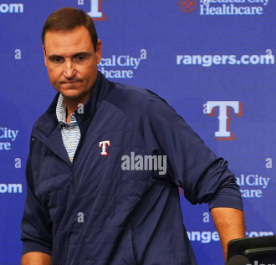
With the MLB trade deadline approaching on Aug. 3, uncertainty continues to surround the Texas Rangers’ plans. The defending contenders have yet to establish themselves as clear buyers or sellers, leaving president of baseball operations Chris Young with several difficult decisions over the coming weeks.
When asked recently about the club’s deadline strategy, Young declined to reveal his intentions. Instead, he emphasized the Rangers’ improved play in recent weeks, suggesting the organization is focused on evaluating its current roster before determining whether to make significant additions.
Despite the uncertainty, speculation around potential trade targets continues to grow. ESPN recently updated its list of the top 100 trade candidates, linking the Rangers to Boston Red Sox first baseman Willson Contreras as a possible fit. The veteran slugger would certainly add experience and offensive production, but acquiring him would also come with considerable financial and roster implications.
Here’s a closer look at why Texas should—and shouldn’t—pursue a trade for Contreras.
Why the Rangers Should Target Willson Contreras
One of the biggest reasons Contreras stands out as an attractive trade candidate is his remarkably consistent offensive production.
Few hitters have been as reliable over the past several seasons. Since transitioning from catcher to first base two years ago, Contreras has continued to provide the middle-of-the-order power that has defined his career while reducing the physical toll of catching.
Power remains one of his greatest strengths. He has now reached the 20-home run mark in four of the past five seasons, including once again in 2026. Already sitting at 20 home runs before the All-Star break, Contreras continues to demonstrate that his bat remains among the most productive at his position.
Beyond his home-run totals, Contreras also brings exactly the type of offensive profile Texas values.
His ability to consistently reach base would immediately strengthen the Rangers’ lineup. Entering this season, his career on-base percentage has never dipped below .339, and in 2026 he owns an outstanding .378 OBP. He combines patience with power, regularly drawing close to 50 walks per season while maintaining disciplined at-bats. Through 86 games this year, he has already earned 34 walks, giving Texas another hitter capable of extending innings and creating scoring opportunities.
Defensively, Contreras has also shown steady improvement since making the permanent move to first base.
Although he isn’t considered an elite defender, he has become a dependable option. After committing nine errors during the 2025 campaign, he has significantly cleaned up his defense this season with only three errors while improving his advanced defensive metrics. His glove now grades around league average, which is more than acceptable considering the offensive value he provides.
A trade could also create flexibility for Texas.
The Rangers could move current first baseman Jake Burger as part of the deal or potentially send him elsewhere to address another organizational need. Burger still possesses two additional years of team control, making him an attractive trade asset. However, Contreras would represent an upgrade in several offensive categories, particularly on-base percentage, plate discipline, and overall consistency.
If added to the lineup, Contreras could immediately slot into the third spot in the batting order, helping protect hitters like Josh Jung and Brandon Nimmo while giving opposing pitchers another dangerous bat they cannot easily work around.
Another appealing factor is contract control.
Contreras remains under team control beyond this season, giving the Rangers at least one additional year—and potentially two years—of production rather than simply renting a player for the remainder of the season.
Why Texas May Be Better Off Passing
Despite the obvious offensive upside, several factors could make the Rangers hesitate before making a deal.
The first concern is age.
Contreras is now 34 years old. While moving to first base should help prolong his career, history suggests many power hitters begin to decline during their mid-30s. Texas would have to determine whether his current production is sustainable or whether signs of offensive regression could begin appearing over the next couple of seasons.
The financial commitment also presents a significant obstacle.
Contreras is earning $18 million this season and is owed $17 million in 2027, with a $20 million team option for 2028 that includes a substantial $7.5 million buyout.
The Rangers have already reduced payroll over the past offseason and are expected to continue operating with financial discipline moving forward. Taking on Contreras’ contract could complicate future roster construction, especially if Boston is unwilling to absorb a meaningful portion of the remaining salary.
Ownership would also need to approve adding another sizable long-term contract, making the financial aspect nearly as important as the baseball fit.
Another reason for caution is Jake Burger’s continued development.
While Burger may not possess Contreras’ elite on-base skills, he has quietly produced a solid 2026 campaign. He is batting .246 with a .309 on-base percentage and a .432 slugging percentage while contributing 15 home runs and 53 RBIs.
Burger has already demonstrated his ability to produce nearly 30 home runs in a season, as evidenced by his 29-homer campaign with Miami in 2024. More importantly, he remains considerably less expensive than Contreras and is under team control for multiple seasons, making him a valuable long-term option.
The acquisition cost could ultimately be the biggest hurdle.
Boston would almost certainly demand far more than Burger alone in return. The Rangers would likely have to include either another major league-ready player plus one or more premium prospects, or package multiple Top-30 prospects to complete the trade.
Chris Young has already dealt away several notable prospects over the past year in trades for Merrill Kelly and MacKenzie Gore. Continuing to deplete the farm system for another veteran player would require confidence that Contreras could remain an impact hitter throughout the life of his contract.
There is one additional complication.
Contreras possesses a no-trade clause, meaning any potential deal would require his approval. Even if both organizations agreed on a package, the veteran first baseman would still control whether the transaction ultimately happens.
Is the Risk Worth the Reward?
From a purely offensive standpoint, Contreras appears to be an ideal fit for the Rangers. His combination of power, patience, and consistent production would immediately strengthen the middle of Texas’ lineup and provide another proven run producer for a club hoping to contend down the stretch.
However, the larger questions revolve around cost rather than talent.
Texas must weigh whether surrendering valuable prospects, absorbing a sizable contract, and betting on a 34-year-old slugger will provide enough long-term value to justify the investment.
If Chris Young believes Contreras can continue performing at his current level for the next several seasons, the move could significantly improve the Rangers’ postseason chances. But if age-related decline begins sooner than expected, the organization could find itself paying a premium for production that no longer matches the price.
As the trade deadline draws closer, Willson Contreras remains one of the most intriguing names connected to Texas—a player capable of elevating the Rangers’ offense, but one whose acquisition would require careful balancing of immediate championship ambitions against future financial and organizational flexibility.
Leave a Reply