
Few coaching hires in college football feel as natural as Collin Klein’s return to Kansas State. The former Wildcats quarterback, one of the most celebrated players in program history, is preparing to begin his first season as head coach at the school where he built his legacy. His appointment marks the beginning of a new chapter for Kansas State football, one built on tradition, continuity, and the promise of taking the Wildcats to even greater heights.
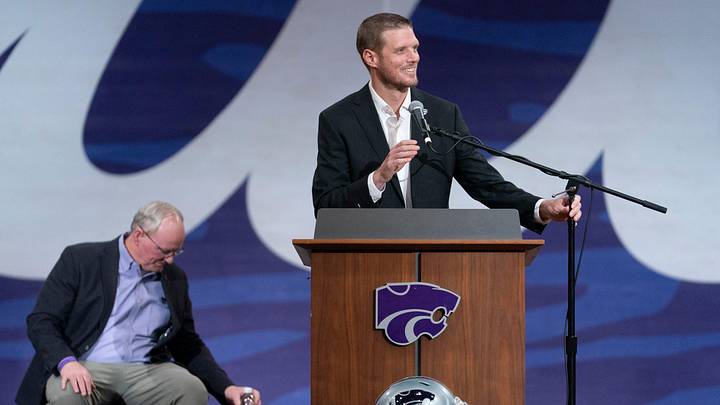
Although Klein was one of the nation’s elite quarterbacks during his playing days, he is often remembered as the overlooked finalist in the memorable 2012 Heisman Trophy race. While Johnny Manziel captivated the college football world with his electrifying freshman campaign at Texas A&M and Notre Dame linebacker Manti Te’o dominated headlines with an unforgettable season, Klein quietly delivered one of the most productive and efficient careers in Kansas State history.
Despite receiving less national attention than some of his contemporaries, Klein’s accomplishments were extraordinary. During the 2011 and 2012 seasons, he accounted for 79 combined passing and rushing touchdowns, leading Kansas State to consecutive double-digit win seasons. The Wildcats finished 10-3 in 2011 before posting an outstanding 11-2 record in 2012, earning a share of the Big 12 championship and producing one of the finest seasons the program has ever enjoyed.
That remarkable 2012 campaign remains one of the defining moments in Kansas State football history, rivaling the legendary 1998 season as arguably the greatest year the Wildcats have ever experienced. Klein’s leadership, toughness, and consistency became the foundation of the team’s success, even if national recognition often gravitated elsewhere.
Now, more than a decade later, Klein returns to Manhattan with a different mission.
Instead of leading the Wildcats from behind center, he now takes over as head coach, tasked with preserving one of college football’s most respected programs while elevating it to even greater success during the expanded College Football Playoff era.
Kansas State athletic director Gene Taylor admitted that Klein’s hiring was hardly a surprise.
When introducing his new coach last December, Taylor joked that Klein’s return had become “the worst-kept coaching secret in America,” adding that nearly everyone expected the former quarterback to take over the program. Taylor humorously remarked that failing to hire Klein would likely have left fans demanding his own departure, underscoring just how closely Klein’s identity is tied to Kansas State football.
It is difficult to find another coach in college football whose personal history aligns so perfectly with the program he now leads.
For Kansas State fans, Klein represents far more than a successful former player. He embodies the values that transformed one of college football’s least successful programs into one of its most respected.
For much of the 20th century, Kansas State struggled mightily.
Between 1912 and 1989, the Wildcats rarely enjoyed sustained success, finishing with winning records only a handful of times. The program was widely regarded as one of the weakest in major college football before legendary coach Bill Snyder arrived in 1989 and engineered one of the greatest rebuilding projects in sports history.
Snyder completely transformed Kansas State’s culture.
Over the next three decades, the Wildcats became known for discipline, player development, consistency, and toughness. Losing seasons became rare, conference championships became attainable, and Kansas State evolved into one of the Big 12’s most respected programs.
Following Snyder’s retirement, Chris Klieman faced the enormous challenge of replacing a coaching icon.
Fortunately for the Wildcats, Klieman proved more than capable of maintaining the program’s high standards. During his tenure, Kansas State won at least eight games in five of seven seasons and captured the 2022 Big 12 Championship, ending a decade-long conference title drought.
While Klieman successfully preserved the winning culture Snyder established, the Wildcats’ identity has always remained deeply connected to Snyder’s philosophy.
Now Klein inherits a stable and competitive program rather than the rebuilding project Snyder once faced.
The challenge before him is not simply maintaining success—it is taking Kansas State to levels the program has never consistently reached.
One reason many believe Klein is uniquely suited for the role is his impressive coaching résumé despite being only 36 years old.
As Kansas State’s offensive coordinator during the Wildcats’ 2022 conference championship season, Klein built one of the nation’s most physical and productive rushing attacks. His offense averaged nearly 210 rushing yards per game while combining power football with creative offensive concepts that consistently wore down opposing defenses.
His success eventually earned him the opportunity to become offensive coordinator at Texas A&M.
During his two seasons with the Aggies, Klein demonstrated that his offensive philosophy extends well beyond a run-heavy attack. Under his guidance, Texas A&M developed into a balanced offense capable of producing explosive passing numbers while maintaining physicality at the line of scrimmage.
Last season, the Aggies averaged approximately 260 passing yards per game and reached the College Football Playoff for the first time in school history, giving Klein valuable postseason experience that few coaches his age possess.
Perhaps Klein’s greatest strength is his adaptability.
Throughout both his playing and coaching careers, he has shown an ability to tailor his offense to the strengths of his personnel rather than forcing players into a rigid system.
That flexibility mirrors the philosophy Bill Snyder successfully employed throughout his Hall of Fame career.
Whether Kansas State featured dynamic dual-threat quarterbacks like Klein himself or strong-armed passers such as Michael Bishop, Snyder consistently adjusted his schemes to maximize his roster’s potential. Klein now appears prepared to continue that tradition while incorporating modern offensive innovations gained during his time in the Southeastern Conference.
The timing of Klein’s arrival could not be better.
With the expanded College Football Playoff now offering more opportunities for championship contention, programs like Kansas State no longer need a perfect season to compete for a national title.
Many observers believe that several of the Wildcats’ greatest teams—including those from 1998, 2003, 2012, and 2022—would likely have qualified for today’s playoff format.
That reality presents Klein with an opportunity unavailable to many of his predecessors.
Rather than simply pursuing conference championships, Kansas State can realistically aspire to compete on college football’s biggest stage year after year.
For a coach who once narrowly missed college football’s highest individual honor as a player, leading his alma mater into national championship contention would represent the ultimate full-circle moment.
Collin Klein already occupies a permanent place among the greatest players in Kansas State history.
Now, as he begins his tenure as head coach, he has the opportunity to build an entirely new legacy—one that could eventually surpass even his remarkable playing career.
If he succeeds in combining Kansas State’s proud traditions with the evolving demands of modern college football, Klein may not only become the perfect steward of the Wildcats’ identity but also the coach who leads the program into its most successful era yet.
Leave a Reply