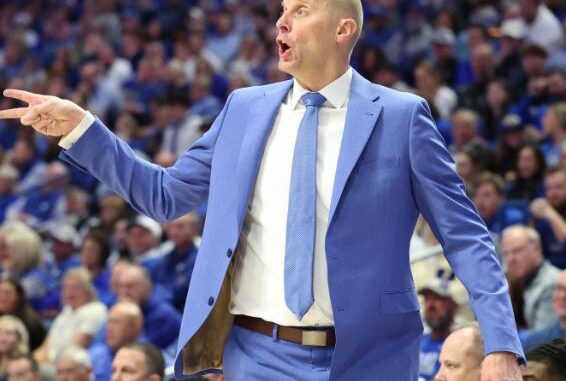
Mark Pope is entering his third season as head coach of the Kentucky Wildcats with a clear understanding that expectations in Lexington are unforgiving. Rather than asking Kentucky fans to be patient or pointing to circumstances that have complicated his first two seasons, Pope is embracing the pressure and insisting that his program must earn everything it gets. His message is particularly significant following a disappointing 2025-26 campaign and the latest setback involving Mark Mitchell, who has returned to Missouri while his eligibility situation continues to be tied up in a legal battle.

Pope’s philosophy can be summed up by one blunt phrase: “You just eat what you kill.” The Kentucky coach used the expression while discussing the reality of building a championship-caliber program in an extremely competitive environment. His point was that Kentucky cannot expect opponents, circumstances or anyone else to make things easier. If the Wildcats want to win, Pope believes they must take opportunities for themselves through preparation, toughness, discipline and execution.

Pope Refuses to Blame Injuries or the SEC
There are certainly reasons Pope could use to explain some of Kentucky’s struggles. The Wildcats have dealt with significant injuries during his first two seasons, including issues involving Lamont Butler and Jaland Lowe. At the same time, Kentucky has been competing in an increasingly demanding SEC that has become one of the toughest environments in college basketball.
But Pope is refusing to lean on those circumstances. Instead, he has made it clear that his players must approach every challenge with the mentality that nobody owes Kentucky anything. His message is essentially that successful programs cannot spend their time waiting for favorable conditions. They have to create those conditions themselves.
That attitude matters because Pope knows the scrutiny surrounding Kentucky basketball has intensified. His first two seasons produced 46 wins and three NCAA Tournament victories, which represented an improvement over Kentucky’s results during the final four seasons of the John Calipari era. However, the progress has not been enough to eliminate concerns. Kentucky finished 22-14 in 2025-26, suffered another double-digit-loss season and ultimately saw its NCAA Tournament run end in a disappointing loss to Iowa State.
For a program accustomed to competing for championships, simply reaching the NCAA Tournament is not necessarily considered sufficient. That reality is now hanging over Pope as he prepares for another season in which expectations will be considerably higher.
The Mark Mitchell Situation Adds More Pressure
The timing of Pope’s comments is particularly notable because Kentucky has just experienced another major roster setback. Mark Mitchell, who had committed to Kentucky after receiving an opportunity to pursue another season of college eligibility, has instead decided to return to Missouri while the eligibility dispute plays out.
Mitchell’s departure creates another question for Pope and his staff because Kentucky had apparently planned around the possibility of having him available. The Wildcats now have to move forward without a player who could have added experience, physicality and versatility to the roster.
The situation also highlights the uncertainty surrounding college basketball’s evolving eligibility and transfer landscape. Kentucky had invested considerable attention in Mitchell’s situation, but the uncertainty ultimately contributed to a dramatic change in plans. With the season approaching and Big Blue Madness only weeks away, the Wildcats must now determine whether the open roster spot will be filled or whether Pope will move forward with the group already assembled.
Pope Knows the Pressure Is Real
Despite those complications, Pope’s comments suggest that he is not interested in lowering expectations. Instead, he appears prepared to accept responsibility for whatever happens during the upcoming season.
That is an important distinction. Coaches under pressure often point to injuries, difficult schedules, roster turnover or bad luck when results do not match expectations. Pope’s approach is different. He is essentially telling his players that none of those factors can become an excuse. Kentucky has to compete with whatever roster is available and find ways to win.
“If we’re out here looking for someone to do us a favor, we’re wrong,” Pope said, reinforcing the idea that his team cannot wait for circumstances to improve.
The message is particularly appropriate for the SEC, where Kentucky will face a schedule filled with teams capable of punishing mistakes. There will be few easy nights, meaning Pope’s players will have to establish their identity quickly and maintain it throughout the season.
Year 3 Could Define Pope’s Kentucky Era
The 2026-27 campaign is shaping up as one of the most important seasons of Pope’s coaching tenure. He has already demonstrated that he can stabilize the program and get Kentucky back into the NCAA Tournament picture. What remains to be proven is whether he can take the Wildcats from being competitive to genuinely threatening for an SEC championship and a deep NCAA Tournament run.
That is where the “eat what you kill” mentality becomes more than a motivational slogan. Pope is challenging his players to develop the toughness required to win against elite competition rather than expecting talent alone to carry them.
Kentucky’s roster still contains plenty of reasons for optimism, and the program continues to attract major recruiting attention. But losing Mitchell undoubtedly lowers the ceiling on paper, particularly when considering the physical demands of SEC basketball.
Pope, however, appears to be embracing the challenge rather than retreating from it.
Kentucky Fans Want Results Now
There is little doubt that Kentucky fans will enter the season with enormous expectations. Pope has already shown that he can produce postseason appearances, but the next step is winning at a level that satisfies one of college basketball’s most demanding fan bases.
A third straight season with a significant number of losses would inevitably increase questions about whether Pope is the long-term answer in Lexington. While his job is not necessarily dependent on one particular season, the pressure surrounding the program is unmistakable. The Wildcats need to show meaningful progress, and Pope understands that better than anyone.
His latest comments therefore represent more than simple preseason motivation. They are a declaration that he is willing to accept the consequences of the program’s results. There will be no requests for sympathy, no appeals for easier circumstances and no attempt to blame outside factors.
Kentucky wants to win. Pope knows it. His players know it. And now he is making it clear that they intend to pursue those wins themselves.
For the Wildcats, the message heading into Year 3 is straightforward: no favors, no shortcuts and no excuses earn everything.
Leave a Reply