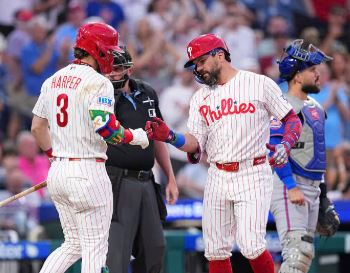
Phillies Announce Major Bryce Harper and Kyle Schwarber Changes After Playoff Elimination
The Philadelphia Phillies are already looking toward the 2027 season after another disappointing postseason exit, and two of their biggest stars are at the center of the club’s plans. President of baseball operations Dave Dombrowski has announced important changes involving Bryce Harper and Kyle Schwarber, revealing how Philadelphia intends to handle its first-base position and manage the workload of its veteran sluggers next season.
The announcement comes after the Phillies were eliminated by the Atlanta Braves in the National League Wild Card Series. Despite having an experienced roster loaded with established hitters, Philadelphia could not advance, extending a troubling run of postseason disappointments. The club must now address its lineup construction, defensive alignment and ability to deliver when the pressure rises in October.
Dombrowski’s latest comments offer an early indication of how the Phillies intend to approach one of their most important roster decisions: Harper is expected to return to first base as the full-time starter in 2027, while Schwarber is likely to receive additional opportunities at the position to help reduce Harper’s workload. The plan could influence the roles of other infielders and the way Philadelphia manages its designated-hitter spot.
Harper Set to Return to Full-Time First Base


Harper’s defensive position became a major talking point during the 2026 campaign. He started the season at first base, a position Philadelphia had embraced for him following his recovery from an elbow injury that previously limited his ability to play right field. However, the club eventually had to adjust its defensive arrangement after making a significant midseason acquisition.
The Phillies acquired Luis Arraez from the San Francisco Giants near the trade deadline, adding a proven contact hitter to strengthen their offense. Arraez was expected to play second base, prompting Bryson Stott to move to third base, Alec Bohm to take on more first-base responsibilities and Harper to return to right field.
Harper supported the move because he believed it would improve the team’s chances of winning. Nevertheless, the arrangement was understood to be temporary, and the Phillies have now reaffirmed their intention to make him their regular first baseman again in 2027.
The decision makes sense from a roster-planning perspective. Harper is one of Philadelphia’s most important offensive players, and keeping him at first base gives the team greater flexibility when constructing its lineup. It also reduces the need to move him between positions throughout the season.
However, the announcement does not mean Harper will never appear in right field. He has indicated a willingness to play wherever the organization believes he can contribute to winning. The main objective is to establish first base as his primary position while retaining some flexibility when circumstances require it.
Harper’s 2026 production also demonstrates why the Phillies want to keep him central to their plans. He appeared in all 162 regular-season games, recording a .269 batting average, a .380 on-base percentage and a .485 slugging percentage. He finished with 29 home runs and 87 RBIs, along with an estimated 3.3 wins above replacement according to FanGraphs.
Those numbers represent a productive season, even if the Phillies expected more from a player of Harper’s stature. His ability to reach base and provide power remains essential to an offense that struggled to produce consistently from several other positions.
The bigger question is whether Philadelphia can build a more balanced lineup around him. Harper’s production alone was not enough to prevent another early postseason exit, and the team needs more dependable contributions from its supporting hitters.
Schwarber Expected to Play More First Base


The second part of Dombrowski’s announcement concerns Schwarber, who is expected to receive more opportunities at first base next season.
Schwarber has primarily served as Philadelphia’s designated hitter, with his offensive value coming largely from his power and ability to drive in runs. The club now wants to use him more frequently in the field so that Harper and other veterans can receive additional rest without necessarily losing their places in the lineup.
According to the team’s offseason plans, Dombrowski hopes Schwarber can play approximately 30 games at first base in 2027. That would represent a meaningful increase from his limited experience at the position in 2026, when he made eight appearances at first base, including six starts.
The strategy could create several advantages for the Phillies.
First, it would allow Harper to serve as the designated hitter on selected days rather than having to play first base every time he is in the starting lineup. That could help manage the physical demands of a long regular season and keep one of the franchise’s most valuable players fresher for the final months.
Second, it would give Philadelphia additional options for rotating its veteran hitters. If Schwarber plays first base, Harper can occupy the designated-hitter spot. On other occasions, Harper can play first while Schwarber serves as the DH. The arrangement could also open the designated-hitter role to other players who need a break from defensive duties.
Third, a more flexible lineup could help the Phillies navigate injuries and demanding stretches of the schedule. Rather than relying on the same players to perform every day in fixed roles, the coaching staff would have more opportunities to distribute playing time.
There is, however, an important consideration: Schwarber must become sufficiently comfortable defensively at first base for the plan to work consistently. His reputation is built primarily on his bat, and increasing his defensive responsibilities will require preparation and adjustment.
The Phillies cannot assume that moving Schwarber into the field will automatically improve the team’s defense. They must weigh the value of resting Harper against the defensive demands of the position.
Nevertheless, the proposed arrangement gives the coaching staff another option, particularly when facing stretches of games in which maintaining the health and energy of key hitters becomes increasingly important.
Harper and Schwarber Remained Philadelphia’s Most Productive Power Threats
The decision to build the 2027 lineup around Harper and Schwarber is supported by their respective offensive performances in 2026.


Kyle Schwarber
Regular-season statistics reported for 2026. OPS combines on-base percentage and slugging percentage.
Schwarber delivered the greater home-run total, finishing with 45 homers and 97 RBIs in 156 games. His .232 batting average was relatively modest, but his .354 on-base percentage and .503 slugging percentage reflected his ability to combine patience at the plate with considerable power.
Harper, meanwhile, finished with 29 home runs and 87 RBIs while producing a .380 on-base percentage. His ability to get on base and generate extra-base hits makes him an important presence in the middle of Philadelphia’s batting order.
Together, the two sluggers supplied much of the team’s offensive production. Their performances were particularly important because several other regulars struggled to reach league-average production during the season.
That contrast helps explain why the Phillies are not simply looking to replace their established stars. Instead, the front office is trying to get more out of the existing core while finding ways to improve the players around it.
However, their regular-season numbers also underline the team’s central postseason problem: Philadelphia needs its offensive strength to translate into more consistent results when facing elimination.
What Happened During the Playoff Series Against Atlanta?
Philadelphia’s offseason decisions followed a three-game Wild Card Series defeat against Atlanta that ended the club’s postseason hopes.
The Phillies managed to force a decisive third game after an important comeback in Game 2. Harper and Schwarber hit consecutive home runs in the eighth inning to tie the game, and Alec Bohm later delivered the decisive solo home run in the 10th inning of a 4–3 victory.
That win briefly revived Philadelphia’s hopes of advancing, but the team could not carry the momentum into the deciding game. Atlanta won Game 3 by a score of 6–2, ending the Phillies’ season.
Harper went 3-for-13 with a home run and a double across the series. Schwarber finished 4-for-11 with a home run and two walks. Both contributed offensively, but neither could prevent Philadelphia from being eliminated.
The series loss was another painful outcome for a club that had invested heavily in its roster with the expectation of competing for a championship. It also intensified questions about whether the team’s established approach was producing enough postseason success.
Philadelphia’s early exit does not mean its core has lost all its value. Instead, it raises a difficult question for the front office: how can the club maintain its offensive strengths while addressing weaknesses in defense, lineup depth and overall consistency?
Dombrowski’s announcement about Harper and Schwarber represents one relatively clear answer. The Phillies intend to retain the power and experience of their veteran stars while changing how their playing time is managed.
What the Changes Mean for the Phillies’ 2027 Lineup
The first-base decision is only one part of a broader offseason evaluation. Philadelphia must determine how its veterans fit together, which free agents to retain and where outside additions could make the biggest difference.
Harper’s return to first base provides a degree of certainty, but the situation at other positions remains more complicated. Arraez, Bohm and José Alvarado are among the players entering free agency, while the club also needs to consider its outfield depth and bullpen.
The proposed use of Schwarber at first base could be particularly valuable if Philadelphia adds another hitter who needs regular at-bats but does not have an everyday defensive position. It would give the manager another way to fit productive bats into the starting lineup without forcing Harper or Schwarber to play every day in the field.
At the same time, the team must avoid treating positional flexibility as a substitute for addressing its defensive shortcomings. Schwarber’s increased work at first base will need to be evaluated carefully, and the club must make sure its lineup changes do not create new problems elsewhere.
The Phillies also need a more consistent offensive contribution from the players around their two leading sluggers. A lineup cannot depend on Harper and Schwarber to provide nearly all its power and run production, especially when facing strong postseason pitching.
The front office will therefore have to balance continuity with meaningful improvements. Keeping the core together may preserve the team’s offensive potential, but the supporting cast must improve if Philadelphia hopes to produce a different outcome in October.
The Bigger Picture: Philadelphia Is Still Pursuing a World Series
Dombrowski has made clear that the Phillies’ objective remains winning a World Series. The organization is not approaching the offseason as though the roster needs to be completely dismantled, and he has indicated that he does not intend to pursue trades involving major veterans such as Harper and Schwarber.
That position makes the Harper and Schwarber announcement especially significant. Rather than suggesting a dramatic change in direction, the plan points toward a retooling effort built around the existing core.
Harper is expected to resume his regular role at first base, while Schwarber could play approximately 30 games there to provide additional rest opportunities. The arrangement would allow the club to preserve its most productive hitters while creating greater flexibility in the designated-hitter position.
Still, the success of the strategy will depend on more than where two players stand on defense. Philadelphia must improve its overall roster balance, get stronger contributions from its supporting hitters and ensure that its veteran stars remain productive throughout the season.
The 2026 campaign showed that regular-season talent alone does not guarantee postseason success. The Phillies reached the playoffs but were unable to advance beyond the Wild Card Series, leaving the organization with another offseason of difficult questions.
Ultimately, Harper and Schwarber remain central to Philadelphia’s plans for 2027. The challenge now is to build a more complete team around them—one capable of turning individual power and regular-season success into a deeper postseason run.
Leave a Reply