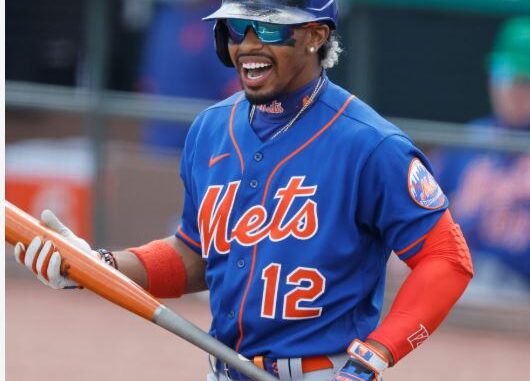
The New York Mets continued to make noise against the Miami Marlins, riding a three-home-run attack and another strong stretch from their offense to defeat Miami 7-5 on Tuesday night at loanDepot Park. Francisco Lindor, Juan Soto and Brett Baty all went deep, giving the Mets an early cushion and helping them withstand a late Marlins comeback.
The victory was particularly important for a Mets team that has spent much of the season searching for consistency. New York entered the game with a 66-78 record, but the win marked another positive result in a stretch that has included three consecutive series victories. The Mets now have an opportunity to complete a sweep of Miami and build additional momentum during the closing weeks of the season.
Lindor wasted little time setting the tone. The Mets shortstop launched a 405-foot leadoff home run on the first pitch of the game, immediately putting New York in front and continuing his ability to change games from the top of the lineup. It was also the 35th leadoff homer of Lindor’s career, adding another milestone to an already productive season.
Soto then delivered the biggest offensive blow of the night. The Mets superstar crushed a 417-foot three-run homer, his 24th of the season, as New York opened up a commanding lead against Miami ace Sandy Alcantara. Soto’s blast became one of the decisive moments of the game, giving the Mets breathing room before the Marlins had an opportunity to settle into the contest.
Baty added even more damage with a 426-foot solo home run, while also contributing a sacrifice fly. His production was another encouraging development for a Mets club evaluating several players who could have important roles moving forward. The combination of power from Lindor, Soto and Baty gave New York a six-run advantage early in the game and forced Miami to play from behind almost immediately.
The Mets’ offensive explosion came against one of Miami’s biggest weapons. Alcantara, a former Cy Young winner and one of the Marlins’ most accomplished starters, surrendered seven runs over 4⅓ innings. Despite reaching 200 innings for the third time in his career, he was unable to slow down a Mets lineup that repeatedly found ways to produce hard contact.
Manaea Dominates Then Suddenly Unravels
While the Mets offense stole most of the headlines, the game also featured one of the strangest pitching performances of the night.
Sean Manaea appeared to be cruising through the first five innings. The veteran left-hander retired the first 15 Marlins hitters he faced, throwing just 52 pitches while keeping Miami completely off balance. For five innings, Manaea looked like he might deliver one of his most dominant outings of the season.
Everything changed in the sixth.
Manaea surrendered five consecutive hits over only nine pitches and suddenly found himself in serious trouble. He was removed without recording an out in the inning after giving up four earned runs on five hits. The dramatic collapse transformed what had looked like a comfortable Mets victory into a tense contest.
The rough inning continued a troubling trend for Manaea. According to the latest game coverage, he has now allowed at least four earned runs in five consecutive starts, posting a 6.75 ERA during that stretch. For a Mets team already thinking about its pitching plans beyond 2026, Manaea’s inconsistency is becoming an important storyline.
Still, New York’s bullpen prevented the game from slipping away.
Mets Bullpen Holds the Line
Once Manaea departed, the Mets needed their relievers to protect what remained of their lead. Jonathan Pintaro, Nate Lavender and Dedniel Núñez helped keep Miami from completing the comeback, while Kodai Senga eventually took over the ninth inning.
Senga faced pressure in the final inning after the Marlins pushed another run across the plate, but the right-hander responded when the Mets needed him most. He struck out the final two batters to secure his seventh save of the season. His final sequence featured 10 consecutive forkballs, once again showcasing the pitch that has become his signature weapon.
The bullpen’s performance was especially noteworthy because New York has been reshaping its relief corps throughout the season. With several relievers moved around at the trade deadline and injuries affecting the pitching staff, the Mets have been forced to rely on younger arms while determining who can be trusted in important situations.
Soto Continues to Drive the Offense
Soto’s contribution was arguably the biggest offensive development of the night. His three-run blast gave him 24 home runs for the season and provided another reminder of the impact the Mets expected when they made him the centerpiece of their lineup.
His presence has become even more important as New York evaluates the roster for the future. The Mets have endured significant inconsistency across the lineup this season, but Soto and Lindor remain two of the most dangerous bats capable of changing the game with one swing. Their production against Miami demonstrated how quickly the Mets can create separation when both stars are locked in.
Baty Provides Another Encouraging Sign
Brett Baty’s performance also deserves attention. His home run and sacrifice fly gave him a significant contribution in a game where the Mets needed production throughout the lineup.
For Baty, the bigger storyline is whether he can turn flashes of power into sustained production. The Mets have spent considerable time evaluating his development, and performances like Tuesday’s give the organization another reason to keep monitoring his progress closely.
If Baty can become a consistent power threat alongside Lindor and Soto, New York would have a much stronger offensive foundation heading into the offseason.
A.J. Ewing Showing Signs of Life
The Mets’ recent series against Miami has also provided encouragement regarding rookie A.J. Ewing.
Ewing entered September looking to rebound from a difficult August in which his offensive production dropped sharply. He responded with a three-hit, three-RBI performance in Monday’s 9-4 victory over Miami, suggesting that he may finally be beginning to turn the corner.
The rookie’s emergence could be significant for New York because the Mets need younger players to establish themselves as reliable contributors. His ability to regain confidence at the plate could give the organization another piece to evaluate as it plans for 2027.
Jonah Tong Adds Another Reason for Optimism
Another important storyline from the series has been the return of young pitcher Jonah Tong.
Tong was recalled from Triple-A Syracuse and made his first major-league start of the season Monday. Although he surrendered four runs in the second inning, he recovered impressively, finishing with seven strikeouts over five innings. He had also posted a 0.84 ERA over four Triple-A starts before his return.
For a Mets organization that has been looking toward its younger talent, Tong’s ability to adjust during his outing was encouraging. Rather than allowing the early damage to completely derail him, he changed his pitch selection and leaned more heavily on his cutter and changeup.
The Bigger Mets Picture
Tuesday’s win is not simply about beating the Marlins. The Mets are using these final weeks of the season to determine which players can become part of the organization’s next competitive team.
New York’s postseason position is difficult, but there are still plenty of individual developments worth watching. Young players are receiving opportunities, veterans are being evaluated, injured players are working toward potential returns, and the front office is beginning to gather information that could shape the 2027 roster.
One of the most encouraging developments has been the progress of the bullpen. Reed Garrett, who underwent elbow reconstruction and bone-spur surgery last October, recently took another major step in his rehabilitation by throwing off a mound. Although he is not expected to return this season, his progress could make him an important part of New York’s bullpen plans for 2027.
The Mets are also monitoring Tylor Megill’s recovery from Tommy John surgery, while Senga has increasingly taken on a larger role late in games. Those developments could have major implications for how the club constructs its pitching staff next season.
Mets Have Momentum, But Questions Remain
The 7-5 victory showed both sides of the Mets’ current identity.
On one hand, the offense demonstrated tremendous firepower. Lindor, Soto and Baty combined for three home runs, and New York built a six-run lead against one of Miami’s best pitchers. The bullpen then did enough to protect the advantage.
On the other hand, Manaea’s sixth-inning collapse highlighted why the Mets cannot simply assume that their pitching problems are solved. The starting rotation remains one of the biggest questions facing the organization, especially with the season approaching its final weeks.
Still, the Mets have now won another series and have played considerably better baseball against Miami than they did earlier in the season. The immediate goal may no longer be solely about the standings; it is also about identifying players who can help New York return to contention in 2027.
With the Marlins now facing another opportunity to avoid a sweep, the Mets will look to finish the series strongly and carry the offensive momentum into their next stretch of games. Miami, meanwhile, has lost five of its last six games, causing its own postseason hopes to take a significant hit.
For the Mets, the message from Tuesday’s win is clear: the season may be winding down, but the evaluation process is accelerating. Lindor and Soto are producing, Baty is showing power, younger players are receiving opportunities, and the bullpen continues to uncover potential pieces for the future.
What happens over the next few weeks could therefore be just as important for the Mets’ long-term plans as the final win-loss record.
Leave a Reply