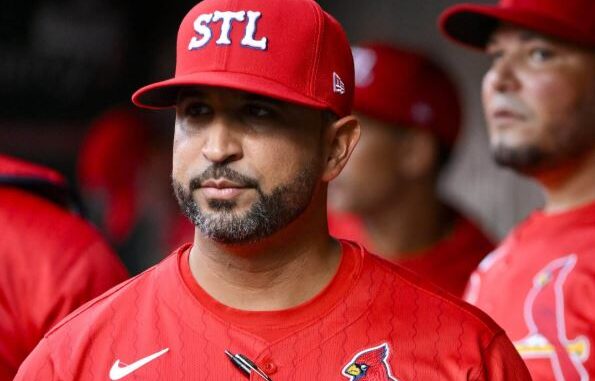
The St. Louis Cardinals may finally be seeing some stability develop at a position that has been a major problem for several seasons. Rookie outfielder Nathan Church has increasingly made his case to become the Cardinals’ starting center fielder in 2027, giving the organization another young player who could potentially establish himself as part of the club’s long-term plans.
While St. Louis has watched Leo Bernal strengthen his argument for a starting role next season, Church is attempting to do something similar in the outfield. Center field has not offered the Cardinals the same level of depth they have enjoyed at some other positions, but Church’s recent surge has changed the conversation around what the club should do at the position. Rather than automatically searching for another external solution, St. Louis now has an intriguing internal candidate who could deserve a legitimate opportunity to take control of the job.
That possibility is particularly important because center field has been one of the Cardinals’ weakest offensive positions over the past several years. Entering the 2026 season, St. Louis center fielders had combined for only a 74 wRC+ since 2023, ranking second-worst among the league’s teams during that span. The group accumulated just 3.5 fWAR over those three seasons, with much of that value coming from defensive contributions rather than offensive production.
The Cardinals have tried several different approaches to solve the problem. Three players Lars Nootbaar, Victor Scott II and Michael Siani each received at least 100 games in center field during that period. Nootbaar was the lone player of the three to provide above-average offensive production, while Scott and Siani struggled significantly with the bat. That lack of consistent offense has left St. Louis searching for a player capable of combining adequate defense with enough production to make center field a reliable part of the lineup.
Church Has Taken Advantage of His Opportunity
The Cardinals entered 2026 hoping Victor Scott II could finally turn his athletic ability and speed into consistent offensive production. After working extensively on his swing during the offseason, Scott was given an opportunity to take the everyday center-field job and prove that he could become the long-term answer.
Unfortunately for St. Louis, the offensive issues continued.
Scott produced only a 55 wRC+ over more than 60 games before the Cardinals ultimately sent him to Memphis in June. The move opened the door for Church, who had already begun receiving opportunities around the outfield after an impressive April.
Church did not immediately turn into an unquestioned star, and there were stretches where his offensive production raised concerns about whether he could actually hold down a starting role. However, the Cardinals eventually gave him the everyday center-field job after Scott was demoted, particularly as Jordan Walker established himself in right field and St. Louis continued looking for a way to restore Nootbaar’s value in left.
July was a difficult month for Church and briefly caused the organization to reconsider whether center field would once again become a position requiring an outside solution. But the rookie has responded in a much more encouraging way since the beginning of August.
That turnaround has become one of the more interesting developments in the Cardinals’ season.
Since August 1, Church has appeared in 37 games while hitting .292 with a .736 OPS. That production translates to a wRC+ roughly six percent above league average, which would represent a meaningful improvement over what St. Louis has received from its center fielders in recent seasons.
The improvement becomes even more encouraging when looking at his strikeout rate.
Church has dramatically reduced the frequency with which he is striking out. Over 127 plate appearances during this recent stretch, he has struck out only 10 percent of the time. From June through July, he struck out 28 times in 128 at-bats. Since then, he has struck out only 13 times in 117 at-bats.
That is a substantial change for a young hitter still learning how to handle major-league pitching.
Although Church has not provided significant power during his recent hot stretch, he has already demonstrated that he is capable of contributing in multiple areas. He entered the latter portion of the season with 10 home runs and 10 stolen bases, giving the Cardinals a player who can create value with both his speed and developing power.
Defense Could Help Church Stay in the Lineup
One of the biggest factors working in Church’s favor is his defensive ability.
The Cardinals do not necessarily need Church to become a 30-home-run hitter to justify giving him the center-field job. If he can remain around league-average offensively while providing dependable defense, his overall value could make him a perfectly reasonable everyday option.
That becomes especially relevant when considering the organization’s current alternatives.
Scott has not started a game since returning to the major leagues, leaving questions about whether the Cardinals still view him as their preferred long-term center fielder. Meanwhile, Chase Davis has received opportunities in Memphis but has struggled to produce the consistency necessary to force his way into the major-league conversation.
There are also younger prospects making progress through the system. Josiah Ragsdale has drawn attention after dominating Double-A pitching, but he is still expected to need additional development before becoming a realistic candidate for a major-league starting role.
That leaves Church in an advantageous position.
The Cardinals simply do not have an overwhelming internal candidate waiting behind him. If Church continues to perform at something close to his current level, there may be little reason for St. Louis to remove him from the position simply for the sake of bringing in another player.
Cardinals Could Pair Church With a Veteran
Even if Church earns the starting job for 2027, however, the Cardinals may not be ready to hand him the position without additional support.
A platoon partner could make considerable sense.
Church is a left-handed hitter, and St. Louis could look for an experienced right-handed outfielder capable of taking some of the tougher matchups while also providing defensive depth. Such a player would not necessarily need to be a major free-agent acquisition or a long-term commitment.
Instead, the Cardinals could pursue a veteran who understands that his role would be complementary rather than central to the team’s future.
That type of move would fit particularly well with the broader direction of the organization.
If St. Louis continues treating 2027 as another transitional season in its rebuilding process, it would be difficult to envision president of baseball operations Chaim Bloom making a major financial commitment to solve center field. The organization has more pressing long-term decisions to make, and committing significant money to an aging outfielder could limit opportunities for younger players.
A short-term veteran signing, however, could be different.
The Cardinals could bring in an experienced player who gives Church occasional rest, provides a right-handed bat and allows the club to protect the rookie against particularly difficult matchups. At the same time, Church could potentially receive enough opportunities against left-handed pitching to continue developing into a more complete offensive player.
That approach would give St. Louis flexibility without blocking its young talent.
Is Church the Long-Term Answer or Just a Bridge?
The biggest question surrounding Church is not whether he can play center field in 2027. It is whether the Cardinals believe he can remain there beyond next season.
His recent performance certainly gives the organization reason to be optimistic, but it is still too early to declare him the permanent solution.
The Cardinals have experienced too much instability at the position to make that decision based on a few good months. Scott was once viewed as a potential long-term answer because of his speed and defensive potential, only for his offensive struggles to derail that plan. Other players have also received opportunities without establishing themselves as reliable everyday options.
Church now has the chance to break that cycle.
If he can carry his improved plate discipline into 2027, maintain respectable offensive production and continue playing dependable defense, he could give the Cardinals something they have lacked for years: a young center fielder capable of holding the position without forcing the front office to search for another solution every offseason.
At the same time, St. Louis should remain cautious. A strong finish does not automatically guarantee that Church will become an established major-league starter. His power, performance against different pitching styles and ability to sustain his reduced strikeout rate will all be important factors.
For now, though, Church has put himself in a position to control his own future.
The Cardinals desperately need stability in center field, and the rookie is beginning to look like a legitimate candidate to provide it. Whether he becomes the long-term answer or simply holds the position until the next highly regarded prospect arrives remains uncertain, but one thing is becoming increasingly clear: St. Louis can no longer overlook Nathan Church when planning its 2027 roster.
Leave a Reply