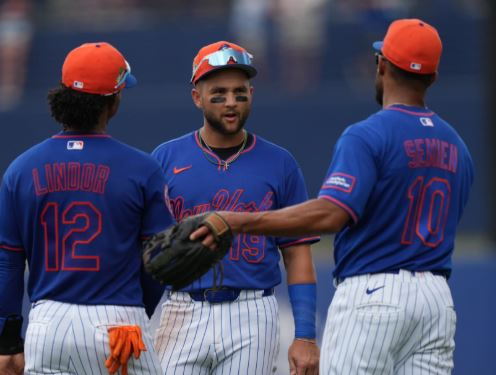
The New York Mets could be heading toward another major offseason decision involving Bo Bichette, and the situation is becoming increasingly complicated as the infielder approaches a pair of opt-out opportunities in his contract. Bichette signed a three-year, $126 million deal with the Mets, a contract that gives him the ability to opt out after each of the first two seasons. That means the upcoming offseason could put the former Toronto Blue Jays star in position to either remain in New York on the remaining two years of his contract or return to free agency in search of a longer and potentially more lucrative deal.
The immediate financial question is significant. Bichette has approximately $84 million remaining over the final two years of his contract, which works out to $42 million annually. That is an enormous amount of guaranteed money, but whether Bichette can realistically surpass that annual value on the open market has become a matter of debate. SNY’s John Harper delivered a blunt assessment, arguing that Bichette should seriously consider remaining with the Mets because he may not be able to secure another contract paying him $42 million per season. Harper’s argument is based partly on Bichette’s overall production profile and the uncertainty surrounding the upcoming free-agent market.
The Case for Bichette Staying in New York
Harper’s argument is not necessarily a criticism of Bichette’s ability. Instead, it reflects the difficult reality of the free-agent market. Bichette has been a productive offensive player, but Harper pointed out that he does not fit the profile of an elite superstar who consistently produces enormous power numbers. Bichette has also posted an OPS below .800 during the second half, despite doing much of his best hitting during that portion of the season. That combination could make it difficult for him to convince another club to match or exceed the $42 million annual salary currently attached to his Mets contract.
There is also the possibility that the upcoming MLB labor situation could influence the decision. Harper noted that the looming lockout could create uncertainty around the league’s future salary structure. From Bichette’s perspective, giving up two years and $84 million would be a significant gamble. Even if he believes he can obtain a longer contract, there is no guarantee that the total value or annual salary would immediately exceed what he already has secured with New York.
Bichette’s performance since the beginning of June, however, provides another side to the argument. His first couple of months with the Mets were difficult, but he has gradually settled into his new surroundings and become much more productive. That turnaround could strengthen his negotiating position if he ultimately decides to test free agency. The question is whether interested teams will view his recent production as evidence of his true level or simply as a strong stretch following a difficult beginning.
Another Analyst Sees a Much Bigger Payday
David Lennon of Newsday Sports has a considerably different view of Bichette’s situation. Rather than believing the infielder should simply accept the remaining $84 million, Lennon believes Bichette could potentially earn more than that amount by returning to the open market.
One reason is the relatively weak free-agent class expected this offseason. When there are fewer marquee players available, a proven offensive player such as Bichette can become significantly more valuable. Teams looking for an impact bat could view him as one of the premier options available, potentially creating a bidding environment that pushes his total contract value beyond the $84 million he would receive from remaining with the Mets.
Lennon believes Bichette’s strong performance since June could also work in his favor. After struggling badly at the beginning of the season, Bichette has turned things around and moved closer to the type of offensive production the Mets expected when they signed him. If he finishes the season strongly, he could enter the offseason with considerably more leverage than he would have had several months ago.
The key difference is contract length. Bichette might not receive $42 million per year on another deal, but a longer agreement could ultimately give him more guaranteed money. Instead of two remaining years at $42 million annually, another team could potentially offer four, five or even more years at a lower annual figure. That would give Bichette greater long-term security while potentially exceeding the $84 million still available under his current Mets contract.
The Biggest Question May Not Be Money
Perhaps the most intriguing part of the situation is that money may not be the only factor influencing Bichette’s decision. Lennon suggested that even people close to the situation may not know what Bichette ultimately wants to do.
Bichette’s adjustment to New York has taken time. His difficult beginning created questions about whether he would eventually feel comfortable with the Mets, particularly after fans quickly became frustrated with his early struggles. But his recent improvement has changed the atmosphere around him. He now appears much more settled, and his offensive production has helped ease some of the concerns surrounding his transition to the Mets.
That creates an important decision for both sides. Bichette must determine whether he believes New York is the right place for the next stage of his career, while the Mets must decide how aggressively they want to keep a player who could potentially test the market. After another disappointing season for the franchise, the front office could face several major roster decisions, making Bichette’s situation particularly important.
Mets Could Face a High-Stakes Decision
For the Mets, losing Bichette would create another significant hole in a lineup that was expected to compete at a much higher level. The organization invested heavily in him, and his ability to provide consistent offense makes him an important piece of the roster. If he opts out, New York would have to determine whether to pursue him again or redirect that money toward other areas of the team.
Bichette, meanwhile, has a decision that could shape the remainder of his career. Staying with the Mets would guarantee him another $84 million and eliminate the uncertainty of free agency. Testing the market could potentially lead to a larger long-term commitment, particularly if several teams view him as one of the best offensive players available. But it would also mean walking away from an enormous amount of guaranteed money.
That is why the upcoming offseason could become one of the most important moments of Bichette’s Mets tenure. One side of the argument says he should protect the $84 million already guaranteed to him. The other believes the scarcity of elite free agents could create the perfect opportunity to cash in again.
For now, there is no definitive indication that Bichette has made his choice. He has settled into New York after a difficult beginning, and his improved play has only made the decision more complicated. The Mets may want him back, Bichette may ultimately prefer to stay, and another team could still make an offer too attractive to ignore. What appeared to be a straightforward contract situation is now shaping up to be one of the Mets’ most fascinating offseason storylines.
Leave a Reply