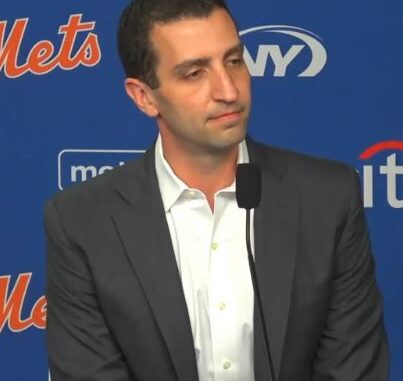
David Stearns walked into Citi Field on Monday knowing he had plenty to explain after a deeply disappointing 2026 season for the New York Mets. Instead of simply looking ahead to the offseason, the president of baseball operations was forced to address a long list of decisions that contributed to the club’s collapse, including major roster changes, the decision not to bring back Pete Alonso and a slow start that ultimately left New York out of the postseason. The Mets finished 74-88 and last in the National League East, ending a season that began with enormous expectations and one of baseball’s largest payrolls. Stearns acknowledged that some of his offseason choices created significant risk, but his corporate-style language during the press conference quickly became a major talking point among frustrated Mets supporters.
One particular phrase immediately caught attention. While discussing the decisions that preceded the disastrous opening months, Stearns said that he and the organization had made choices that created the possibility of an “almost uncapped downside scenario.” He also acknowledged that there had been substantial change around the club and suggested that making those changes in New York carries a different level of pressure compared with other markets. The remarks were intended to explain the risks behind the organization’s offseason strategy, but some Mets fans interpreted the language as overly polished and detached given the results on the field. Social-media reactions quickly focused less on the substance of Stearns’ comments and more on the unusual terminology he used to describe the team’s failure.
The criticism was amplified because the Mets had entered the year with expectations of competing deep into October. Instead, the club endured a disastrous start that included a 12-game losing streak and spent much of the season trying to recover. The organization also made significant changes to its roster and coaching staff during the offseason, meaning the poor beginning could not simply be attributed to bad luck or one isolated problem. Injuries to major contributors Juan Soto and Francisco Lindor further complicated the situation, while the club struggled to generate consistent production at several positions. Despite improving later in the year, the Mets could not overcome the damage created during the first half.
Stearns did, however, accept responsibility for the team’s shortcomings rather than attempting to completely distance himself from them. He acknowledged that the Mets had “missed too much” during the previous offseason and recognized that several decisions did not produce the results the organization expected. He also admitted that the team’s approach to roster construction needed to be reassessed. According to Stearns, the Mets had placed too much emphasis on certain concepts, including run prevention, without producing the overall results required to win consistently. He even joked that he might retire the phrase “run prevention” after the strategy failed to deliver the expected payoff.
Perhaps the most uncomfortable issue surrounding Stearns remains the decision to allow Pete Alonso to leave in free agency. Alonso subsequently signed a five-year, $155 million contract with the Baltimore Orioles and produced a huge season, leading the American League with 43 home runs and 113 RBIs. Meanwhile, the Mets struggled to find adequate production at first base. Stearns conceded that the total production from the position was not good enough and said he recognized Alonso had an outstanding season. He also made it clear that he does not get a second chance to redo previous decisions, famously saying, “In this job, I don’t get mulligans.”
That situation became even more noticeable because the Mets finished the year with a $358 million Opening Day payroll, according to reporting from the Associated Press. The combination of enormous financial investment, high expectations and a last-place finish inevitably increased scrutiny on the front office. The Mets’ final record was their worst since 2017, and the club missed the postseason for the second consecutive season. The contrast between the team’s spending and its final position in the division made the disappointing campaign particularly difficult for supporters to accept.
Still, Stearns did not present the entire season as a failure without any positive developments. He pointed toward the team’s improvement after the All-Star break and the emergence of younger players as reasons for optimism entering 2027. MLB reported that the Mets went 34-31 after the All-Star break, while players such as Carson Benge, A.J. Ewing and Nolan McLean provided the organization with pieces to build around. Stearns also identified starting pitching, first base, second base and the bullpen as areas that could require attention during the offseason.
The Mets also believe the second half provided evidence that the roster has a foundation worth developing. Stearns pointed to the performance of young players and the improved cohesion of the club after the trade deadline as encouraging signs. The organization therefore does not appear to be planning a complete teardown, but there are still substantial holes to address if the Mets are going to return to postseason contention in 2027.
For Mets fans, however, the bigger question now is whether Stearns can turn his acknowledgment of the mistakes into tangible improvements. His end-of-season comments showed that he understands the consequences of the decisions made during the previous offseason, but the next test will come when the Mets begin reshaping the roster. The front office must address the first-base situation, strengthen the rotation and determine how much of the emerging young core can become part of the team’s long-term plan.
Stearns’ press conference therefore became more than a season-ending media session. It served as an early explanation of how the Mets ended up at the bottom of the NL East and what the organization believes must change. While some fans focused heavily on his unusual “uncapped downside scenario” wording, Stearns’ broader message was that the Mets’ 2026 collapse exposed problems in roster construction that he now has to fix. The organization has already acknowledged the mistakes. The offseason will determine what it does about them.
Leave a Reply