
Alabama has officially made its quarterback decision for the 2026 season, naming sophomore Keelon Russell as the Crimson Tide’s QB1. The decision could have major implications for Auburn, particularly when the two rivals meet in the Iron Bowl later this year.
For Auburn, Russell’s promotion removes what appeared to be a potentially significant strategic advantage. The Tigers were expected to enter the rivalry matchup believing they could pressure Alabama by forcing the Crimson Tide to rely on a questionable running game. Russell’s athletic ability and dual-threat potential, however, could make that strategy considerably more difficult to execute.
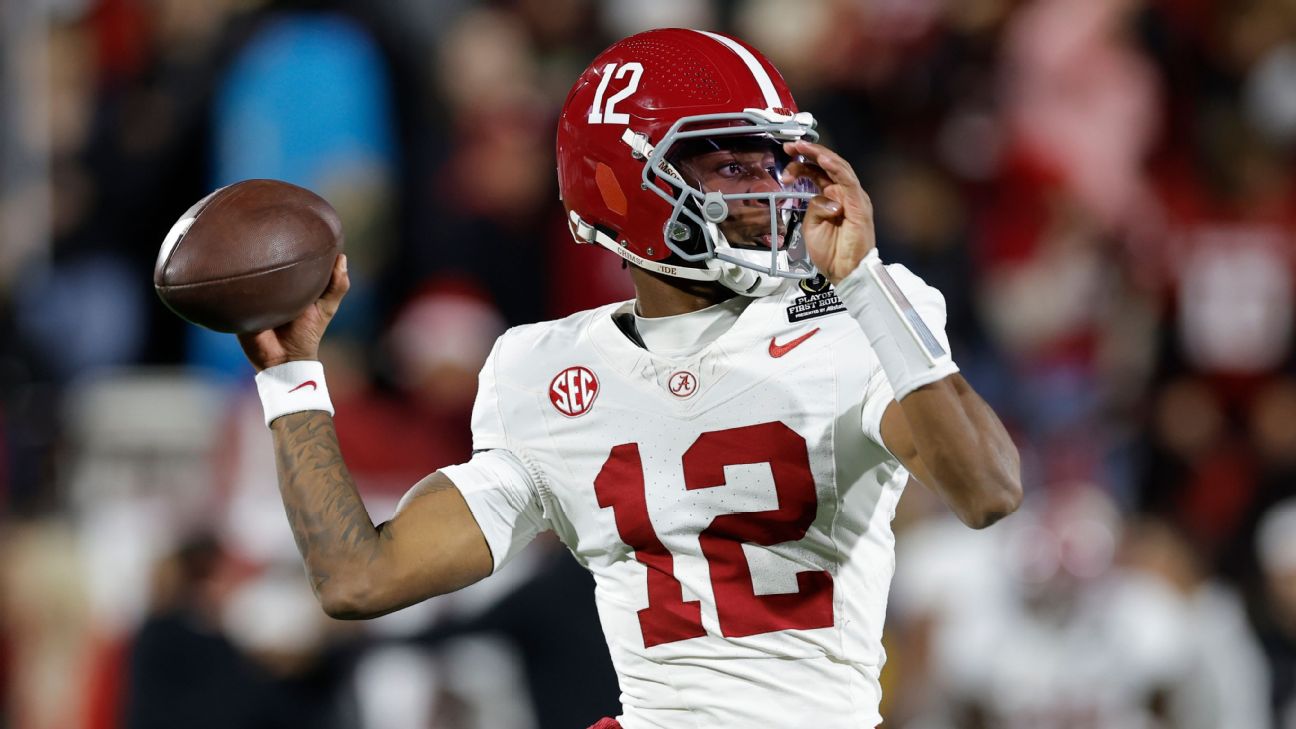
Russell does not enter the season with extensive college experience. He played only 37 total snaps across two appearances during his first season in Tuscaloosa. By the time Alabama reaches the Iron Bowl, though, he should have accumulated considerably more experience and could be a much more polished quarterback than the player who saw limited action last season.
His physical talent is one of the primary reasons Alabama handed him the starting job.
Russell reportedly possesses the speed to create problems outside the pocket, including a 40-yard dash time of approximately 4.59 seconds. But his greatest value may not come from simply taking off and running whenever a play breaks down. Instead, he can use his athleticism to extend plays, remain behind the line of scrimmage and give his receivers additional time to uncover downfield.
That ability could be especially dangerous against Auburn.
Russell has the skill set of a modern dual-threat quarterback capable of hurting defenses both with his arm and his legs. His quick release and ability to improvise could force Auburn defenders to remain disciplined rather than immediately attacking the line of scrimmage.
The Iron Bowl could also carry enormous postseason implications.
If Alabama remains in contention for the College Football Playoff late in the season, the rivalry game could become one of the most important contests on its schedule. In that type of high-pressure environment, Russell’s ability to create plays when the initial design breaks down could become one of Alabama’s biggest advantages.
Auburn’s defensive strategy could therefore become much more complicated.
One of the areas the Tigers were expected to target was Alabama’s running game. The Crimson Tide struggled badly on the ground in 2025, ranking near the bottom nationally in rushing production. Alabama’s problems were not limited to its running backs, either, as the offensive line struggled to consistently create running lanes.
The Tide also enters the 2026 season with questions at running back. AK Dear and EJ Crowell have dealt with injuries during camp, while Daniel Hill has yet to firmly establish himself as the unquestioned lead back. There have been encouraging signs from players such as Trae’shawn Brown and Kevin Riley, but Alabama still has plenty to prove before it can be considered a dominant rushing team.
That weakness could have presented Auburn with an obvious game plan.
The Tigers have strength in the middle of their defense, including linebacker Xavier Atkins, who led the team with 17 tackles for loss last season. Auburn could have attempted to crowd the box, challenge Alabama to run between the tackles and force the Crimson Tide into difficult down-and-distance situations.
Russell changes the equation.
Because of his mobility, Alabama does not necessarily need to rely on traditional inside rushing attacks to move the football. Designed quarterback runs, scrambles and short passing concepts could all become effective ways of attacking Auburn.
Russell’s presence may also allow Alabama to exploit the perimeter of Auburn’s defense. The Tigers have concerns in the secondary, particularly at cornerback, and Alabama could look to use Russell’s arm strength and ability to extend plays to attack those weaknesses.
Rather than repeatedly challenging Auburn’s defensive front, Alabama could spread the field and make the Tigers defend every inch of the field.
That is where Russell’s dual-threat ability becomes particularly valuable.
If Auburn sends additional defenders to stop the run, Russell has the ability to make them pay with his arm. If the Tigers back off to protect against deep passes, Alabama can potentially create opportunities for Russell to run or use short and intermediate throws to move the chains.
The quarterback decision therefore gives Alabama greater flexibility heading into the season.
Russell will still have to prove that he can handle the pressure of being Alabama’s full-time starter. Limited college snaps mean there will inevitably be questions about his consistency, decision-making and ability to perform against elite defenses.
However, his ceiling appears considerably higher than simply being a game manager.
Alabama’s decision to name Russell QB1 also removes the uncertainty surrounding the position. Instead of splitting valuable practice repetitions between multiple quarterbacks deep into camp, the Crimson Tide can now build its offensive identity around Russell and give him the majority of the preparation needed to become comfortable as the starter.
For Auburn, that is an important development.
The Tigers can no longer simply assume that Alabama’s struggles running the football will be enough to contain the Crimson Tide. They will have to prepare for a quarterback who can create offense in multiple ways and potentially turn broken plays into explosive gains.
The Iron Bowl remains months away, but the quarterback decision has already changed the strategic landscape of the rivalry.
Alabama may still have questions to answer, particularly in the running game, but handing the offense to Russell gives the Crimson Tide a dynamic element it may not have possessed with a less mobile option under center.
Auburn will have to find another way to exploit Alabama.
And if Russell develops as quickly as Alabama expects, the Tigers could discover that the Crimson Tide’s quarterback decision was one of the biggest developments of the entire Iron Bowl buildup.
Leave a Reply