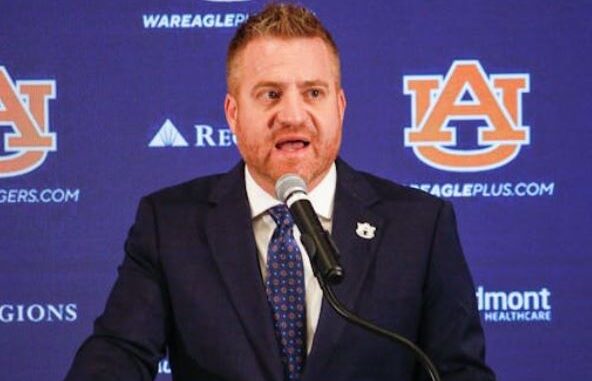
Auburn football is less than a week away from beginning the Alex Golesh era, and excitement surrounding the Tigers is building rapidly.
But beneath the optimism surrounding a new coaching staff, a new offensive philosophy and a reworked roster is one major concern that could determine how successful Auburn’s first season under Golesh ultimately becomes.
The offensive line.
It was already one of the biggest questions surrounding Auburn entering the 2026 season.
Now, as the season approaches, the issue looks even more important.
Auburn lost an enormous amount of experience from last year’s offensive line. Six of the seven offensive linemen who recorded starts for the Tigers in 2025 are no longer on the roster, with departures coming through the NFL Draft and the transfer portal.

That means Golesh and offensive line coach Tyler Hudanick are essentially trying to build a new front from the ground up.
And that is a dangerous situation for a team entering SEC competition.
A New Era Needs a Reliable Offensive Line
There is plenty to like about what Auburn is attempting to build.
Golesh arrives with an offensive identity centered around tempo, explosive plays and pressure on opposing defenses. His offenses at Tennessee and South Florida demonstrated how dangerous a fast-paced system can become when the players execute it properly.
But there is one fundamental requirement for that offense to work.
The offensive line has to hold up.
Tempo means nothing if the quarterback is constantly under pressure.
Explosive passing concepts mean little if there is no time to develop routes.
And a running game cannot consistently function if the offensive front cannot create openings.
That is why Auburn’s offensive line may ultimately be more important than any individual skill-position battle.
The Departure of So Much Experience Hurts
Auburn’s offensive line was not exactly dominant in 2025.
In fact, the unit struggled to consistently protect quarterback Jackson Arnold, despite having more experience on paper.
That makes this year’s situation particularly fascinating.
The Tigers did not simply lose a great offensive line and need to replace it.
They lost most of a unit that already had problems.
Now the new staff must find a combination capable of performing better despite having far less continuity.
That is an enormous challenge.
Golesh has spent the offseason rebuilding the roster, but offensive line chemistry is difficult to manufacture overnight.
Five players may understand their individual assignments perfectly, yet still struggle if they have not developed the communication and timing required to operate as a unit.
Auburn Has Reloaded the Position
The Tigers have not ignored the problem.
Golesh and his staff have aggressively rebuilt the offensive line through recruiting and the transfer portal.
The objective is clear: find players who can compete immediately and create enough depth to survive the physical demands of SEC football.
But there is a difference between adding talented players and proving that those players can function together.
That is the challenge facing Auburn now.
The Tigers need the new group to develop quickly.
They do not have the luxury of spending half a season figuring things out.
Byrum Brown Makes the Situation Even More Important
Auburn’s quarterback situation adds another layer to the offensive-line discussion.
Byrum Brown enters the season with familiarity with Golesh’s system after previously playing for him at South Florida.
That relationship could give Auburn an advantage during the transition.
Brown understands the terminology.
He understands the tempo.
He understands what Golesh wants from the quarterback position.
But none of that eliminates the need for protection.
Brown can make plays with his legs and extend possessions outside the pocket, but Auburn cannot build an entire offense around asking its quarterback to escape pressure.
If the offensive line struggles, defenses will recognize it quickly.
SEC opponents will attack weaknesses relentlessly.
They will blitz.
They will disguise coverages.
They will challenge inexperienced linemen with complicated fronts.
And they will force Auburn’s new offense to prove it can operate under pressure.
The Running Game Could Be the Answer
One reason Auburn fans can remain optimistic is the talent available in the backfield.
The Tigers have multiple running backs capable of carrying significant workloads, including Jeremiah Cobb and Bryson Washington.
A strong running game could help take pressure off the offensive line and quarterback.
That might sound contradictory, but establishing the run can actually make life easier for an offensive front.
Defenses become less aggressive when they have to respect the possibility of a handoff.
Play-action opportunities increase.
Passing lanes can open.
And the quarterback gets more favorable situations.
Golesh will likely want to create that balance.
He does not need Brown to throw 40 or 50 passes every Saturday.
He needs an offense that can keep defenses guessing.
And that begins with the offensive line.
The Biggest Question: Can They Stay Healthy?
Depth could become just as important as the starting five.
The SEC season is long.
Auburn will face physical defensive fronts throughout the schedule, and injuries are inevitable.
If the Tigers suffer one or two significant injuries along the offensive line, the quality of the replacements could determine whether the offense continues functioning normally.
That is why the development of the second unit matters.
Golesh cannot simply prepare five starters.
He needs eight, nine or even 10 linemen he believes can contribute when necessary.
Auburn’s new staff has spent months evaluating that depth.
Now the games are about to provide the real test.
Auburn’s Offense Cannot Afford Slow Starts
There is another reason the offensive line is so important.
Golesh is attempting to establish an entirely new identity at Auburn.
The Tigers have endured five consecutive losing seasons, and the patience of the fan base is understandably limited.
Auburn does not need to win a national championship in Golesh’s first season to prove the program is moving in the right direction.
But fans need to see tangible improvement.
They want to see an offense that looks organized.
They want to see explosive plays.
They want to see the quarterback protected.
They want to see the running game create consistent yardage.
And they want to see Auburn compete against the best teams in the SEC.
A shaky offensive line could prevent all of that.
Baylor Provides the First Test
Auburn’s season opener against Baylor will be the first real opportunity to evaluate the new-look offensive line.
The Tigers will enter the game with plenty of questions.
Can Brown operate comfortably?
Can Auburn run the football?
Can the receivers get open?
Can the offensive line create enough time for the passing game?
Can the Tigers maintain Golesh’s preferred tempo without allowing the defense to dictate the game?
Those questions will begin receiving answers immediately.
The opener will not determine Auburn’s entire season, but it could provide an early indication of whether the offensive rebuild is ahead of schedule or still requires significant work.
The Pressure on Tyler Hudanick
Much of the attention will naturally fall on Golesh.
He is the head coach.
He is the person responsible for changing Auburn’s fortunes.
But offensive line coach Tyler Hudanick may quietly have one of the most important jobs on the entire staff.
His task is not simply to teach technique.
He has to create a cohesive unit from players who did not spend last season working together.
That means communication will be critical.
So will accountability.
And perhaps most importantly, development.
If Auburn’s younger linemen can make a significant jump during the season, the Tigers could become a much more dangerous team by November than they are in September.
That is the best-case scenario.
The Worst-Case Scenario Is Obvious
The nightmare scenario for Auburn is equally straightforward.
If the offensive line struggles early, opposing defenses will attack it.
If opponents can consistently pressure Brown, Auburn’s passing game could become predictable.
If the running lanes disappear, the offense could become one-dimensional.
And if the offense repeatedly struggles to stay on the field, Auburn’s defense will be forced to spend too much time on the field.
That creates a chain reaction.
One weakness can expose another.
Suddenly, an offensive-line problem becomes a quarterback problem.
Then it becomes a defensive problem.
Then it becomes a fourth-quarter conditioning problem.
That is how difficult seasons can develop.
But Auburn Has Reasons to Believe
The situation is not all negative.
Golesh has already demonstrated that he can build productive offenses.
His South Florida teams became known for playing at an extremely fast pace, and his Tennessee offenses showed what can happen when an aggressive system has the right personnel.
Auburn also has a quarterback who knows the system.
It has intriguing skill-position talent.
The running back room has depth.
And the coaching staff has spent the entire offseason identifying the players best suited for the new system.
The offensive line is simply the area where the margin for error may be smallest.
There Is Another Auburn Story Worth Watching
While the offensive line is the bigger structural question, Auburn also has the unusual situation surrounding wide receiver Tray Taylor.
Taylor was added during preseason camp after receiving an additional year of eligibility, but his ability to actually compete remains tied to the rapidly changing eligibility landscape. Auburn’s official roster confirms that he joined the Tigers during training camp and received an extra year of eligibility.
The broader SEC eligibility situation has become increasingly complicated.
The conference recently adopted restrictions involving athletes returning from professional opportunities, while courts in Texas and Louisiana have issued temporary orders challenging those restrictions.
That means Auburn has another unusual roster storyline unfolding at the same time it attempts to solve its offensive problems.
If Taylor eventually receives clearance, he could give the Tigers another explosive option.
But the offensive line remains the more fundamental issue.
Why This Could Define Auburn’s Season
Auburn does not necessarily need the best offensive line in the SEC.
It simply needs one that is good enough.
Good enough to protect Brown.
Good enough to establish the run.
Good enough to keep the offense on schedule.
Good enough to allow Golesh to run the system at the pace he wants.
If Auburn gets that level of performance, the Tigers have enough talent elsewhere to make things interesting.
If the offensive line becomes a liability, however, the rest of the roster may not be able to compensate.
That is why this position group deserves so much attention.
The New Auburn Era Is About to Become Real
For months, Auburn fans have heard about the changes.
New coach.
New offensive philosophy.
New players.
New expectations.
Now the talking is almost over.
The Tigers are about to play real football.
And when Auburn takes the field, one of the first things worth watching will not necessarily be the quarterback or the receivers.
Watch the offensive line.
Watch how quickly the ball comes out.
Watch whether the running backs have somewhere to go.
Watch how Brown responds when the pocket collapses.
Watch whether the Tigers can maintain their tempo without losing control.
Those details could tell Auburn fans more about the future of the program than any preseason prediction.
Because if the offensive line holds together, Auburn’s new offense could become dangerous.
If it doesn’t, Golesh could have a much harder first season than anyone expected.
For now, Auburn has plenty of reasons for optimism.
But the Tigers also have a problem that cannot be hidden.
The offensive line is young, inexperienced and almost entirely new and Auburn’s season could depend on how quickly it becomes a strength rather than a weakness.
Leave a Reply