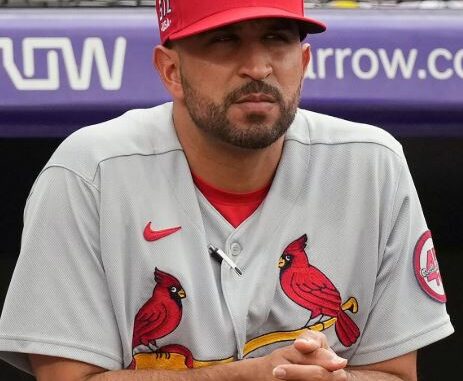
The St. Louis Cardinals ended the 2026 season with more questions than they would have wanted, finishing September at 9–15 and ending the year 77–85. Yet amid the disappointing finish, president of baseball operations Chaim Bloom believes the organization found an important answer concerning Ivan Herrera.
Herrera entered the season as one of the Cardinals’ more important offensive pieces while continuing to develop behind the plate. According to Bloom, the 2026 season demonstrated that Herrera can handle the physical and mental demands of catching at the major-league level. Bloom specifically pointed to the amount of work Herrera received, noting that he caught more than 50 games and made significant progress in preparing himself for the position.
Bloom’s assessment changes the conversation around Herrera
Bloom’s comments are significant because Herrera’s defensive ability, particularly his work as a catcher, has been debated throughout his Cardinals tenure. Earlier in 2026, questions surrounding the team’s catching situation included concerns about Herrera’s defense and throwing, while Pedro Pages, Jimmy Crooks and other organizational options also remained in the picture.
However, the Cardinals appear to have gained confidence that Herrera can at least provide legitimate catching depth. His ability to remain behind the plate gives St. Louis another option when constructing the roster, even if the organization ultimately decides that his best long-term value comes from getting his bat into the lineup elsewhere.
That distinction could become especially important entering the offseason.
Leonardo Bernal has changed the equation
The biggest complication for Herrera is not necessarily whether he can catch. It is the emergence of Leonardo Bernal.
Bernal, a highly regarded defensive catcher who won a minor-league Gold Glove last season, received his first significant opportunity in the majors during September. He immediately made a strong impression, hitting .284 with five home runs and 21 RBIs across his first 24 major-league games.
That performance has positioned Bernal as a serious candidate for the Cardinals’ primary catching job entering 2027.
Bernal’s emergence means St. Louis could have a difficult decision to make. If the organization views him as the long-term starting catcher, Herrera may not receive enough innings behind the plate to justify keeping him primarily at the position.
Instead, the Cardinals could look for ways to preserve Herrera’s offensive value while reducing his defensive responsibilities.
The Cardinals clearly still want Herrera’s bat
That may ultimately be the most important part of Bloom’s comments.
The Cardinals are not discussing Herrera as someone they simply need to find a roster spot for. They view his offensive ability as an important part of their future.
Bloom emphasized that St. Louis wants to find a way to keep Herrera’s bat in the lineup, describing him as a major part of the offense who can help the club in different ways.
That opens several possibilities.
Herrera could serve as a designated hitter, rotate into the lineup at different positions, catch periodically or potentially see limited time in the outfield. Such a role would allow St. Louis to take advantage of his offensive production without requiring him to be the everyday catcher.
The challenge is that every one of those possibilities creates another roster question.
St. Louis has an unusual catching surplus
The Cardinals are not short of catching prospects and young players.
Beyond Herrera and Bernal, the organization has Pedro Pages, Jimmy Crooks and Rainel Rodriguez. That gives Bloom considerable depth at a position where many organizations struggle to find even one reliable option.
Rodriguez’s development has made the situation even more interesting. His emergence means the Cardinals have another young catcher whose progress could eventually demand a bigger role.
That creates a potential logjam.
If Bernal becomes the everyday catcher and Rodriguez continues developing rapidly, Herrera could find himself squeezed out of regular catching opportunities despite proving that he is capable of handling the position.
Herrera’s offensive decline adds another layer
There is also a statistical wrinkle to consider.
Herrera’s offensive production declined in 2026, with his OPS falling by nearly 100 points compared with the previous season. However, his overall WAR increased to 2.9 from 2.3 in each of the previous two seasons.
That suggests his value cannot be judged simply by looking at his offensive numbers.
Earlier in the season, Herrera was also recognized for his ability to reach base, with his discipline at the plate standing out as one of the strengths of his offensive game. His ability to draw walks and get hit by pitches helped keep him productive even when his power numbers were not as impressive.
The Cardinals therefore have an incentive to keep finding opportunities for him.
The DH could become Herrera’s path
One logical solution would be to use Herrera primarily as a designated hitter while allowing him to catch when needed.
That would give St. Louis a way to preserve his offensive contribution while reducing the pressure of making him the primary defensive catcher.
There is also a possibility of using him around the field on occasion. Herrera could potentially receive limited outfield opportunities, although moving him into a regular outfield role would represent a significant adjustment.
The most realistic scenario appears to involve Herrera remaining primarily an offensive player who can also provide catching depth rather than becoming a full-time defensive catcher.
The offseason decision could shape the roster
For Bloom and the Cardinals, the question now is not whether Herrera belongs in the organization’s plans. His importance to the offense appears clear.
The bigger question is where Herrera fits.
If Bernal takes over as the primary catcher, St. Louis will need to determine how frequently Herrera catches, how much time he spends at DH and whether he can provide occasional versatility elsewhere.
The Cardinals carried three catchers for much of 2026, but Bloom’s comments suggest the organization could look for a more flexible arrangement next season. Finding enough at-bats for Herrera could therefore become one of the more important roster-construction decisions of the offseason.
The encouraging part for Herrera is that the Cardinals appear to have answered at least one question: they believe he has demonstrated that he can handle major-league catching duties.
The unresolved question is whether catching will remain his primary job.
With Bernal’s emergence, Rodriguez’s development and Herrera’s offensive importance, St. Louis now has several competing options at the position. The 2027 roster could ultimately depend on how Bloom balances those pieces without allowing Herrera’s bat to disappear from the lineup.
Leave a Reply