
The Philadelphia Phillies entered the 2026 season hoping that veteran right-hander Aaron Nola would rebound from a difficult and injury-affected 2025 campaign. Instead, the former All-Star has continued to struggle, raising concerns about his role in the rotation as the season progresses. After allowing five runs on six hits and four walks in just 4⅓ innings against the Chicago White Sox, Nola’s ERA climbed to 5.86 through 13 starts, barely improving on the 6.01 ERA he posted last season.
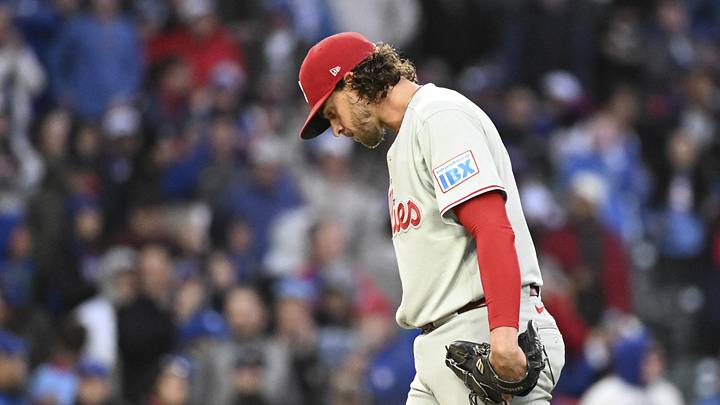
While Nola has managed to stay healthy and take every scheduled turn in the rotation, many of the issues that plagued him in 2025 have carried over into 2026. His four-seam fastball, once a dependable weapon, has become one of the least effective pitches among qualified major-league pitchers. Opposing hitters are batting .407 against the pitch and slugging an alarming .864, making it one of the most heavily punished fastballs in baseball. Even though the pitch is being thrown slightly harder than last season, the results have worsened significantly.
Recognizing the problem, Nola has adjusted his pitch selection. His knuckle curve has emerged as his most effective offering and is now his most frequently used pitch. Hitters have struggled against the breaking ball, batting just .194 against it, while his changeup has also remained a reliable weapon. During his outing against the White Sox, Nola leaned heavily on the curveball and limited his use of the fastball, but the damage still came primarily when he threw the heater.
Another challenge for Nola has been his inability to consistently get ahead of hitters. Falling behind in counts has forced him into longer at-bats, elevated pitch counts, and more opportunities for opposing hitters to capitalize on mistakes. His strikeout rate has dropped to its lowest level since his rookie season, while his WHIP has risen to a career-high mark. Walks have also become a bigger issue, and Nola believes the league’s automated ball-strike challenge system has contributed to some of those struggles by turning borderline strike calls into balls.
Despite the disappointing overall numbers, there have been signs that Nola can still be effective. He delivered strong performances against the San Diego Padres, including an outing in which he struck out eight batters while allowing only two runs. Earlier in the season, he also threw six scoreless innings against the Miami Marlins, demonstrating that the talent and command that made him one of the Phillies’ most dependable starters have not completely disappeared.
Advanced metrics suggest there may still be hope for improvement. While his traditional statistics are concerning, his expected ERA is considerably lower than his actual ERA, indicating that some bad luck has played a role in his struggles. In addition, several of his secondary pitches remain highly effective, particularly his changeup, which opponents have rarely been able to square up.
Phillies manager Don Mattingly continues to express confidence in the veteran, emphasizing that Nola remains capable of competing against any lineup when he effectively mixes his pitches and commands the strike zone. The challenge now is turning those occasional flashes of brilliance into consistent results.
Ultimately, Nola’s path to a midseason turnaround is clear. He must find a way to make his four-seam fastball more effective, improve his command early in counts, reduce walks, and rely more heavily on the deep arsenal that has made him successful throughout his career. The Phillies are in need of another dependable starter behind their top arms, and if Nola can correct those issues, he still has the ability to re-establish himself as a key piece of Philadelphia’s rotation and play an important role in the club’s postseason push.
Leave a Reply