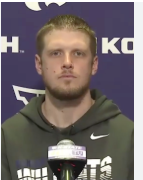
Kansas State football is entering a new chapter under first-year head coach Collin Klein, and while early signs from spring practices have generated excitement around the program, the long-term success of the Wildcats will largely depend on recruiting. As Klein begins shaping the future of Kansas State football, the 2027 recruiting class is already becoming increasingly important. Several key roster areas will need attention if the Wildcats hope to remain competitive in the ever-demanding Big 12 landscape.
Among the biggest priorities for Kansas State moving forward are securing the future at quarterback, rebuilding depth along the offensive line, and strengthening the secondary. These three areas could determine how smoothly the Wildcats transition into the next phase of the Klein era.
Quarterback succession plan remains critical
One of the most pressing long-term questions surrounding Kansas State football is what happens after quarterback Avery Johnson exhausts his eligibility. Johnson enters the 2026 season with only one year remaining, meaning the program must begin preparing for the future immediately.
Over the past several seasons, Johnson has established himself as one of the faces of the program. Whether serving as a backup early in his career or stepping into the starting role, he consistently showcased his athleticism, leadership, and playmaking ability. His development alongside former Wildcats quarterback Will Howard helped elevate expectations for the position, and Johnson eventually became the type of in-state star Kansas State fans had always hoped to build around.
Replacing a player with that kind of impact will not be easy, but the Wildcats may already have a promising candidate lined up in the 2027 recruiting class. Three-star quarterback prospect Cam Kruse, originally from Olathe before relocating to Tennessee, has emerged as one of the most intriguing future additions to the program. Kruse chose Kansas State over offers from schools such as Miami, West Virginia, and Northwestern, signaling the Wildcats’ ability to win recruiting battles against major programs.
If Kruse develops quickly after arriving in Manhattan, he could eventually position himself as the frontrunner to succeed Johnson as Kansas State’s next starting quarterback. Even so, quarterback recruiting remains one of the most important responsibilities for Klein moving forward, especially in a conference where elite quarterback play often separates contenders from the middle of the pack.
Rebuilding the offensive line for the future
Another major challenge facing Kansas State is replacing the leadership and production lost along the offensive line. The departure of standout center Sam Hecht to the 2026 NFL Draft leaves a massive void for the Wildcats, not only because of his talent, but because of the consistency and leadership he provided throughout his career.
Hecht was widely viewed as one of the top offensive linemen in the country and served as a cornerstone of Kansas State’s offense. Players like that are difficult to replace overnight. While sophomore Kyle Rakers is expected to step into a larger role this season, the Wildcats still need to continue building long-term depth across the trenches.
For Klein and his staff, recruiting offensive linemen in the 2027 cycle will be essential. Developing quality depth up front has long been a defining trait of successful Kansas State teams, and maintaining that identity will be critical moving forward. At the moment, three-star Texas prospect Canaan Smith stands as one of the Wildcats’ notable hard commits in the class, though additional reinforcements will almost certainly be needed before the cycle is complete.
The emphasis will not simply be finding talented players, but identifying prospects who can stay in the program, develop physically, and become multi-year contributors similar to Hecht. Sustained success in the Big 12 begins with controlling the line of scrimmage, and Kansas State cannot afford to let its offensive line depth decline.
Maintaining depth and playmaking ability in the secondary
The Wildcats also face important questions in the secondary after losing starting safety VJ Payne, who was selected by the New York Jets in the seventh round of the NFL Draft. Payne’s departure leaves uncertainty at a key defensive position and increases the need for continued recruiting and development on the back end of the defense.
Kansas State still has several talented defensive backs on the roster, creating strong competition for starting jobs heading into the upcoming season. However, the long-term picture remains less certain, which is why recruiting defensive backs in the 2027 class will be another major priority for Klein and his coaching staff.
The secondary has consistently played an important role in many of Kansas State’s recent successes. The Wildcats’ defense was instrumental during their Pop-Tarts Bowl victory and has often been the difference-maker in rivalry games against teams like Kansas and Iowa State. Maintaining that defensive identity requires both talent and depth, especially in today’s pass-heavy college football environment.
Going forward, Kansas State’s staff must continue targeting athletic playmakers who can thrive in coverage while also keeping experienced contributors within the program. Building an elite secondary core could help establish one of the strongest foundations on the roster and ensure the Wildcats remain competitive defensively for years to come.
As Collin Klein continues settling into his role as head coach, the 2027 recruiting class will serve as one of the first true indicators of his long-term vision for Kansas State football. If the Wildcats can successfully address quarterback succession, offensive line depth, and secondary talent, they will put themselves in a strong position to sustain success in the Big 12 throughout the coming years.
Leave a Reply