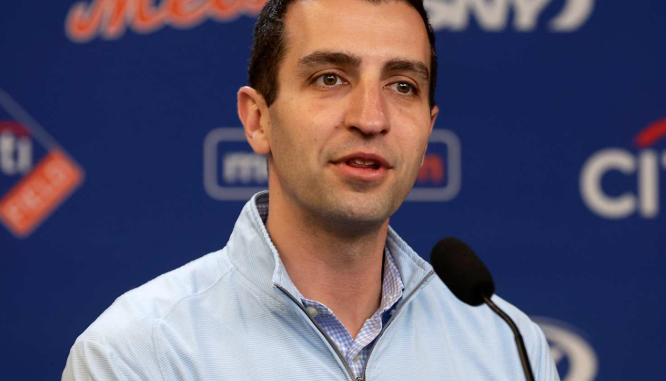
Former New York Mets hitting coach and former bench coach Eric Chavez did not hold back in his criticism of team president of baseball operations David Stearns, delivering a scathing assessment during an appearance on “The EC3 Pod” on June 28. As the Mets continue to endure a disappointing 2026 campaign, Chavez blamed much of the organization’s struggles on Stearns’ leadership, claiming the club’s problems extend far beyond the firing of manager Carlos Mendoza.
Stearns has faced mounting scrutiny after the Mets stumbled to a disappointing 35-48 record, a stretch that ultimately cost Mendoza his job. While many fans and analysts have questioned Stearns’ offseason roster construction, Chavez offered a rare insider’s perspective, drawing on his firsthand experiences working alongside the front office during the executive’s first two seasons in New York.
Chavez originally joined the Mets as hitting coach in 2022 before being promoted to bench coach in 2023. After Stearns took over baseball operations following the 2023 season, Chavez was moved back into the hitting coach role for the 2024 and 2025 campaigns. Reflecting on that period, Chavez outlined what he described as a series of “red flags” that steadily eroded his confidence in Stearns’ leadership.
According to Chavez, the first warning sign came when Stearns asked him to accept a salary reduction of roughly $30,000 to $40,000 after shifting him back to the hitting coach position. He viewed the request as a poor way to begin their working relationship.
The second issue centered on player development philosophy. Chavez revealed that he strongly opposed Stearns’ directive encouraging minor league hitters to prioritize pull-side power, arguing both in emails and face-to-face discussions that the approach was misguided. Despite his objections, Stearns ultimately backed an analytical hitting coach from Triple-A, a decision Chavez felt ignored practical baseball experience in favor of analytics.
Chavez’s most pointed criticism involved superstar outfielder Juan Soto. He recalled that Soto struggled emotionally during the opening months of the season following his blockbuster move from the Yankees, suggesting the adjustment may have left the star with some buyer’s remorse. Chavez said Soto frequently left the outfield between innings to sit alone on a couch inside the batting cage rather than remain in the dugout alongside his teammates.
While Chavez emphasized that he did not fault Soto personally, he argued the organization’s leadership failed to address the situation. He claimed an assistant general manager regularly sat with Soto and comforted him instead of encouraging him to rejoin the team in the dugout, creating what Chavez believed was a damaging example for younger players.
Concerned about the message being sent throughout the clubhouse, Chavez brought the issue directly to Stearns. He warned that allowing one player to operate under a different standard could negatively influence the team’s younger talent. According to Chavez, Stearns responded that the younger players simply needed to understand they were “not Juan Soto,” an answer Chavez viewed as evidence of weak leadership and inconsistent accountability.
Chavez described that exchange as his third major red flag, arguing that effective leadership requires holding every player accountable regardless of star status. In his view, a lack of firmness at the top inevitably filters throughout the clubhouse and contributes to a losing culture.
The former Mets coach also ridiculed Stearns’ preference for using the term “run prevention” instead of the more traditional baseball phrase “pitching and defense.” Chavez dismissed the wording as unnecessary jargon, criticizing what he saw as an overly analytical approach and saying the terminology served only to complicate a straightforward concept.
Throughout the podcast appearance, Chavez directed his criticism squarely at Stearns, portraying the executive as a leader whose management style, personnel decisions, and communication have played a significant role in the Mets’ disappointing season. His comments add another layer of pressure on the front office as the organization attempts to recover from one of the most turbulent campaigns in recent franchise history.
Leave a Reply