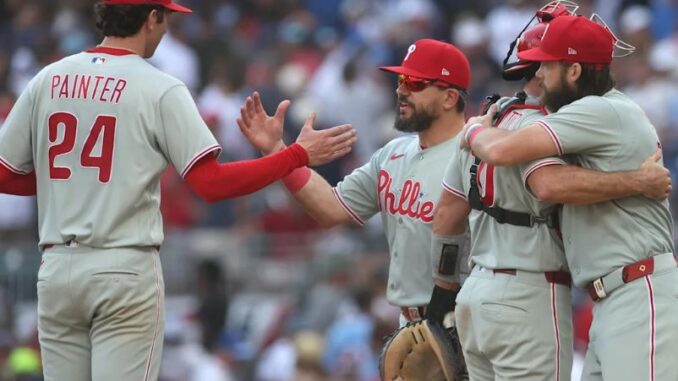
The Philadelphia Phillies are not done yet. After a wild and pressure-filled Game 2 against the Atlanta Braves, Philadelphia managed to keep its postseason alive and force a decisive Game 3. At the center of the dramatic victory was 23-year-old rookie Andrew Painter, who stepped into a high-pressure relief role and delivered three scoreless innings when the Phillies desperately needed someone to shut the door.
Painter’s performance may prove to be one of the most important moments of Philadelphia’s postseason so far. Entering the game with the Phillies’ bullpen under considerable strain, the young right-hander showed remarkable composure against an Atlanta lineup packed with dangerous hitters. Rather than simply surviving the situation, Painter attacked the Braves’ hitters and kept them off the scoreboard for three consecutive innings, giving Philadelphia’s offense the opportunity to complete its comeback. His outing demonstrated the progress he has made since returning to the major-league club and could provide him with a significant confidence boost heading into the biggest games of his young career.

The rookie’s performance was particularly impressive because of the difficult path he had taken earlier in the season. Painter had experienced the normal challenges that come with being a young pitcher adjusting to Major League Baseball, but his Game 2 appearance provided a strong reminder of why the Phillies have remained so invested in his development. With the season potentially on the line, the organization trusted him in a situation where one mistake could have ended Philadelphia’s postseason run. Painter responded by producing the kind of calm, high-leverage pitching that teams hope to get from an established veteran.
His biggest moment came in the 10th inning. Atlanta managed to put runners on base, creating the possibility of a dramatic comeback of its own. Painter struck out Austin Riley before allowing another baserunner, leaving the Braves with an opportunity to extend the game. He then faced Dominic Smith with the decisive strikeout within reach. The initial pitch was called a ball by home-plate umpire Adam Beck, but catcher J.T. Realmuto immediately recognized the importance of the pitch and called for an Automated Ball-Strike System challenge.
The challenge changed everything. The ABS review determined that Painter’s 0-2 fastball had clipped the strike zone, turning the call into a strike and completing the strikeout. With that ruling, the game officially ended and the Phillies secured the victory. The sequence became historically significant because Philadelphia became the first team in the ABS era to win a postseason game on a game-ending overturned strike call. Realmuto’s awareness and Painter’s execution combined to produce an extraordinary finish.
Realmuto’s role in the moment deserves particular attention. Catchers are often responsible for helping pitchers navigate the most important situations of a game, and his immediate decision to challenge the call demonstrated how closely he was following the at-bat. Instead of allowing the ruling to stand, Realmuto trusted his assessment and gave the Phillies another opportunity to get the final strike. The technology then confirmed his judgment, allowing Painter to complete his three-inning masterpiece and send Philadelphia into Game 3.
The victory was even more significant because of how the game had unfolded. The Phillies had been forced to fight back after falling behind, with Atlanta appearing capable of taking a commanding position in the series. Philadelphia’s offense eventually responded with a dramatic late rally, setting up the extra-inning showdown. The comeback required contributions from several of the club’s biggest players, but Painter became the unexpected figure who stabilized the game when Philadelphia’s pitching staff needed it most.
For the Phillies, that development could be extremely important heading into the decisive contest. Postseason series often turn on unexpected performances, and Painter’s emergence gives manager Don Mattingly another potential weapon to consider. Whether Painter is used again in Game 3 will depend on his workload and the club’s pitching plans, but his Game 2 performance has already changed the conversation surrounding the rookie.
It also offers a different perspective on his season. Instead of focusing exclusively on the struggles Painter experienced earlier in the year, the Phillies can now point to one of the most pressure-filled situations imaginable and highlight how he responded. Young pitchers often need a defining performance to build confidence, and three scoreless postseason innings in a must-win environment could provide exactly that.
Philadelphia’s Game 2 victory also continued a postseason that has already produced several major storylines around baseball. The Chicago White Sox completed their first postseason series sweep since 2005 by eliminating the Houston Astros, creating one of the more notable playoff developments of the year. Meanwhile, the Boston Red Sox removed Roman Anthony from their postseason roster after his existing hand and wrist problems worsened, adding another injury storyline to October baseball.
The New York Yankees are also dealing with uncertainty surrounding Aaron Judge as they attempt to navigate the postseason without one of their most important offensive players. Those developments underline just how quickly circumstances can change once October arrives. One injury, one pitching performance or one late-game decision can completely alter a team’s postseason trajectory.
For Philadelphia, however, the immediate focus remains on Atlanta. The Phillies now have another opportunity to extend their season, but the Braves will enter Game 3 determined to recover from the crushing loss. The winner of the decisive matchup will advance, while the loser will see its season come to an end.
That makes the events of Game 2 even more significant. Philadelphia did not simply win another baseball game; it survived a situation that could have ended its postseason. Painter supplied three scoreless innings, Realmuto made the crucial challenge and the Phillies’ offense eventually provided enough support to keep the season alive.
The 23-year-old rookie therefore leaves Game 2 with something far more valuable than a postseason appearance. He leaves with evidence that he can handle pressure at the highest level. Whatever happens in the decisive game, Painter answered the call when the Phillies needed him most—and Philadelphia now gets one more chance to keep its October dream alive.
Leave a Reply