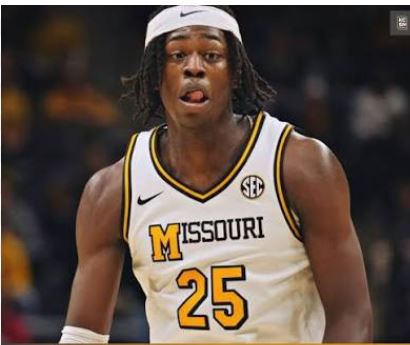
For Kentucky Wildcats fans, the arrival of Mark Mitchell was supposed to be the final piece of an exciting offseason.
Instead, what looked like a massive roster upgrade has quickly turned into one of the most complicated eligibility stories in college basketball.
Kentucky believed it had landed a major addition when former Missouri standout Mark Mitchell committed to the Wildcats for the 2026-27 season after receiving a temporary restraining order that opened the door for him to pursue a fifth year of college basketball. Mitchell had just completed his fourth college season, went undrafted in the 2026 NBA Draft and played in the NBA Summer League before attempting to return to the college game.

The situation appeared to be settled.
Then the SEC stepped in.
The conference introduced a new policy targeting athletes who had previously pursued professional opportunities and attempted to return to college athletics. Almost immediately, questions emerged about whether the new policy could threaten Mitchell’s future at Kentucky.
Now, the situation has become considerably more complicated.
Recent legal developments involving the SEC and athletes seeking additional eligibility have intensified the dispute, while Mitchell’s attorneys have continued challenging restrictions that could prevent him from playing.
For Big Blue Nation, this is no longer just another offseason roster story.
It could have a direct impact on Kentucky’s championship hopes.
Mark Mitchell Was Supposed to Change Everything
Kentucky head coach Mark Pope spent much of the offseason trying to construct a roster capable of competing at the highest level of the SEC.
The Wildcats already had an intriguing collection of young talent and experienced players, but adding Mitchell gave the roster something it desperately needed: another proven scorer with SEC experience.
Mitchell spent the previous season at Missouri, where he averaged 18.3 points, 5.2 rebounds and 3.6 assists per game.
Those numbers explain why Kentucky wanted him so badly.
At 6-foot-9, Mitchell provides size without sacrificing perimeter ability. He can score from multiple areas of the floor, attack defenders, rebound and create opportunities for teammates.
More importantly, he has already experienced the physicality and pressure of SEC basketball.
That makes him a potentially enormous addition for a Kentucky team with legitimate postseason ambitions.
Mitchell’s commitment was therefore viewed as much more than another transfer announcement.
It changed the ceiling of the entire roster.
Kentucky’s projected lineup now has the potential to feature Zoom Diallo in the backcourt, Alex Wilkins on the perimeter, Milan Momcilovic at small forward, Mitchell at power forward and highly touted center Malachi Moreno in the middle.
That is the type of lineup that can make opposing SEC coaches nervous.
But there is one enormous problem.
Kentucky still needs certainty that Mitchell will actually be allowed to play.
Why Mitchell’s Eligibility Became So Complicated
Mitchell’s situation stems from the broader fight over eligibility for players from the high school class of 2022.
Changes to NCAA eligibility rules created an opportunity for some athletes to seek a fifth college season, while the NCAA and conferences have pushed back against what they see as former professional athletes returning to college competition.
Mitchell challenged the NCAA in court and received temporary relief allowing him to pursue another season.
That opened the door for him to enter the transfer portal and eventually choose Kentucky.
The Wildcats celebrated the commitment.
But the story did not end there.
The SEC subsequently adopted a policy restricting athletes who had previously declared for professional drafts without properly withdrawing or who had signed certain professional contracts from returning to SEC competition.
That immediately created questions surrounding Mitchell.
He had participated in the NBA Summer League.
He had been through the NBA Draft process.
And he was now attempting to return to college basketball.
For Kentucky fans, the obvious question was simple:
Could the SEC stop him from playing?
The Good News for Kentucky Fans
There was an important development that initially eased some of those concerns.
An SEC spokesperson clarified that playing in the NBA Summer League does not automatically make a player ineligible under the conference’s new policy.
According to the clarification reported by the Lexington Herald-Leader, an athlete who participated in the 2026 NBA Summer League could still be eligible for SEC competition if the player did not enter the NBA Draft as an early entrant and never signed an NBA contract, including an Exhibit 10 or two-way contract.
That distinction is extremely important in Mitchell’s case.
Reports indicated that Mitchell did not sign an NBA contract during his Summer League experience.
So, at least under that interpretation of the SEC’s new policy, his Summer League participation alone would not prevent him from playing for Kentucky.
That was a major relief for Big Blue Nation.
But another issue remained.
The Transfer Rule Could Be Another Problem
The SEC’s professional-athlete policy is not the only issue surrounding Mitchell.
His transfer from Missouri to Kentucky came after the normal spring transfer-portal period.
That has raised questions about the conference’s intra-conference transfer restrictions.
CBS Sports reported that Mitchell’s transfer situation could run afoul of the SEC’s rules because he did not enter the transfer portal during the conference’s April window.
That means Kentucky is potentially fighting on more than one front.
The Wildcats are not simply waiting for an NCAA eligibility decision.
They are dealing with questions involving conference rules, court orders and the broader legal battle over whether athletes who briefly pursued professional careers should be allowed to return to college competition.
It is a complicated situation that has little to do with what happens on the basketball court.
And that is exactly why Kentucky fans are watching so closely.
Kentucky May Be Willing to Fight
The latest developments suggest Kentucky is not simply preparing to accept whatever decision comes down from the SEC.
Mitchell’s attorneys have amended their lawsuit, directly challenging the NCAA and SEC as the fight over his eligibility continues.
That is significant.
Kentucky did not add Mitchell to its roster because it wanted a short-term publicity boost.
The Wildcats believe he can make a substantial difference on the court.
If Mitchell is available, Kentucky could have one of the more talented rosters in the SEC.
If he is unavailable, Pope suddenly has to redesign his rotation.
That difference could ultimately be measured in wins and losses.
What Mitchell Gives Mark Pope
Assuming Mitchell is cleared, his value to Kentucky goes well beyond his scoring average.
Pope needs players who can handle the demands of SEC basketball, particularly against teams with enormous frontcourts and experienced veterans.
Mitchell brings that experience.
He also gives Kentucky another player who can create his own offense.
That is particularly valuable late in games.
When an opponent shuts down Kentucky’s first option, Mitchell can potentially become the player who attacks a mismatch, gets to the basket or creates a quality shot.
His ability to operate around the perimeter also gives Kentucky more lineup flexibility.
Pope could use him alongside Moreno for a physically imposing frontcourt.
He could play him next to smaller lineups when Kentucky wants more speed.
He could also use Mitchell as a matchup problem against teams that do not have enough size on the wing.
In other words, Mitchell gives Kentucky options.
And options are extremely valuable during March.
The Bigger Impact on Kentucky’s Championship Hopes
Kentucky’s 2026-27 schedule is already loaded with high-profile games.
The Wildcats are scheduled to face Kansas in the Champions Classic, Indiana, Wichita State, Virginia, Louisville and North Carolina before beginning SEC play.
That schedule will provide plenty of opportunities for Kentucky to prove whether it belongs among the nation’s elite.
Having Mitchell available could make those games significantly more manageable.
Imagine Kentucky entering a major matchup with multiple experienced scoring options, elite size and a frontcourt featuring Mitchell and Moreno.
That is a much different proposition than Kentucky without Mitchell.
And the SEC itself is becoming increasingly difficult.
Kentucky cannot afford to enter the conference race with uncertainty surrounding one of its most important players.
The Timing Could Not Be More Important
The Wildcats are approaching the point where basketball preparations will intensify.
Official practice is getting closer.
Big Blue Madness is on the horizon.
The roster is essentially taking shape.
That makes the uncertainty surrounding Mitchell even more frustrating for Kentucky fans.
The Wildcats want to build their chemistry around the players who will actually be available.
Pope needs to know his rotation.
Players need to understand their roles.
Coaches need to establish offensive and defensive systems.
But if Mitchell’s eligibility remains unresolved, Kentucky has to prepare for multiple scenarios.
That is not an ideal situation for any team with championship aspirations.
And Then Came Another Court Ruling
The broader legal battle has now taken another dramatic turn.
A Louisiana judge issued a temporary restraining order expanding eligibility protections for former professional hopefuls and blocking the SEC from penalizing schools for recruiting certain athletes affected by the conference’s restrictions.
Separately, a Texas judge temporarily blocked the SEC’s new eligibility rule in another case involving dozens of athletes.
Those rulings do not automatically settle Mitchell’s individual situation.
But they demonstrate just how quickly the legal landscape is changing.
One court ruling can change the situation.
Another can reverse the momentum.
And that leaves Kentucky, Mitchell and the rest of college basketball waiting for greater clarity.
This Is Bigger Than One Kentucky Player
The Mitchell situation represents a much larger issue facing college athletics.
For years, the NCAA attempted to create clear boundaries between college and professional sports.
The modern transfer portal, NIL era and evolving eligibility rules have made those boundaries increasingly difficult to define.
Now, athletes can pursue professional opportunities, return to college and potentially compete for another season depending on the circumstances surrounding their eligibility.
The conferences are trying to protect opportunities for traditional college athletes.
The athletes and their attorneys argue that the rules should not unfairly prevent them from competing.
And the courts are increasingly being asked to decide where the line should be drawn.
Kentucky just happens to be one of the programs sitting directly in the middle of the fight.
What Happens If Mitchell Cannot Play?
This is the nightmare scenario Kentucky fans do not want to discuss.
If Mitchell ultimately cannot play, Pope would still have a talented roster.
Kentucky would not suddenly become a bad team.
But the Wildcats would lose one of their most experienced and versatile players.
That would place more responsibility on younger players and potentially force Pope to make significant changes to his rotation.
Milan Momcilovic would become even more important.
Malachi Moreno would have to shoulder more responsibility inside.
Kentucky’s guards would likely face additional pressure to create offense.
And the Wildcats would lose the flexibility that Mitchell provides.
In a brutally competitive SEC, those differences could matter.
What Happens If Mitchell Is Cleared?
This is the scenario Big Blue Nation wants.
If Mitchell is cleared without further complications, Kentucky immediately becomes a much more intriguing national championship contender.
Pope would have a roster combining youth, size, shooting, experience and SEC production.
Mitchell would also have something to prove.
After going undrafted and spending time in the NBA Summer League, he would have the opportunity to make one final college basketball statement.
That motivation could make him even more dangerous.
And Kentucky fans would certainly welcome it.
The Wildcats Are Still Waiting
The most frustrating part of the situation is that Kentucky fans cannot settle the debate themselves.
Neither wins nor losses will decide Mitchell’s eligibility.
It will come down to legal decisions, conference policies and the evolving NCAA landscape.
That is why every new development is attracting so much attention.
A player who was supposed to be the final piece of Kentucky’s roster has instead become the center of one of the biggest eligibility stories in college basketball.
And the stakes could not be higher.
For Mark Pope, the goal is obvious.
He wants to take Kentucky back to the national championship conversation.
For Mark Mitchell, the goal is equally clear.
He wants another chance to play college basketball and prove he still belongs at the highest level.
For Big Blue Nation, there is only one question that really matters:
Will Mark Mitchell actually be on the floor when Kentucky’s season begins?
Right now, the answer is still wrapped inside a legal and conference battle that appears to be getting bigger rather than smaller.
And that is exactly why Kentucky fans will be watching every development.
Because if Mitchell plays, Kentucky’s ceiling could rise dramatically.
If he does not, Pope may have to find another way to replace one of the most important additions of his offseason.
For a Kentucky program with championship expectations, that is a storyline impossible to ignore.
Leave a Reply