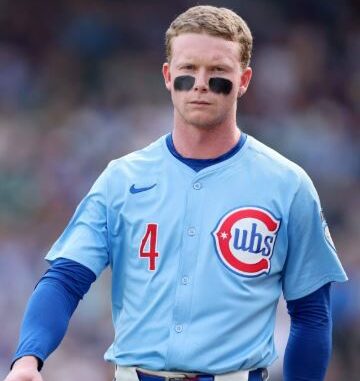
Pete Crow-Armstrong has transformed himself from a promising young outfielder into one of the most compelling candidates for the 2026 National League MVP award. The Chicago Cubs center fielder has been on an extraordinary run, and his combination of power, speed and elite defense has pushed him into a fascinating battle with Los Angeles Dodgers superstar Shohei Ohtani.
However, while Crow-Armstrong has built a legitimate MVP case, an MLB insider has offered a significant warning: the race may not be as straightforward as it currently appears.
Crow-Armstrong’s remarkable rise
Crow-Armstrong’s emergence has been one of the biggest developments of the Cubs’ 2026 season. After entering the year primarily known for his outstanding defensive ability in center field, he has taken a major step forward offensively.
His production has become so impressive that he is now being discussed alongside Ohtani, one of baseball’s most accomplished players and the reigning three-time National League MVP. MLB Network recently described Crow-Armstrong as approaching genuine MVP-favorite status, reflecting just how dramatically his stock has risen during the season.
One of the strongest arguments in Crow-Armstrong’s favor is his all-around impact. He contributes not only with his bat but also with his speed and defense, giving him multiple avenues through which he can influence games.
He has also reached the 30-home-run and 30-stolen-base milestones, putting him on course for a rare 40-40 season. Only six players in MLB history have previously reached 40 home runs and 40 stolen bases in the same season, making the possibility another major storyline surrounding his MVP campaign.
His offensive improvement has changed the conversation
Perhaps the most impressive part of Crow-Armstrong’s season is how much his offensive game has developed.
Earlier in his career, his value was largely connected to defense, athleticism and baserunning. In 2026, however, he has developed into a much more dangerous hitter. His improved plate discipline has helped him reach base more consistently while his power has turned him into a legitimate middle-of-the-order threat.
Recent numbers have placed him among the National League’s statistical leaders, while his overall value metrics have also made a strong argument for his candidacy. At one point in the latest MVP discussion, Crow-Armstrong held a sizable advantage over Ohtani in WAR, although the exact margin varies depending on which version of WAR is used.
That distinction is important because different defensive metrics evaluate his extraordinary work in center field differently. Crow-Armstrong’s elite defense is one of the biggest reasons his overall statistical value has climbed so dramatically.
The Ohtani problem
Despite Crow-Armstrong’s spectacular campaign, the biggest obstacle remains Ohtani.
The Dodgers superstar continues to produce at an elite offensive level, and his previous success as a two-way player gives him an extraordinary résumé. Before his pitching workload was interrupted by injury, Ohtani had already produced significant value on the mound while continuing to perform at an MVP level offensively.
That is where the warning surrounding Crow-Armstrong becomes important.
An MVP race is not determined simply by who has the highest WAR number or who has accumulated the most home runs and stolen bases. Voters also consider overall impact, team success, offensive production, defense, durability and the uniqueness of a player’s contribution.
Ohtani’s ability to contribute as both a hitter and pitcher gives him a unique argument that few players in baseball history can match.
Why Crow-Armstrong’s defense matters
One of the strongest points in Crow-Armstrong’s favor is his work in center field.
He is widely regarded as one of the best defensive players in baseball, and his range, instincts and ability to turn difficult plays into outs have significantly increased his overall value.
Some advanced defensive systems rate him considerably higher than others, which has created an interesting statistical debate around the MVP race. His supporters argue that his defensive impact separates him from Ohtani because Ohtani’s current role does not provide the same defensive value in the field.
That defensive advantage has helped Crow-Armstrong build an impressive WAR profile and has made him more than simply another power hitter competing for the award.
The 40-40 chase adds another layer
Crow-Armstrong’s pursuit of 40 home runs and 40 stolen bases could become one of the defining elements of the MVP debate.
A 40-40 season is historically rare, but reaching the milestone does not automatically guarantee an MVP award. Several players who achieved 40-40 seasons in the past did not win the MVP, demonstrating that voters ultimately consider the broader body of work.
That history provides another reason for caution. Crow-Armstrong could reach 40-40 and still face a serious challenge from Ohtani if the Dodgers star continues producing at an elite level.
The Cubs star has momentum
If there is one thing clearly working in Crow-Armstrong’s favor, it is momentum.
His performances have increasingly captured national attention, and his recent surge has caused him to move from an outside contender to one of the leading names in the MVP conversation. MLB analysts, fans and even fellow players have increasingly recognized his case. A recent ESPN player poll reportedly showed strong support for Crow-Armstrong over Ohtani, demonstrating that his reputation has expanded beyond Chicago.
His clutch performances have also strengthened the narrative. Crow-Armstrong has delivered several major moments for the Cubs during their push, including dramatic home runs and late-game contributions.
That type of production can have a significant impact on MVP voting because voters often remember players who repeatedly influence important games.
The Cubs’ success strengthens his case
Crow-Armstrong’s individual numbers are only part of the story. His performances have come while helping Chicago remain competitive in the National League.
The Cubs have relied heavily on him throughout their postseason push, and his ability to contribute in virtually every aspect of the game has made him one of the central figures in their season.
That creates a compelling MVP narrative: a young player who has developed into an elite two-way position player while helping drive his team toward October.
Why the warning still matters
The warning from the MLB insider should not be interpreted as a dismissal of Crow-Armstrong’s MVP credentials. Instead, it highlights how difficult it will be to definitively separate him from Ohtani.
Crow-Armstrong has the defensive advantage, outstanding baserunning numbers and a realistic chance to finish with a 40-40 season. Ohtani, meanwhile, possesses superior name recognition, a remarkable offensive résumé and the added value of his pitching contributions.
The race could ultimately come down to how voters evaluate those different forms of value.
Crow-Armstrong’s supporters can point to his defense, speed, power and overall consistency. Ohtani’s supporters can counter with his historic two-way ability and offensive production.
A race that could go down to the wire
What once appeared to be another likely Ohtani MVP campaign has developed into one of the most intriguing individual award battles of the 2026 season.
Crow-Armstrong has already accomplished something remarkable simply by putting himself in the conversation. He has gone from being viewed primarily as a defensive standout to becoming a complete offensive weapon and one of the most valuable players in the National League.
For the Cubs, the hope is that his incredible form continues through the final weeks of the regular season. If he maintains his current production, reaches the 40-40 mark and continues playing elite defense, the MVP argument could become nearly impossible to ignore.
But the warning remains clear: Crow-Armstrong may be leading the conversation right now, but Ohtani is far from out of the race. With both stars continuing to produce and the season entering its decisive stretch, the NL MVP battle could remain unsettled until the very end.
Leave a Reply